
We read your photo as:
Calculate log (15) - 2 log (5/4) + log (100/243)
ScanSolve AI Answer
Step-by-step solution
7 stepsOkay, Empress🥰🥰🥰, let's break down these two problems.
: Logarithm Calculation
Calculate
Apply the power rule of logarithms, .
The expression becomes:
Apply the quotient and product rules of logarithms, and .
Combine the terms into a single logarithm:
Simplify the expression inside the logarithm.
Cancel common factors:
Cancel 5 and 25 (from ):
Cancel 5 and 100:
Cancel 3 and 243:
The final answer is .
: Scientific Notation Calculation
CalculateConvert all numbers to scientific notation.
Substitute these into the expression:
Group the numerical parts and the powers of 10 in the numerator and denominator.
Numerator:
Denominator:
The expression becomes:
Divide the numerical parts and the powers of 10.
Divide the numerical parts:
Both 63 and 105 are divisible by 21: and .
Divide the powers of 10:
Combine these results:
Convert the result to standard scientific notation.
The final answer is .
Still stuck on this one?
Ask a follow-up, and the answer starts from this question.
More Mathematics Questions
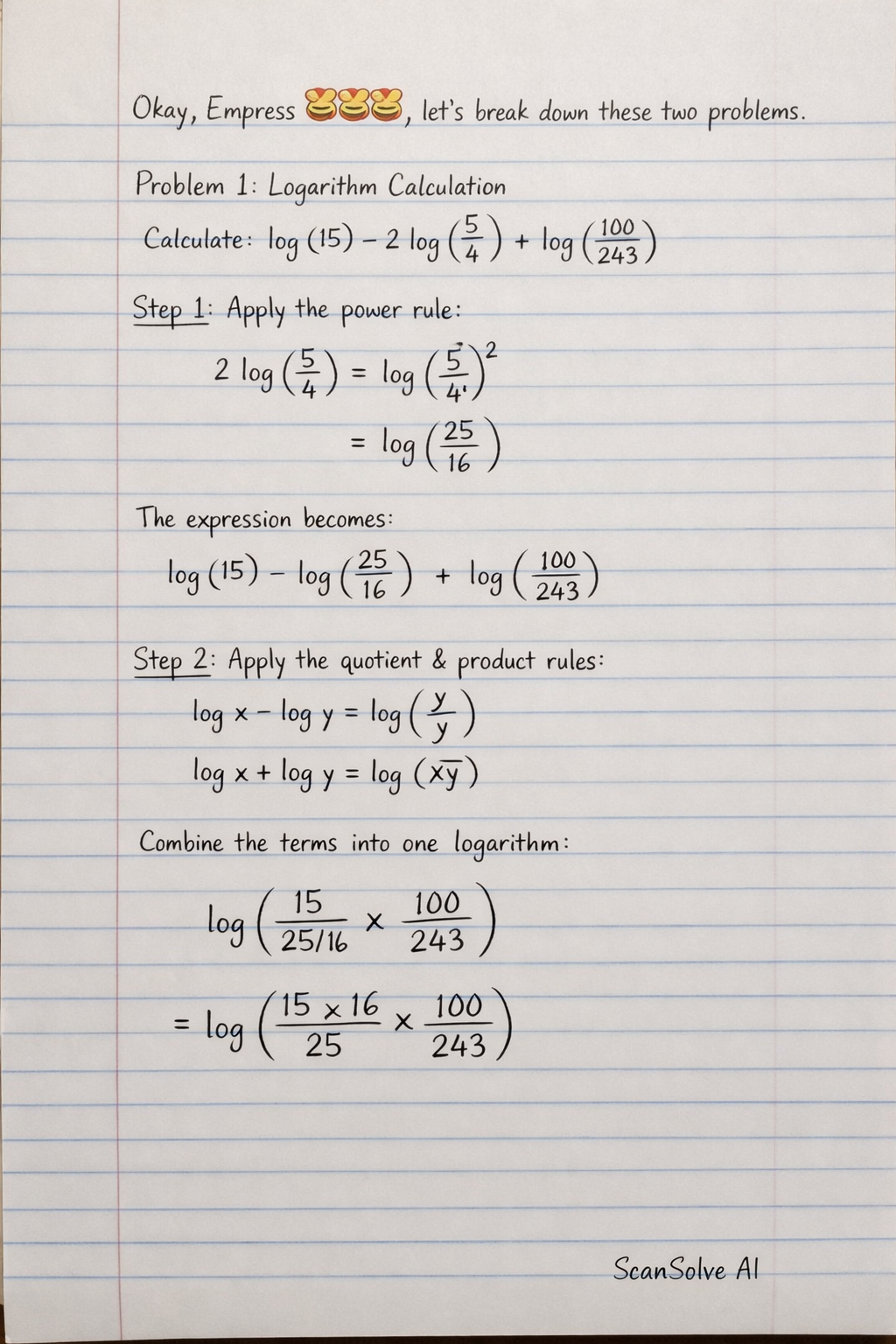
Handwritten Step-by-Step Solution
Get this as a handwritten image on WhatsApp — like a tutor wrote it for you.
Try on WhatsApp