
We read your photo as:
log(x-1) / log(x−1) = 2 log(x-2)
Mathematics
ScanSolve AI Answer
Answer
Step-by-step solution
6 stepsIdentify the equation and determine the domain.
The equation shown in the image is .
For the logarithms to be defined, their arguments must be positive:- For , we need .
- For , we need . Additionally, the denominator cannot be zero. This means , so . Combining these conditions, the valid domain for is .
Simplify the left side of the equation.
Since , is defined and non-zero. Any non-zero quantity divided by itself is 1.
So the equation simplifies to:
Isolate the logarithm term.
Divide both sides by 2:
Convert the logarithmic equation to exponential form.
Assuming the base of the logarithm is 10 (common logarithm, as no base is specified):
Solve for .
Add 2 to both sides:
Verify the solution against the domain.
The approximate value of is 3.162.
So, .
This value satisfies the domain condition . Therefore, the solution is valid.
Was this helpful?
Try one yourself
A new problem that tests the same skill.
Still stuck on this one?
Ask a follow-up, and the answer starts from this question.
Got a different question?Ask your own question
More Mathematics Questions
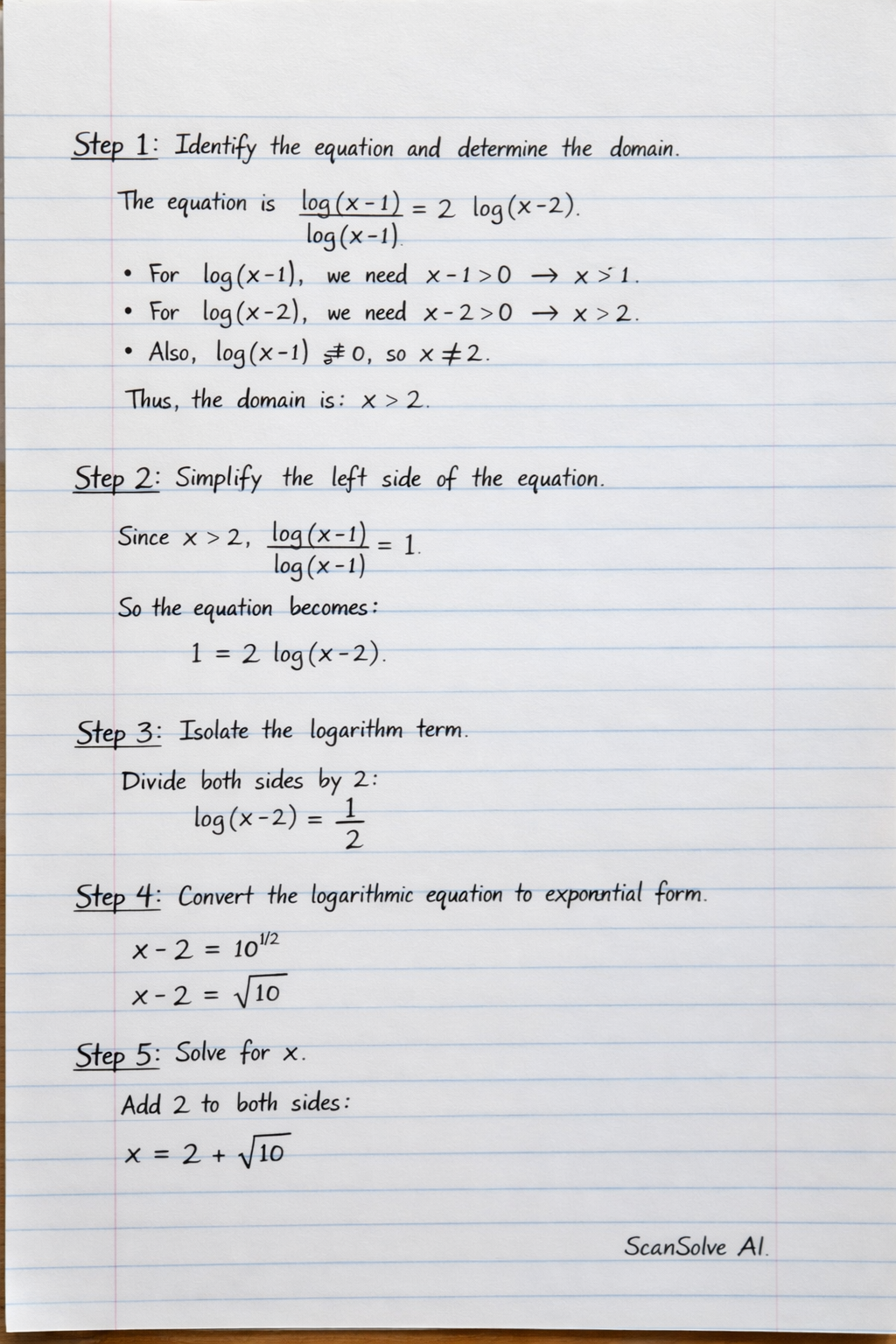
Handwritten Step-by-Step Solution
Get this as a handwritten image on WhatsApp — like a tutor wrote it for you.
Try on WhatsApp