
We read your photo as:
log(x-1) + log(x+1) = 2log(x-2)
ScanSolve AI Answer
Answer
Step-by-step solution
5 stepsApply the logarithm product rule, , to the left side of the equation.
Apply the logarithm power rule, , to the right side of the equation.
Since the logarithms on both sides are equal and have the same base, their arguments must be equal.
Expand the right side and solve the resulting algebraic equation for .
Subtract from both sides:
Add to both sides and add 1 to both sides:
Check the validity of the solution.
For a logarithm to be defined, its argument must be positive ().
For , we need .
For , we need .
For , we need .The most restrictive condition is .
Our calculated value is .
Since 1.25 is not greater than 2, this solution is extraneous and not valid for the original equation.Therefore, there is no real solution for .
Try one yourself
A new problem that tests the same skill.
Still stuck on this one?
Ask a follow-up, and the answer starts from this question.
More Mathematics Questions
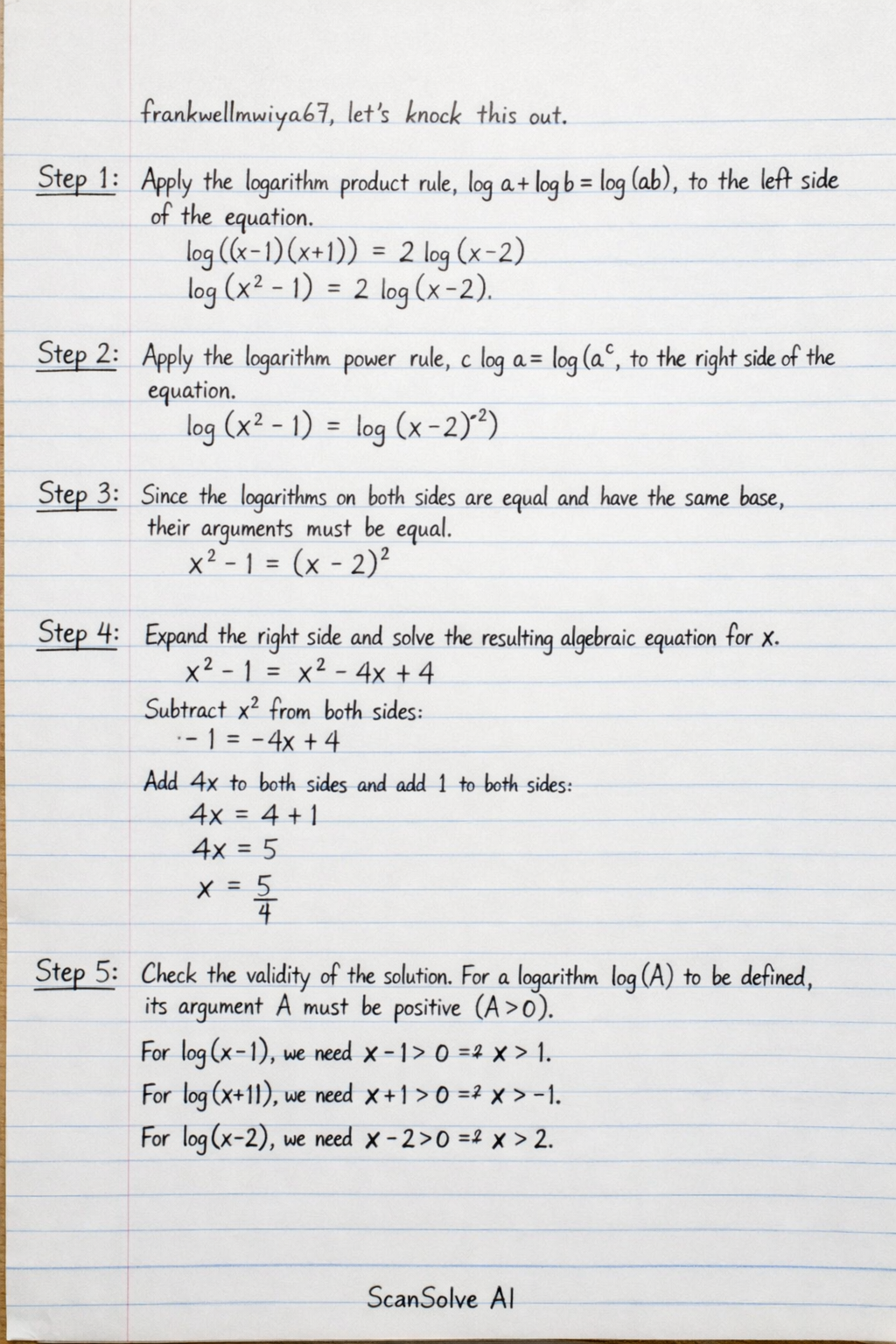
Handwritten Step-by-Step Solution
Get this as a handwritten image on WhatsApp — like a tutor wrote it for you.
Try on WhatsApp