
We read your photo as:
log(x+2) + log(2x−1) = log 15
ScanSolve AI Answer
Answer
Step-by-step solution
5 stepsUse the logarithm property to combine the terms on the left side of the equation.
So the equation becomes:
Since implies , equate the arguments of the logarithms.
Expand the left side and rearrange the equation into a standard quadratic form .
Subtract 15 from both sides:
Solve the quadratic equation using the quadratic formula .
Here, , , .
This gives two potential solutions:
Check for extraneous solutions.
The arguments of the original logarithms must be positive, i.e., and .
This means and . So, we must have .
Let's approximate . Since , is slightly greater than 12, approximately 12.04.For :
This value is greater than , so it is a valid solution.
For :
This value is not greater than (it's less than -2 and less than 1/2), so it is an extraneous solution and must be rejected.
The only valid solution is:
Try one yourself
A new problem that tests the same skill.
Still stuck on this one?
Ask a follow-up, and the answer starts from this question.
More Mathematics Questions
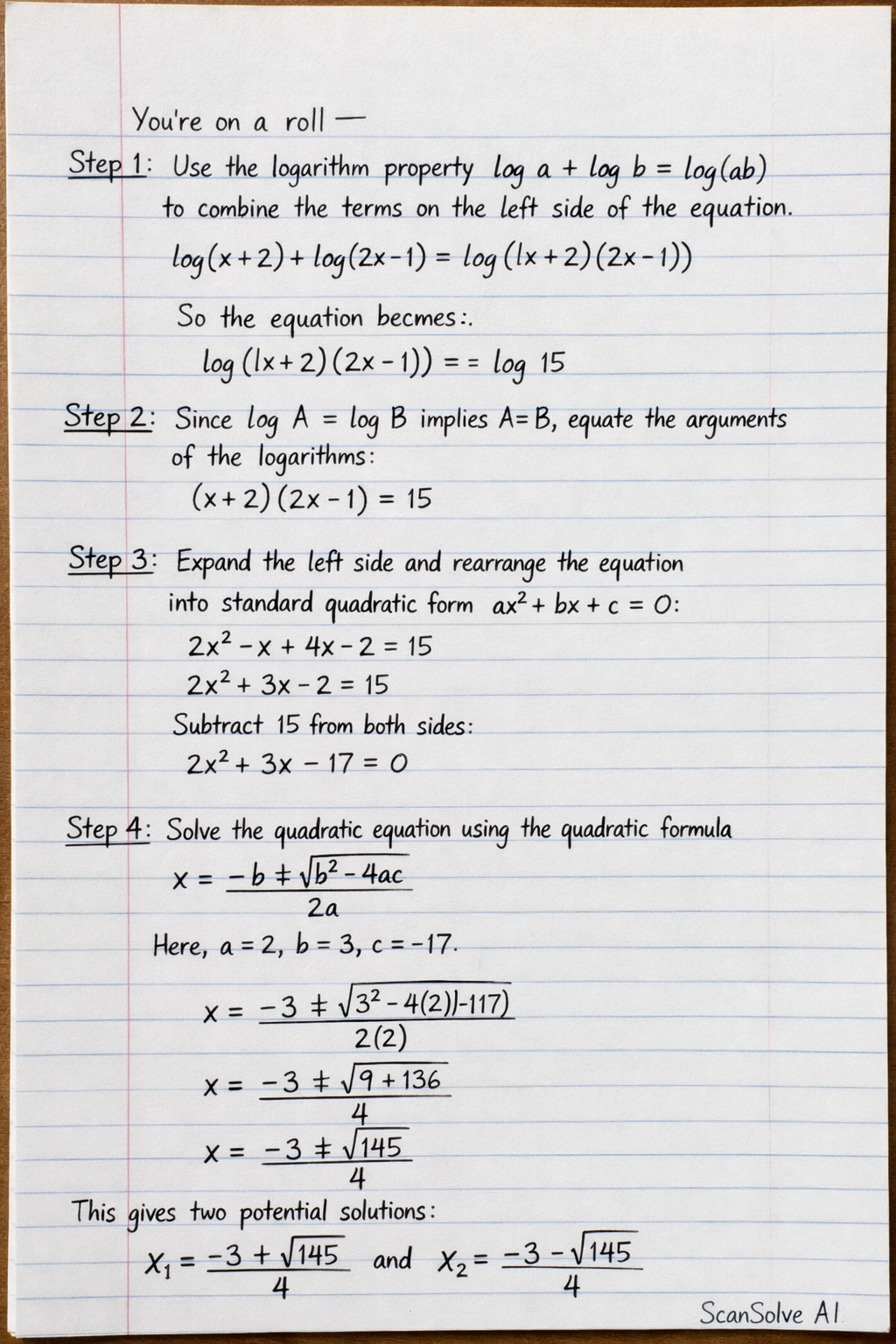
Handwritten Step-by-Step Solution
Get this as a handwritten image on WhatsApp — like a tutor wrote it for you.
Try on WhatsApp