
What is magnitude of vector
Mathematics
ScanSolve AI Answer
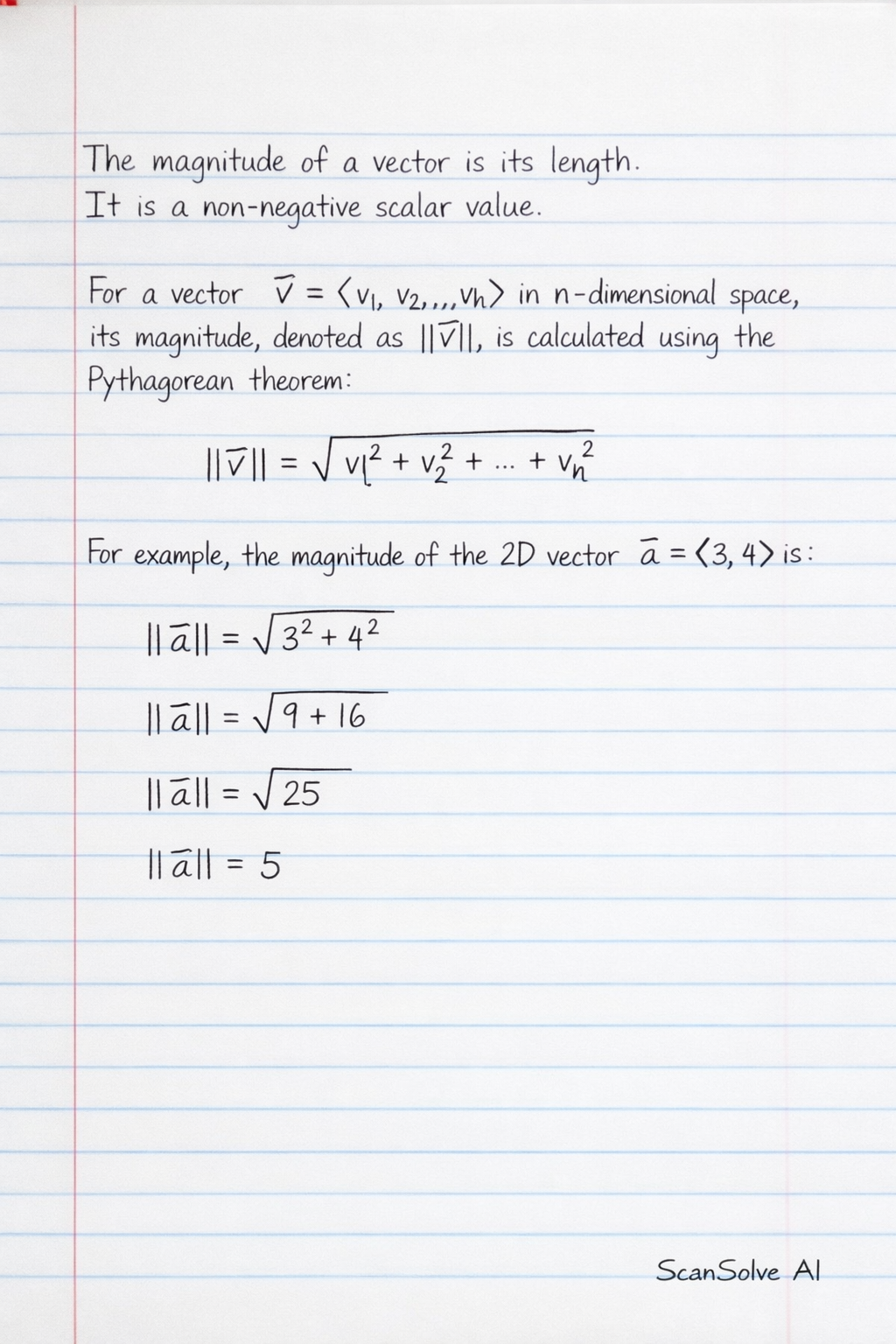
The magnitude of a vector is its length. It is a non-negative scalar value. For a vector in -dimensional space, its magnitude, denoted as , is calculated using the Pythagorean theorem:
For example, the magnitude of the 2D vector is:
Was this helpful?
Still stuck on this one?
Ask a follow-up, and the answer starts from this question.
Got a different question?Ask your own question
More Mathematics Questions
QCalculate the magnitude of the vector.QA vector has a magnitude of 20 units and makes an angle of 30 degrees with the horizontal. What is…QA vector diagram shows two vectors, one of 50N pointing upwards and another vector with magnitude R…QCalculate the magnitude of vector (3,4), find the resultant of (2,3) and (4,1), add matrices…QWhat is a vector
Browse by topic:Linear Algebra
Handwritten Step-by-Step Solution
Get this as a handwritten image on WhatsApp — like a tutor wrote it for you.
Try on WhatsApp