
We read your photo as:
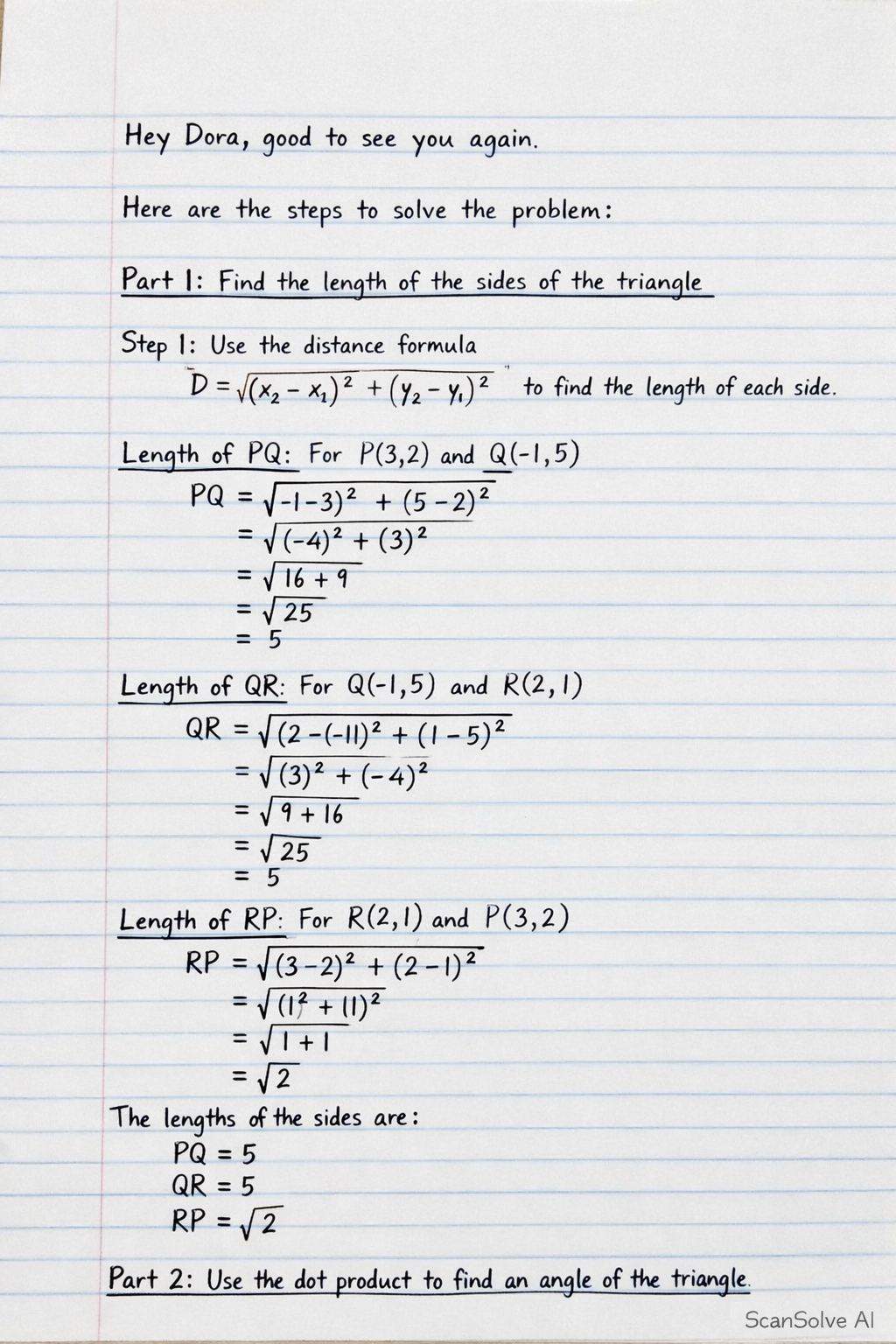
P(3,2), Q(-1,5) and R(2,1) are vertices of a triangle. 1) Find the length of the sides of the triangle. 11) Use the dot product to find an angle of the triangle.
Mathematics
ScanSolve AI Answer
Answers
2 partsStep-by-step solution
6 stepsHere are the steps to solve the problem:
Part 1· 1 step
Find the length of the sides of the triangle
Use the distance formula to find the length of each side.
- Length of PQ: For P and Q
- Length of QR: For Q and R
- Length of RP: For R and P
The lengths of the sides are:
Part 2
Use the dot product to find an angle of the triangle
Choose an angle to find.
Let's find the angle at vertex P, . First, determine the vectors and .
Calculate the dot product of and .
Calculate the magnitudes of and .
Use the dot product formula to find the angle .
Rationalize the denominator:
Calculate the angle.
An angle of the triangle is .
Was this helpful?
Try one yourself
A new problem that tests the same skill.
Still stuck on this one?
Ask a follow-up, and the answer starts from this question.
Got a different question?Ask your own question
More Mathematics Questions
QGiven the vertices of a triangle P(1, −3), Q(7, 5), and R(−3, −5).QP(−1; 2), R(3;0) and Q(−3; a) are the vertices of a triangle in the Cartesian plane and PR = PQQTriangle PQR has vertices P(3,2),Q(−1,1) and R(−3-1)QP(−1; 2), R(3; 0) and Q(−3; a) are the vertices of a triangle in the Cartesian plane and PR = 1…QIdentify the given side lengths for Triangle P and the longest side for Triangle Q.
Browse by topic:Geometry
Handwritten Step-by-Step Solution
Get this as a handwritten image on WhatsApp — like a tutor wrote it for you.
Try on WhatsApp