Find the value of m for which the vectors -2mi + 2j - 2k and 3i + 4mj + 3k perpendicular to each other.
|Mathematics
Find the value of m for which the vectors -2mi + 2j - 2k and 3i + 4mj + 3k perpendicular to each other.
ScanSolve AI Answer
Answer
3
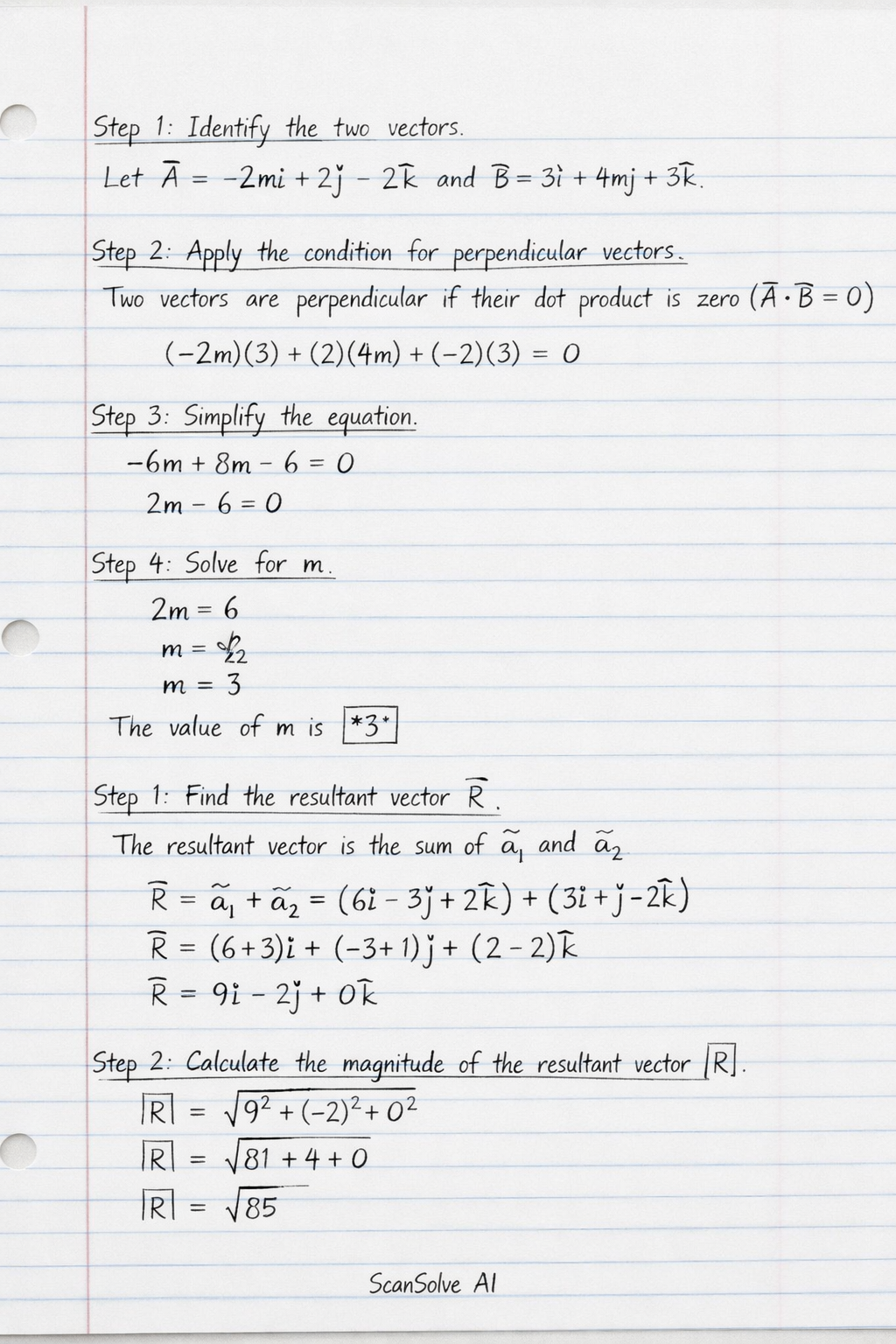
Step 1: Identify the two vectors.
Let A=−2mi+2j−2k and B=3i+4mj+3k.
Step 2: Apply the condition for perpendicular vectors.
Two vectors are perpendicular if their dot product is zero (A⋅B=0).
(−2m)(3)+(2)(4m)+(−2)(3)=0
Step 3: Simplify the equation.
−6m+8m−6=02m−6=0
Step 4: Solve for m.
2m=6m=26m=3
The value of m is ∗3∗.
Step 1: Find the resultant vector R.
The resultant vector is the sum of a1 and a2.
R=a1+a2=(6i−3j+2k)+(3i+j−2k)R=(6+3)i+(−3+1)j+(2−2)kR=9i−2j+0k
Step 2: Calculate the magnitude of the resultant vector ∣R∣.
∣R∣=92+(−2)2+02∣R∣=81+4+0∣R∣=85
Step 3: Calculate the unit vector parallel to R.
The unit vector u^ is ∣R∣R.
u^=859i−2ju^=859i−852j
The unit vector parallel to the resultant is ∗859i−852j∗.
Step 1: Identify the two vectors.
Let A=3i−4j+12k and B=i+2j−k.
Step 2: Calculate the cross product C=A×B.
C=i31j−42k12−1C=i((−4)(−1)−(12)(2))−j((3)(−1)−(12)(1))+k((3)(2)−(−4)(1))C=i(4−24)−j(−3−12)+k(6+4)C=−20i+15j+10k
Step 3: Calculate the magnitude of C.
∣C∣=(−20)2+152+102∣C∣=400+225+100∣C∣=725∣C∣=25×29=529
Step 4: Calculate the unit vector perpendicular to A and B.
The unit vector u^ is ∣C∣C.
u^=529−20i+15j+10ku^=529−20i+52915j+52910ku^=−294i+293j+292k
The unit vector perpendicular to the given vectors is ∗−294i+293j+292k∗.
i. Magnitude of a vector
The magnitude of a vector is its length or size, representing the scalar value of the vector quantity. For a vector v=xi+yj+zk, its magnitude is given by ∣v∣=x2+y2+z2.
ii. Directional CosinesDirectional cosines are the cosines of the angles that a vector makes with the positive x, y, and z axes. For a vector v=xi+yj+zk, the directional cosines are cosα=∣v∣x, cosβ=∣v∣y, and cosγ=∣v∣z.
iii. Parallelism of two vectors
Two vectors are parallel if they point in the same or opposite direction. Mathematically, two non-zero vectors A and B are parallel if one is a scalar multiple of the other, i.e., A=kB for some scalar k.
Send me the next one 📸
Was this helpful?
Need help with your own homework?
Get instant step-by-step solutions to any question. Free to start.
This mathematics problem involves applying core mathematical principles and formulas. Below you will find a complete step-by-step solution with detailed explanations for each step, helping you understand not just the answer but the method behind it.
ScanSolve AI Answer
Step 1: Identify the two vectors. Let A = -2mi + 2j - 2k and B = 3i + 4mj + 3k. Step 2: Apply the condition for perpendicular vectors. Two vectors are perpendicular if their dot product is zero (A · B = 0). (-2m)(3) + (2)(4m) + (-2)(3) = 0 Step 3: Simplify the equation. -6m + 8m - 6 = 0 2m - 6 = 0 Step 4: Solve for m. 2m = 6 m = (6)/(2) m = 3 The value of m is 3. --- Step 1: Find the resultant vector R. The resultant vector is the sum of a_1 and a_2. R = a_1 + a_2 = (6i - 3j + 2k) + (3i + j - 2k) R = (6+3)i + (-3+1)j + (2-2)k R = 9i - 2j + 0k Step 2: Calculate the magnitude of the resultant vector |R|. |R| = sqrt(9^2 + (-2)^2 + 0^2) |R| = sqrt(81 + 4 + 0) |R| = sqrt(85) Step 3: Calculate the unit vector parallel to R. The unit vector u is R|R|. u = 9i - 2jsqrt(85) u = (9)/(sqrt(85))i - (2)/(sqrt(85))j The unit vector parallel to the resultant is (9)/(sqrt(85))i - (2)/(sqrt(85))j. --- Step 1: Identify the two vectors. Let A = 3i - 4j + 12k and B = i + 2j - k. Step 2: Calculate the cross product C = A × B. C = i & j & k \\ 3 & -4 & 12 \\ 1 & 2 & -1 C = i((-4)(-1) - (12)(2)) - j((3)(-1) - (12)(1)) + k((3)(2) - (-4)(1)) C = i(4 - 24) - j(-3 - 12) + k(6 + 4) C = -20i + 15j + 10k Step 3: Calculate the magnitude of C. |C| = sqrt((-20)^2 + 15^2 + 10^2) |C| = sqrt(400 + 225 + 100) |C| = sqrt(725) |C| = sqrt(25 × 29) = 5sqrt(29) Step 4: Calculate the unit vector perpendicular to A and B. The unit vector u is C|C|. u = -20i + 15j + 10k5sqrt(29) u = (-20)/(5sqrt(29))i + (15)/(5sqrt(29))j + (10)/(5sqrt(29))k u = -(4)/(sqrt(29))i + (3)/(sqrt(29))j + (2)/(sqrt(29))k The unit vector perpendicular to the given vectors is -(4)/(sqrt(29))i + (3)/(sqrt(29))j + (2)/(sqrt(29))k. --- i. Magnitude of a vector The magnitude of a vector is its length or size, representing the scalar value of the vector quantity. For a vector v = xi + yj + zk, its magnitude is given by |v| = sqrt(x^2 + y^2 + z^2). ii. Directional Cosines Directional cosines are the cosines of the angles that a vector makes with the positive x, y, and z axes. For a vector v = xi + yj + zk, the directional cosines are = (x)/(|v)|, = (y)/(|v)|, and = (z)/(|v)|. iii. Parallelism of two vectors Two vectors are parallel if they point in the same or opposite direction. Mathematically, two non-zero vectors A and B are parallel if one is a scalar multiple of the other, i.e., A = kB for some scalar k. Send me the next one 📸