
We read your photo as:
How many of these learners do not play any of the sports on the survey (that is netball, tennis or hockey)?
ScanSolve AI Answer
Step-by-step solution
13 stepsOkay, ngengnomhle, I'll solve Question 5 from the image you sent.
Question 5.1:
A group of 33 learners was surveyed at a school. The following information from the survey is given:
- 2 learners play tennis, hockey and netball
- 5 learners play hockey and netball
- 7 learners play hockey and tennis
- 6 learners play tennis and netball
- A total of 18 learners play hockey
- A total of 12 learners play tennis
- 4 learners play netball ONLY
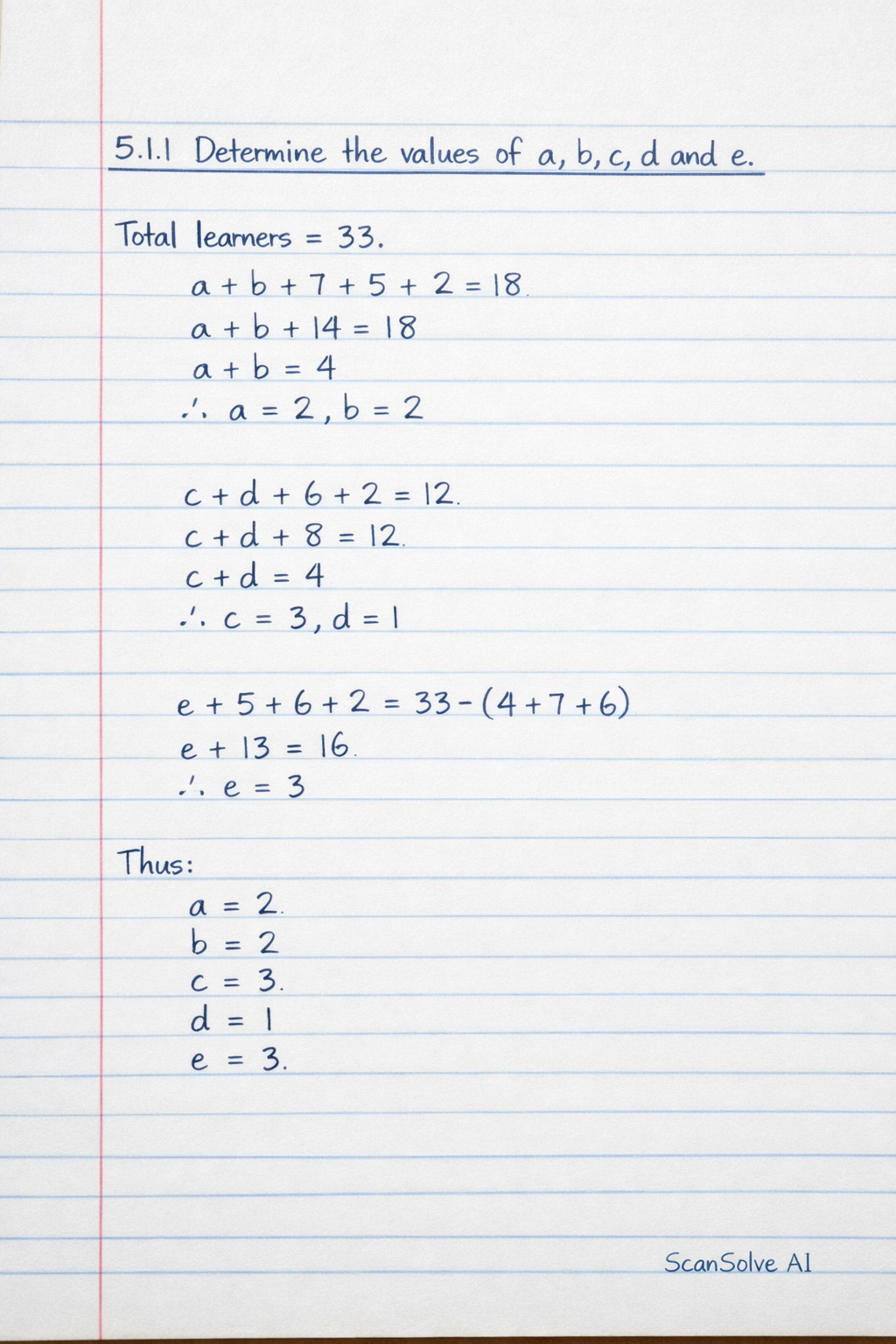
5.1.1 Determine the values of a, b, c, d and e.
Use the given information to fill in the Venn diagram regions.
Let H be Hockey, N be Netball, T be Tennis.
- (This is the center region, already labeled 2).
- . From the diagram, . So, .
- . From the diagram, . (This matches the diagram).
- . From the diagram, . (This matches the diagram).
- .
- . From the diagram, . Substitute : .
- . From the diagram, . Substitute : .
Calculate the value of .
The total number of learners surveyed is 33.
The sum of all learners in the circles is:
.
The number of learners who do not play any sport () is the total learners minus those who play at least one sport.
.The values are: .
5.1.2 How many of these learners do not play any of the sports on the survey (that is netball, tennis or hockey)?
Identify the region representing learners who play none of the sports.
This is the value calculated in 5.1.1.
The number of learners who do not play any of the sports is .
5.1.3 Write down the probability that a learner selected at random from this sample plays netball ONLY.
Identify the number of learners who play netball ONLY.
From 5.1.1, learners play netball ONLY.
The total number of learners is 33.Calculate the probability.
The probability that a learner plays netball ONLY is .
5.1.4 Determine the probability that a learner selected at random from this sample plays hockey or netball.
Identify the number of learners who play hockey or netball.
This includes all regions within the Hockey (H) circle or the Netball (N) circle.
.
The total number of learners is 33.Calculate the probability.
The probability that a learner plays hockey or netball is .
Question 5.2:
In all South African schools, EVERY learner must choose to do either Mathematics or Mathematical Literacy.
At a certain South African school, it is known that 60% of the learners are girls.
The probability that a randomly chosen girl at the school does Mathematical Literacy is 55%.
The probability that a randomly chosen boy at the school does Mathematical Literacy is 65%.Determine the probability that a learner selected at random from this school does Mathematics.
Define the probabilities given.
Let G be the event a learner is a girl, B be the event a learner is a boy.
Let ML be the event a learner does Mathematical Literacy, M be the event a learner does Mathematics.
Calculate the probabilities of doing Mathematics for girls and boys.
Since learners must choose either Mathematics or Mathematical Literacy:
Use the Law of Total Probability to find the overall probability of a learner doing Mathematics.
The probability that a learner selected at random does Mathematics is .
Question 5.3:
William writes a Mathematics examination and an Accounting examination.
He estimates that he has a 40% chance of passing the Mathematics examination.
He estimates that he has a 60% chance of passing the Accounting examination.
He estimates that he has a 30% chance of passing both.Determine the probability that William will fail Mathematics and Accounting.
Define the probabilities given.
Let M be the event William passes Mathematics, A be the event William passes Accounting.
(Probability of passing both)Determine the probability of passing Mathematics OR Accounting.
Using the Addition Rule for probabilities:
Determine the probability of failing Mathematics AND failing Accounting.
This is the complement of passing Mathematics OR Accounting, i.e., .
The probability that William will fail Mathematics and Accounting is .
Still stuck on this one?
Ask a follow-up, and the answer starts from this question.
More Mathematics Questions
Handwritten Step-by-Step Solution
Get this as a handwritten image on WhatsApp — like a tutor wrote it for you.
Try on WhatsApp