
We read your photo as:
How many ways can 12 boys be seated around a round table if two particular boys must sit together? 2. How many ways can six board of directors be seated on a circular table?
ScanSolve AI Answer
Answers
2 partsStep-by-step solution
6 stepsHere are the solutions to your assignment questions:
1. Seating 12 boys around a round table with 2 particular boys together
Step 1: Treat the 2 particular boys who must sit together as a single unit.
This reduces the number of entities to arrange to units.
Step 2: Calculate the number of ways to arrange these 11 units around a circular table.
For circular permutations, the number of ways to arrange distinct items is .
So, for 11 units, the number of arrangements is .
Step 3: Account for the arrangements of the 2 particular boys within their unit.
The 2 boys can sit in ways within their unit (Boy A then Boy B, or Boy B then Boy A).
Step 4: Multiply the arrangements from Step 2 and Step 3 to get the total number of ways.
Total ways = (arrangements of units) (arrangements within the unit)
The 2 particular boys must sit next to each other in .
2. Seating six board of directors on a circular table
Step 1: Identify the number of people to be arranged.
There are directors.
Step 2: Apply the formula for circular permutations.
The number of ways to arrange distinct items in a circle is .
Step 3: Calculate the factorial.
Six board of directors can sit on a circular table in .
3. Expand the given expressions
Part a· 3 steps
Expand
Use the binomial theorem .
Here, , , and .
Calculate each term of the expansion.
Term 1 ():
Term 2 ():
Term 3 ():
Term 4 ():
Term 5 ():Sum the terms to get the expanded form.
Part b
Expand * (Based on your notes for Question 2, where , , )
Use the binomial theorem .
Here, , , and .
Calculate each term of the expansion.
Term 1 ():
Term 2 ():
Term 3 ():
Term 4 ():Sum the terms to get the expanded form.
Still stuck on this one?
Ask a follow-up, and the answer starts from this question.
More Mathematics Questions
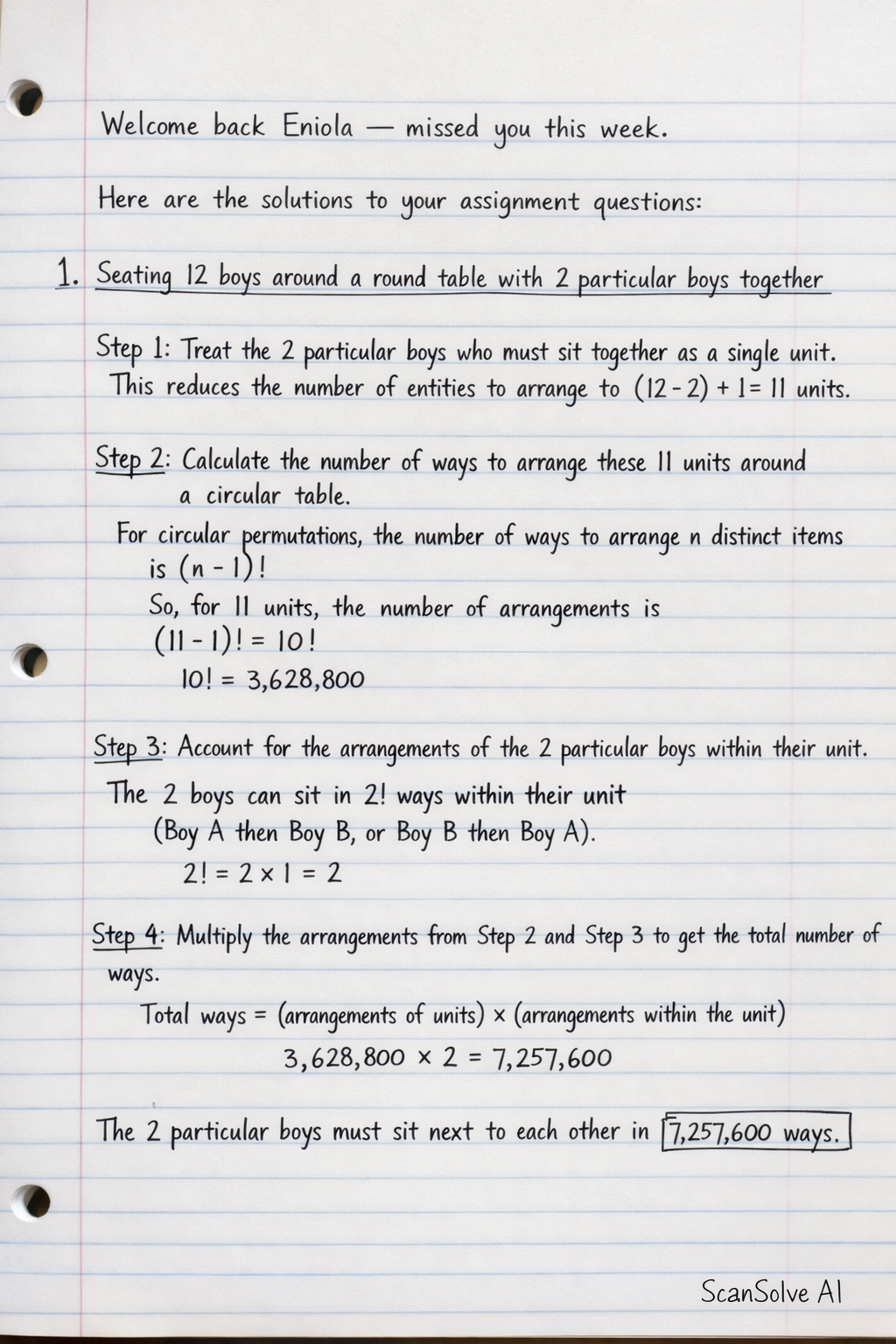
Handwritten Step-by-Step Solution
Get this as a handwritten image on WhatsApp — like a tutor wrote it for you.
Try on WhatsApp