
We read your photo as:
Calculate the mean, median, mode and range for the following Sales data: 1,700, 2,200, 2,400, 2,900, 1,800, 3,700, 1,200, 2,300, 600, 1,600, 2,000, 3,900, 1,100, 1,700, 2,900, 2,900, $2,900. Then, interpret the result.
ScanSolve AI Answer
Step-by-step solution
6 stepsYou've done a great job re-arranging the data and setting up the mean calculation. Let's refine the sum and complete the rest of the question.
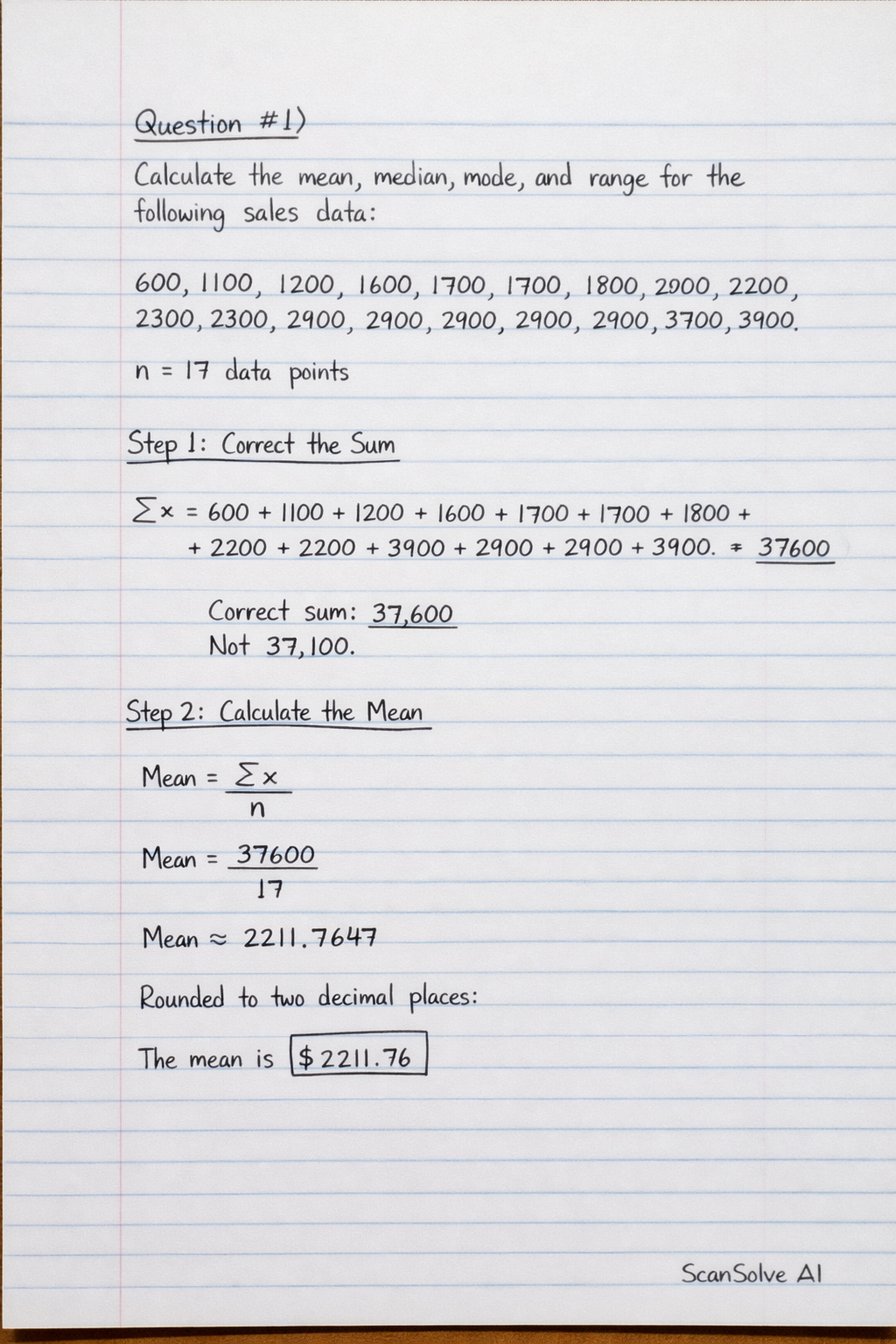
Question #1)
Calculate the mean, median, mode, and range for the following sales data:
$1700; $2200; $2400; $2900; $1800; $3700; $1200; $2300; $600; $1600; $2000; $3900; $1100; $1700; $2900; $2900; $2900.
Use the ordered data and correct the sum.
You correctly re-arranged the sales data in ascending order:
1100, 1600, 1700, 2000, 2300, 2900, 2900, 3700, n=17$ data points.
Let's re-sum the values:Your sum of 37,600.
Calculate the mean.
The mean is the sum of all values divided by the number of values.
Rounding to two decimal places:
The mean is\boxed{\mathbf{\2211.76}}$.Interpret the mean.
The mean of 2211.76. It represents the central tendency of the sales data.
Calculate the median.
Since there are 17 data points (an odd number), the median is the -th value in the ordered list.
Counting to the 9th value in the ordered list:
.
The median is\boxed{\mathbf{\2200}}$.Calculate the mode.
The mode is the value that appears most frequently in the dataset.
The value \boxed{\mathbf{$2900}}$.Calculate the range.
The range is the difference between the maximum and minimum values in the dataset. The range is
\boxed{\mathbf{\3300}}$.
Still stuck on this one?
Ask a follow-up, and the answer starts from this question.
More Mathematics Questions
Handwritten Step-by-Step Solution
Get this as a handwritten image on WhatsApp — like a tutor wrote it for you.
Try on WhatsApp