This mathematics problem involves applying core mathematical principles and formulas. Below you will find a complete step-by-step solution with detailed explanations for each step, helping you understand not just the answer but the method behind it.
ScanSolve AI Answer
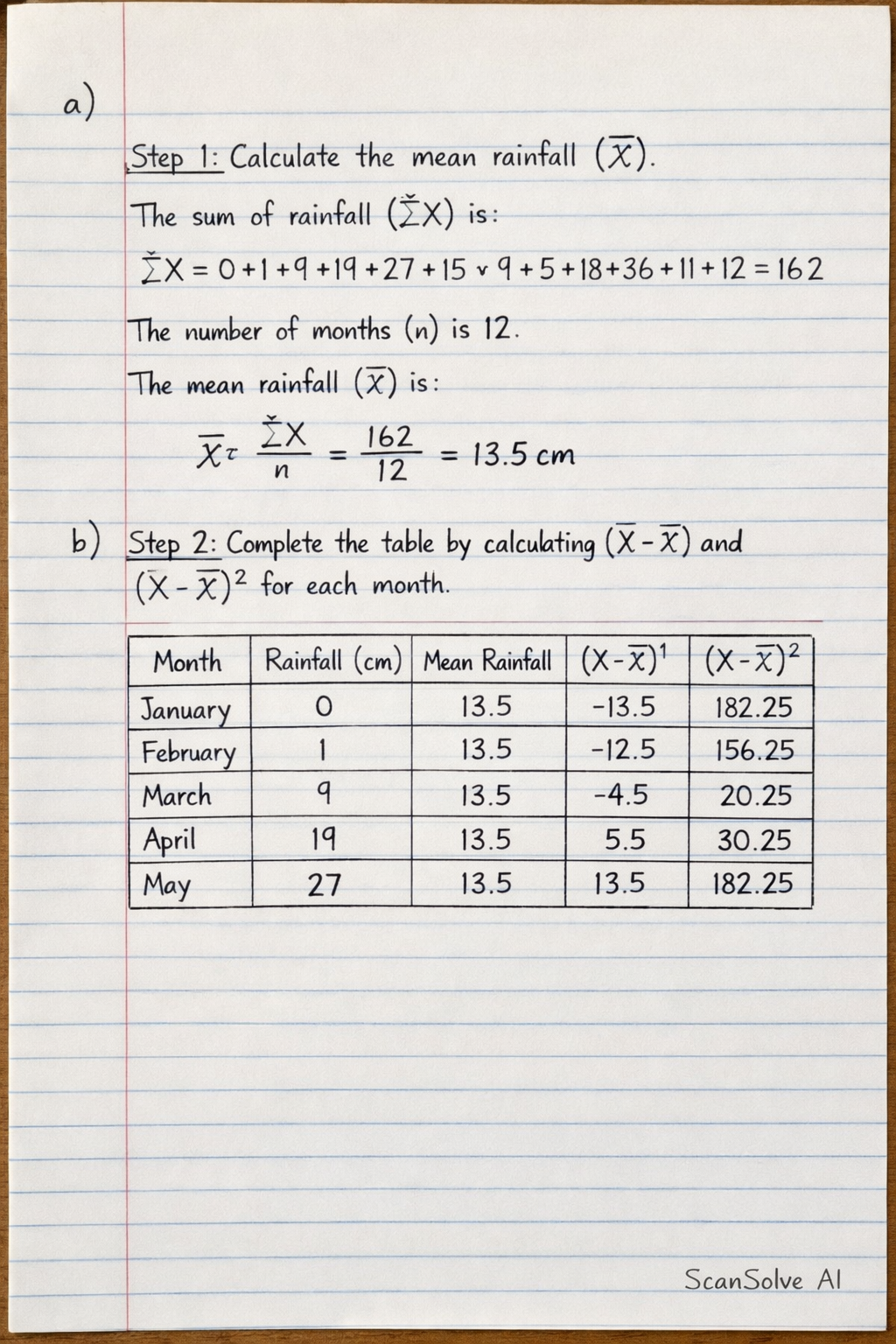
a)
Step 1: Calculate the mean rainfall ($\bar{X}$).
The sum of rainfall ($\sum X$) is:
$$\sum X = 0 + 1 + 9 + 19 + 27 + 15 + 9 + 5 + 18 + 36 + 11 + 12 = 162$$
The number of months ($n$) is 12.
The mean rainfall ($\bar{X}$) is:
$$\bar{X} = \frac{\sum X}{n} = \frac{162}{12} = 13.5 \text{ cm}$$
Step 2: Complete the table by calculating $(X - \bar{X})$ and $(X - \bar{X})^2$ for each month.
| Month | Rainfall (cm) ($X$) | Mean Rainfall ($\bar{X}$) | $(X - \bar{X})$ | $(X - \bar{X})^2$ |
| :-------- | :------------------ | :------------------------ | :-------------- | :---------------- |
| January | 0 | 13.5 | -13.5 | 182.25 |
| February | 1 | 13.5 | -12.5 | 156.25 |
| March | 9 | 13.5 | -4.5 | 20.25 |
| April | 19 | 13.5 | 5.5 | 30.25 |
| May | 27 | 13.5 | 13.5 | 182.25 |
| June | 15 | 13.5 | 1.5 | 2.25 |
| July | 9 | 13.5 | -4.5 | 20.25 |
| August | 5 | 13.5 | -8.5 | 72.25 |
| September | 18 | 13.5 | 4.5 | 20.25 |
| October | 36 | 13.5 | 22.5 | 506.25 |
| November | 11 | 13.5 | -2.5 | 6.25 |
| December | 12 | 13.5 | -1.5 | 2.25 |
| Total | 162 | | 0 | 1203 |
The sum of $(X - \bar{X})^2$ is $\boxed{\sum (X - \bar{X})^2 = 1203}$.
b)
i)
Step 1: Calculate the Standard Deviation ($\sigma$).
Using the formula $\sigma = \sqrt{\frac{\sum (X-\bar{X})^2}{n}}$:
$$\sigma = \sqrt{\frac{1203}{12}}$$
$$\sigma = \sqrt{100.25}$$
$$\sigma \approx 10.01249$$
Rounding to two decimal places:
The standard deviation is $\boxed{\text{10.01 cm}}$.
Significance: The standard deviation of 10.01 cm indicates the average amount of variation or dispersion of the monthly rainfall data around the mean rainfall of 13.5 cm. A higher value would imply greater variability in rainfall, while a lower value would suggest rainfall amounts are more consistent from month to month.
ii)
Two advantages of using Standard Deviation are:
• It considers every observation in the dataset, making it a comprehensive measure of dispersion.
• It is expressed in the same units as the original data, which makes it easy to interpret and compare.
iii)
Step 1: Calculate the Coefficient of Variation (CV).
Using the formula $CV = \frac{\text{Standard Deviation}}{\text{Mean}} \times 100$:
$$CV = \frac{10.01249}{13.5} \times 100$$
$$CV \approx 0.741666 \times 100$$
$$CV \approx 74.17\%$$
Rounding to two decimal places:
The Coefficient of Variation is $\boxed{\text{74.17%}}$.
c)
i)
To represent the information on monthly rainfall using simple bar graphs:
• Draw a horizontal axis labeled "Month" and a vertical axis labeled "Rainfall (cm)".
• For each month (January to December), draw a vertical bar.
• The height of each bar should correspond to the rainfall value for that specific month as given in the table.
• Ensure all bars are of equal width and are separated by equal spaces.
• Provide a clear title for the graph, such as "Monthly Rainfall in Sangmelima".
ii)
The distribution of rainfall shows a bimodal pattern. There is very low rainfall at the beginning of the year (January-February), followed by an increase to a first peak in May (27 cm). Rainfall then decreases in July-August before rising to a second, higher peak in October (36 cm). Rainfall then declines towards the end of the year (November-December). This indicates two distinct rainy seasons.
d)
i)
Step 1: Determine the maximum and minimum rainfall values.
Maximum rainfall = 36 cm (October)
Minimum rainfall = 0 cm (January)
Step 2: Calculate the annual rainfall range.
Range = Maximum Rainfall - Minimum Rainfall
Range = $36 \text{ cm} - 0 \text{ cm} = 36 \text{ cm}$
The annual rainfall range is $\boxed{\text{36 cm}}$.
Q
Calculate the mean rainfall (X).
|Mathematics
Calculate the mean rainfall (X).
ScanSolve AI Answer
a)
Step 1: Calculate the mean rainfall (Xˉ).
The sum of rainfall (∑X) is:
∑X=0+1+9+19+27+15+9+5+18+36+11+12=162
The number of months (n) is 12.
The mean rainfall (Xˉ) is:
Xˉ=n∑X=12162=13.5 cm
Step 2: Complete the table by calculating (X−Xˉ) and (X−Xˉ)2 for each month.
b)i)
Step 1: Calculate the Standard Deviation (σ).
Using the formula σ=n∑(X−Xˉ)2:
σ=121203σ=100.25σ≈10.01249
Rounding to two decimal places:
The standard deviation is ∗10.01cm∗.
Significance: The standard deviation of 10.01 cm indicates the average amount of variation or dispersion of the monthly rainfall data around the mean rainfall of 13.5 cm. A higher value would imply greater variability in rainfall, while a lower value would suggest rainfall amounts are more consistent from month to month.
ii)
Two advantages of using Standard Deviation are:
• It considers every observation in the dataset, making it a comprehensive measure of dispersion.
• It is expressed in the same units as the original data, which makes it easy to interpret and compare.
iii)
Step 1: Calculate the Coefficient of Variation (CV).
Using the formula CV=MeanStandardDeviation×100:
CV=13.510.01249×100CV≈0.741666×100CV≈74.17%
Rounding to two decimal places:
The Coefficient of Variation is \boxed{*74.17%*}.
c)i)
To represent the information on monthly rainfall using simple bar graphs:
• Draw a horizontal axis labeled "Month" and a vertical axis labeled "Rainfall (cm)".
• For each month (January to December), draw a vertical bar.
• The height of each bar should correspond to the rainfall value for that specific month as given in the table.
• Ensure all bars are of equal width and are separated by equal spaces.
• Provide a clear title for the graph, such as "Monthly Rainfall in Sangmelima".
ii)
The distribution of rainfall shows a bimodal pattern. There is very low rainfall at the beginning of the year (January-February), followed by an increase to a first peak in May (27 cm). Rainfall then decreases in July-August before rising to a second, higher peak in October (36 cm). Rainfall then declines towards the end of the year (November-December). This indicates two distinct rainy seasons.
d)i)
Step 1: Determine the maximum and minimum rainfall values.
Maximum rainfall = 36 cm (October)
Minimum rainfall = 0 cm (January)
Step 2: Calculate the annual rainfall range.
Range = Maximum Rainfall - Minimum Rainfall
Range = 36cm−0cm=36 cm
The annual rainfall range is ∗36cm∗.
Need help with your own homework?
Get instant step-by-step solutions to any question. Free to start.