
We read your photo as:
Explain the meaning of the following terms as used in Mathematical Literacy: route map, north elevation map, strip map, bar scales, and 3-D model.
ScanSolve AI Answer
The provided image contains questions related to a "Mathematical Literacy Investigation" but does not include the "attached map" or "information above" that is referenced in the instructions. Therefore, I can only answer the questions that do not require information from the map.
Questions that cannot be answered without the map:
1.2, 1.3, 1.4, 1.5, 2, 3.1, 3.2.
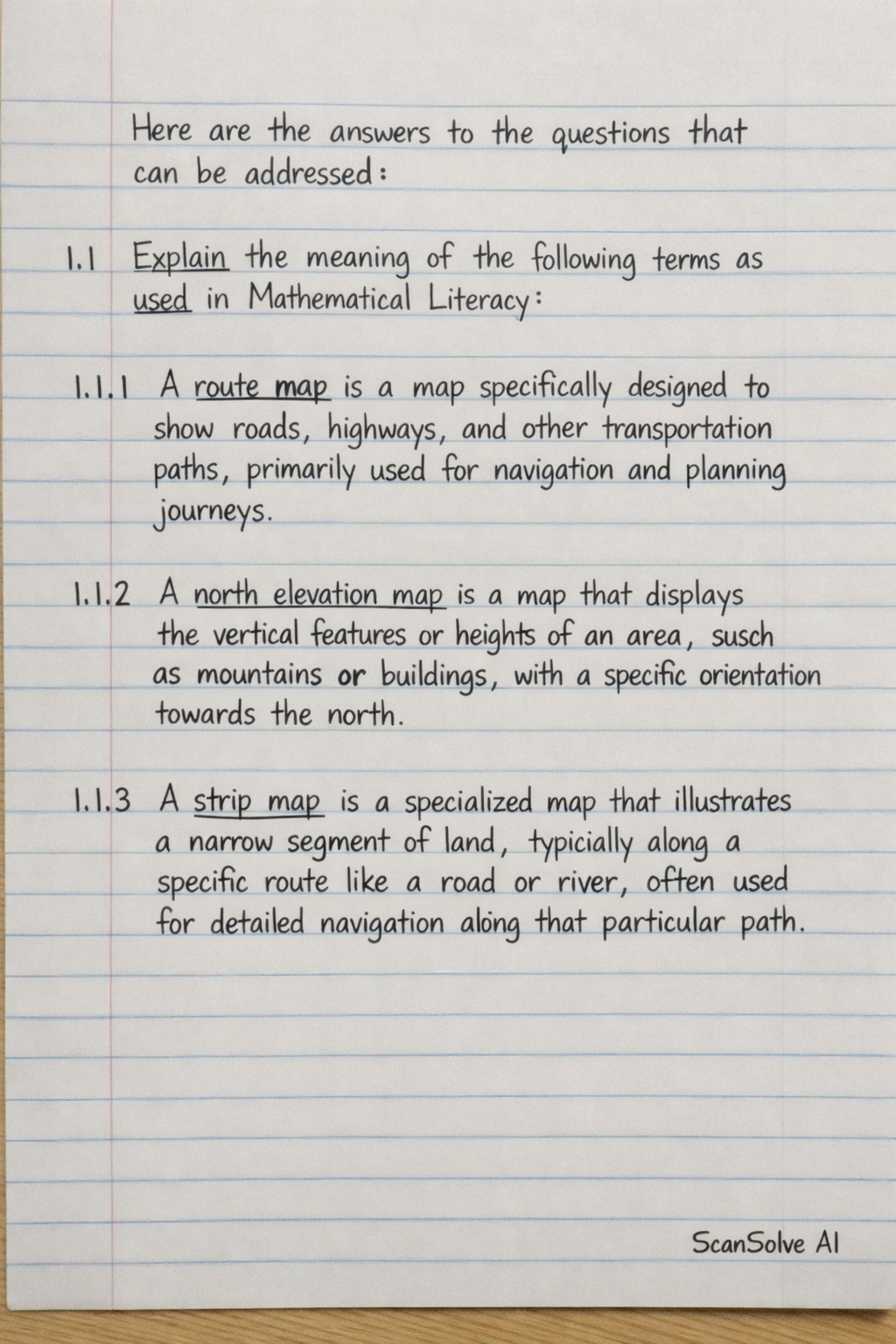
Here are the answers to the questions that can be addressed:
1.1 Explain the meaning of the following terms as used in Mathematical Literacy.
1.1.1 A route map is a map specifically designed to show roads, highways, and other transportation paths, primarily used for navigation and planning journeys.
1.1.2 A north elevation map is a map that displays the vertical features or heights of an area, such as mountains or buildings, with a specific orientation towards the north.
1.1.3 A strip map is a specialized map that illustrates a narrow segment of land, typically along a specific route like a road or river, often used for detailed navigation along that particular path.
1.1.4 Bar scales are graphic representations on a map that show the relationship between a distance on the map and the corresponding actual distance on the ground, usually depicted as a line marked with units.
1.1.5 A 3-D model is a physical or digital representation of an object or area that includes three dimensions (length, width, and height), providing a realistic and comprehensive view.
4.1 Explain how scale is important in everyday contexts.
Scale is important because it allows us to represent large real-world objects, distances, or areas in a smaller, manageable format while maintaining accurate proportions. This enables effective planning, design, and understanding of spatial relationships without needing to work with actual sizes.
4.2 Provide two examples where scale can be applied in real life.
- Architecture and construction: Architects use scale drawings (blueprints) to design buildings, showing the relative sizes of rooms, walls, and features before construction begins.
- Cartography (map-making): Maps use scale to represent vast geographical areas on a smaller medium, allowing people to navigate, estimate distances, and understand the layout of regions.
Still stuck on this one?
Ask a follow-up, and the answer starts from this question.
More Mathematics Questions
Handwritten Step-by-Step Solution
Get this as a handwritten image on WhatsApp — like a tutor wrote it for you.
Try on WhatsApp