
We read your photo as:
Calculate the missing frequencies for the given particle size ranges using the provided fX and Mean (X) values.
Mathematics
ScanSolve AI Answer
Step-by-step solution
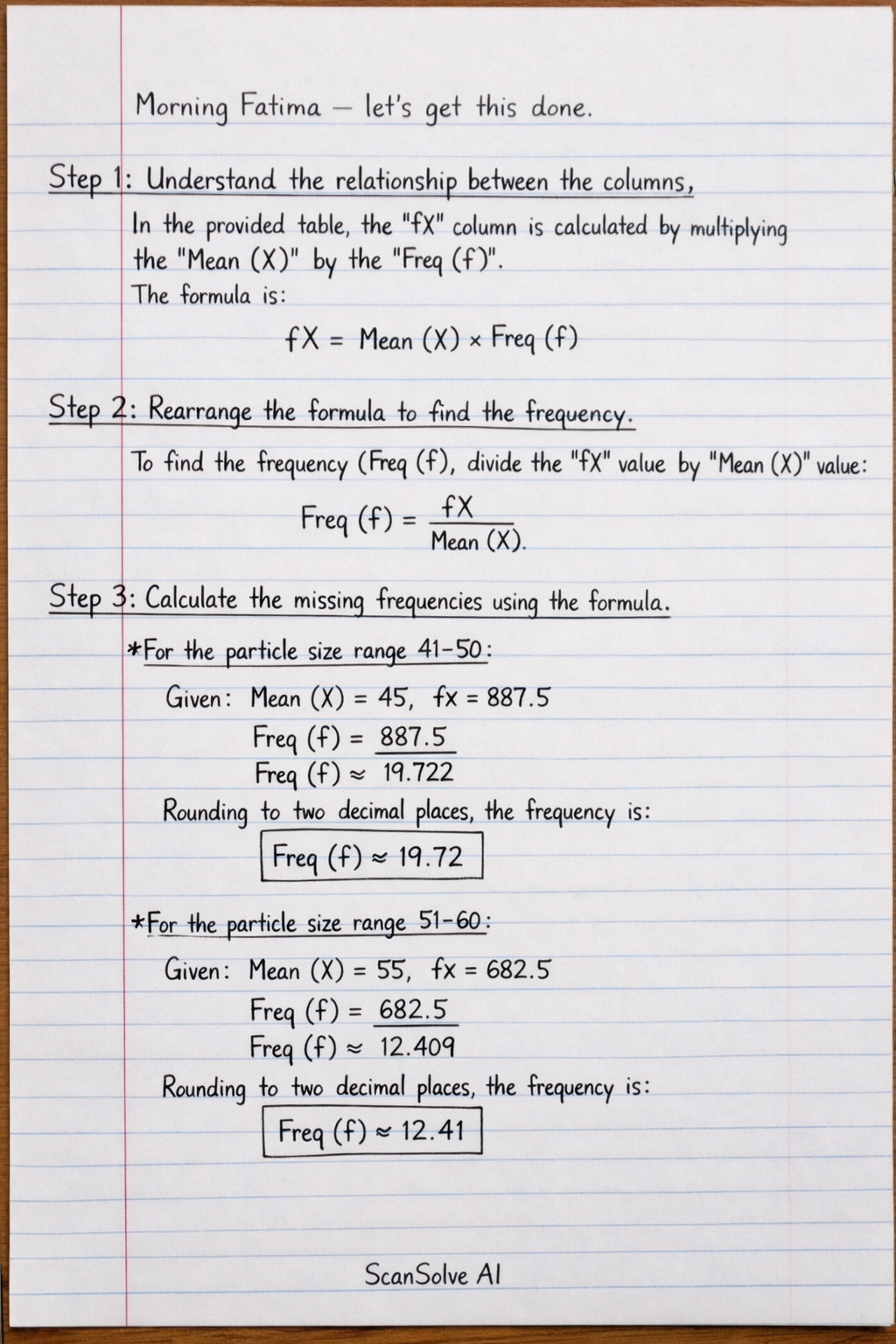
3 stepsUnderstand the relationship between the columns.
In the provided table, the "fX" column is calculated by multiplying the "Mean (X)" by the "Freq (f)".
The formula is:Rearrange the formula to find the frequency.
To find the frequency (Freq (f)), divide the "fX" value by the "Mean (X)" value:
Calculate the missing frequencies using the formula.
For the particle size range 41-50:
Given: Mean (X) = 45, fX = 887.5
Substitute these values into the formula:Rounding to two decimal places, the frequency is:
For the particle size range 51-60:
Given: Mean (X) = 55, fX = 682.5
Substitute these values into the formula:Rounding to two decimal places, the frequency is:
Was this helpful?
Still stuck on this one?
Ask a follow-up, and the answer starts from this question.
Got a different question?Ask your own question
More Mathematics Questions
QCalculate the sum of frequencies (sum f) and the sum of (frequency x mark) (sum fx).QDetermine the class midpoints (x) and sum of frequencies (sum f).QCalculate the class boundaries, midpoints, fx, fx2, and cumulative frequencies for the given data…QCalculate the missing values of X and H based on the provided box-and-whisker plot and data…QThe mean of the following frequency distribution is 48.2. Two frequencies are missing. Find the…
Handwritten Step-by-Step Solution
Get this as a handwritten image on WhatsApp — like a tutor wrote it for you.
Try on WhatsApp