
We read your photo as:
Find the missing term in the sequence: 10, 14, 26, 42, 70, ?
ScanSolve AI Answer
Answer
Step-by-step solution
4 stepsFind the differences between consecutive terms in the given sequence.
The sequence is
Calculate the first differences:The sequence of differences is .
Identify the pattern in the sequence of differences.
Let's examine if there's a relationship between these differences.
Notice that:This shows that each difference (starting from the third one) is the sum of the two preceding differences. This is a Fibonacci-like sequence for the differences.
Apply the pattern to find the next difference.
Following this pattern, the next difference will be the sum of the last two differences found:
Next difference .Add the next difference to the last term of the original sequence to find the missing term.
The last term in the given sequence is 70.
Missing term .The complete sequence is .
The missing term is 114.
Try one yourself
A new problem that tests the same skill.
Still stuck on this one?
Ask a follow-up, and the answer starts from this question.
More Mathematics Questions
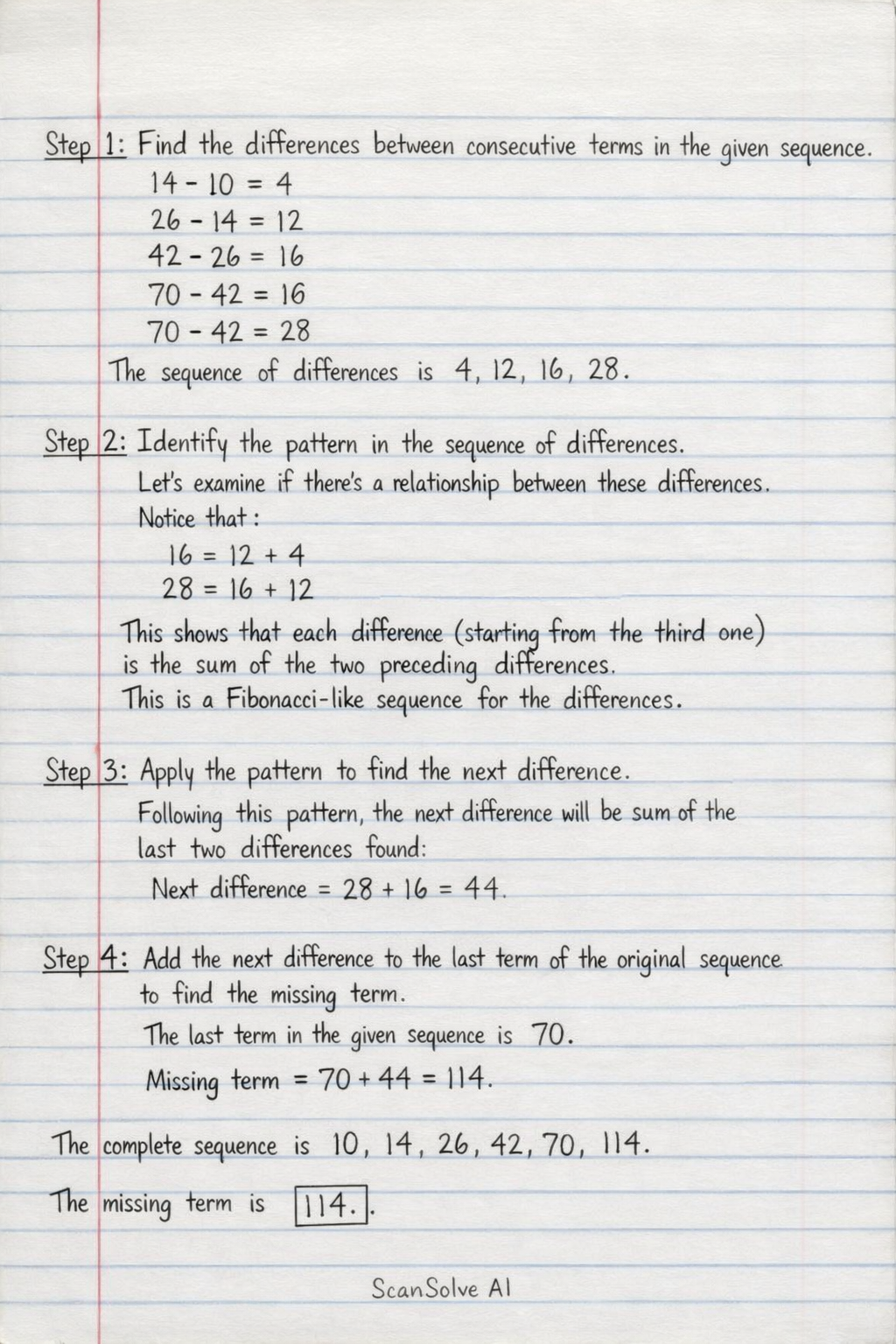
Handwritten Step-by-Step Solution
Get this as a handwritten image on WhatsApp — like a tutor wrote it for you.
Try on WhatsApp