
We read your photo as:
Find n(A ext ext extbar } B), n(B ext ext extbar } A), n(A ext ext extbar } B^c) and n(A^c ext ext extbar } B) given n(A)=10, n(B)=7, n(A ext ext extbar } B)=8 and n(U)=15.
ScanSolve AI Answer
Step-by-step solution
11 stepsHere are the solutions to the problems:
1. Find if sets and have , and .
Use the formula for the number of elements in the union of two sets.
Substitute the given values into the formula.
Simplify the equation.
Solve for .
The number of elements in the intersection of A and B is .
2. Find the value of if .
Convert the logarithmic equation to an exponential equation.
The definition of a logarithm states that is equivalent to .
Solve for .
Take the square root of both sides.
Consider the domain of the logarithm.
The base of a logarithm must be positive and not equal to 1. Therefore, and .
The value of is .
3. Simplify .
Combine the terms under a single fourth root, using the property .
Simplify the expression inside the root using exponent rules .
Rewrite the radical expression using fractional exponents, .
Apply the exponent to each term inside the parentheses, using and .
The simplified expression is .
Still stuck on this one?
Ask a follow-up, and the answer starts from this question.
More Mathematics Questions
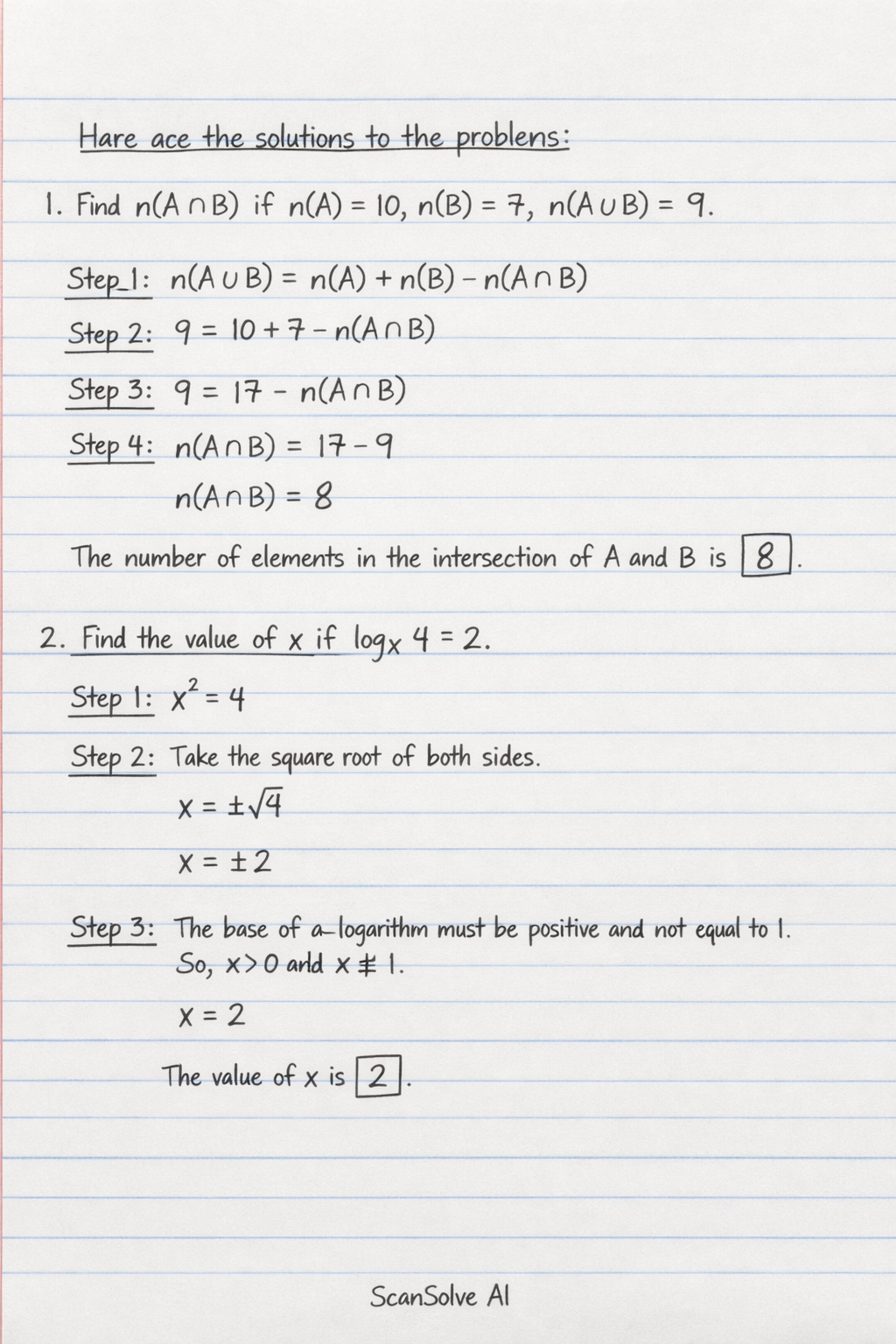
Handwritten Step-by-Step Solution
Get this as a handwritten image on WhatsApp — like a tutor wrote it for you.
Try on WhatsApp