We read your photo as:

Find the nature of roots for quadratic equations and calculate expressions involving roots.

Mathematics

ScanSolve AI Answer

Answer

b

112\frac{1}{12}

Step-by-step solution

10 steps

Part a· 3 steps

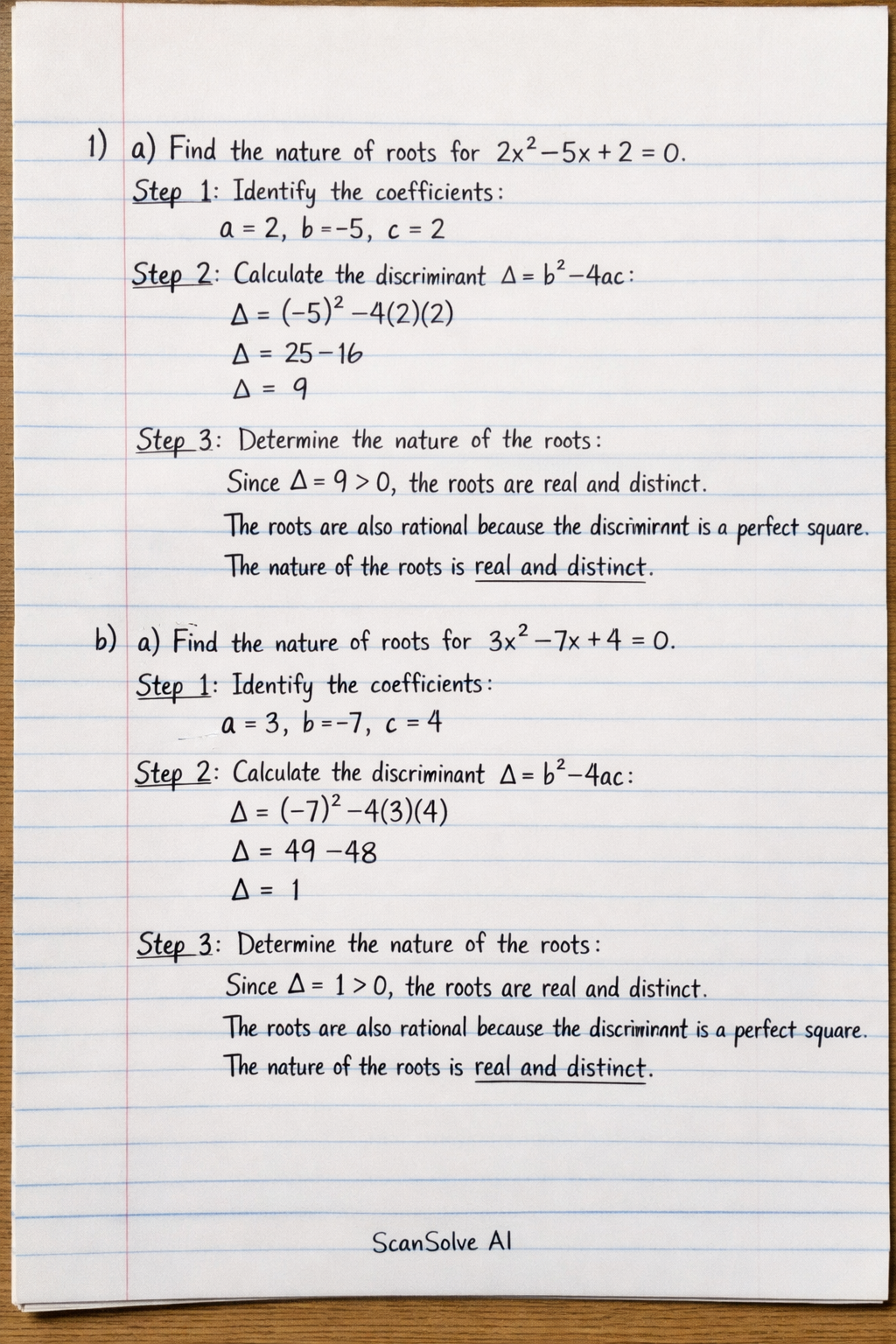
Find the nature of roots for 2x2−5x+2=02x^2 - 5x + 2 = 0.

  1. Identify the coefficients.

    For the quadratic equation ax2+bx+c=0ax^2 + bx + c = 0, we have a=2a = 2, b=−5b = -5, c=2c = 2.

  2. Calculate the discriminant Δ=b2−4ac\Delta = b^2 - 4ac.

    Δ=(−5)2−4(2)(2)\Delta = (-5)^2 - 4(2)(2) Δ=25−16\Delta = 25 - 16 Δ=9\Delta = 9
  3. Determine the nature of the roots.

    Since Δ=9>0\Delta = 9 > 0, the roots are real and distinct.
    The roots are also rational because the discriminant is a perfect square.
    The nature of the roots is real and distinct.

Part b

112\frac{1}{12}

Find the nature of roots for 3x2−7x+4=03x^2 - 7x + 4 = 0.

  1. Identify the coefficients.

    For the quadratic equation ax2+bx+c=0ax^2 + bx + c = 0, we have a=3a = 3, b=−7b = -7, c=4c = 4.

  2. Calculate the discriminant Δ=b2−4ac\Delta = b^2 - 4ac.

    Δ=(−7)2−4(3)(4)\Delta = (-7)^2 - 4(3)(4) Δ=49−48\Delta = 49 - 48 Δ=1\Delta = 1
  3. Determine the nature of the roots.

    Since Δ=1>0\Delta = 1 > 0, the roots are real and distinct.
    The roots are also rational because the discriminant is a perfect square.
    The nature of the roots is real and distinct.

    If α\alpha and β\beta are the roots of the equation 3x2−5x+4=03x^2 - 5x + 4 = 0, find the value of αβ+βα\frac{\alpha}{\beta} + \frac{\beta}{\alpha}.

  4. Identify the coefficients.

    For the quadratic equation ax2+bx+c=0ax^2 + bx + c = 0, we have a=3a = 3, b=−5b = -5, c=4c = 4.

  5. Find the sum and product of the roots.

    Sum of roots: α+β=−ba\alpha + \beta = -\frac{b}{a}

    α+β=−−53=53\alpha + \beta = -\frac{-5}{3} = \frac{5}{3}

    Product of roots: αβ=ca\alpha \beta = \frac{c}{a}

    αβ=43\alpha \beta = \frac{4}{3}
  6. Simplify the expression αβ+βα\frac{\alpha}{\beta} + \frac{\beta}{\alpha}.

    αβ+βα=α2+β2αβ\frac{\alpha}{\beta} + \frac{\beta}{\alpha} = \frac{\alpha^2 + \beta^2}{\alpha \beta}

    We know that α2+β2=(α+β)2−2αβ\alpha^2 + \beta^2 = (\alpha + \beta)^2 - 2\alpha \beta.
    So, the expression becomes:

    (α+β)2−2αβαβ\frac{(\alpha + \beta)^2 - 2\alpha \beta}{\alpha \beta}
  7. Substitute the values of α+β\alpha + \beta and αβ\alpha \beta into the simplified expression.

    (53)2−2(43)43\frac{\left(\frac{5}{3}\right)^2 - 2\left(\frac{4}{3}\right)}{\frac{4}{3}} 259−8343\frac{\frac{25}{9} - \frac{8}{3}}{\frac{4}{3}}

    To subtract the terms in the numerator, find a common denominator:

    259−8×33×343\frac{\frac{25}{9} - \frac{8 \times 3}{3 \times 3}}{\frac{4}{3}} 259−24943\frac{\frac{25}{9} - \frac{24}{9}}{\frac{4}{3}} 1943\frac{\frac{1}{9}}{\frac{4}{3}}

    To divide by a fraction, multiply by its reciprocal:

    19×34\frac{1}{9} \times \frac{3}{4} 336\frac{3}{36} 112\frac{1}{12}

    The value of αβ+βα\frac{\alpha}{\beta} + \frac{\beta}{\alpha} is 112\boxed{\frac{1}{12}}.

Was this helpful?

Try one yourself

A new problem that tests the same skill.

Still stuck on this one?

Ask a follow-up, and the answer starts from this question.

Got a different question?Ask your own question
Handwritten step-by-step solution preview

Handwritten Step-by-Step Solution

Get this as a handwritten image on WhatsApp — like a tutor wrote it for you.

Try on WhatsApp