
We read your photo as:
Determine the nature of the roots for the following quadratic equations: a) 2x2 + 2x = 10 b) 2y − rac14yy+3 + 1 = 0.
ScanSolve AI Answer
Step-by-step solution
18 stepsTo determine the nature of the roots of a quadratic equation without solving it, we use the discriminant, .
- If , the roots are real and distinct.
- If , the roots are real and equal.
- If , the roots are complex (non-real) and distinct.
Part a· 4 steps
The given equation is .
Rewrite the equation in standard quadratic form .
Identify the coefficients $a, b, c$.
Here, , , .
Calculate the discriminant .
Determine the nature of the roots based on the discriminant.
Since , the roots are real and distinct.
Part b· 5 steps
The given equation is .
Clear the denominator by multiplying the entire equation by , assuming .
Combine like terms to get the equation in standard quadratic form .
Identify the coefficients $a, b, c$.
Here, , , .
Calculate the discriminant .
Determine the nature of the roots based on the discriminant.
Since , the roots are real and distinct.
Part c· 5 steps
The given equation is .
Expand the squared term .
Substitute the expanded term back into the equation and simplify to standard quadratic form .
Identify the coefficients $a, b, c$.
Here, , , .
Calculate the discriminant .
Determine the nature of the roots based on the discriminant.
Since , the roots are complex and distinct.
Part d· 4 steps
The given equation is .
The equation is already in standard quadratic form .
Identify the coefficients $a, b, c$.
Here, , , .
Calculate the discriminant .
Determine the nature of the roots based on the discriminant.
Since , the roots are real and distinct.
Still stuck on this one?
Ask a follow-up, and the answer starts from this question.
More Mathematics Questions
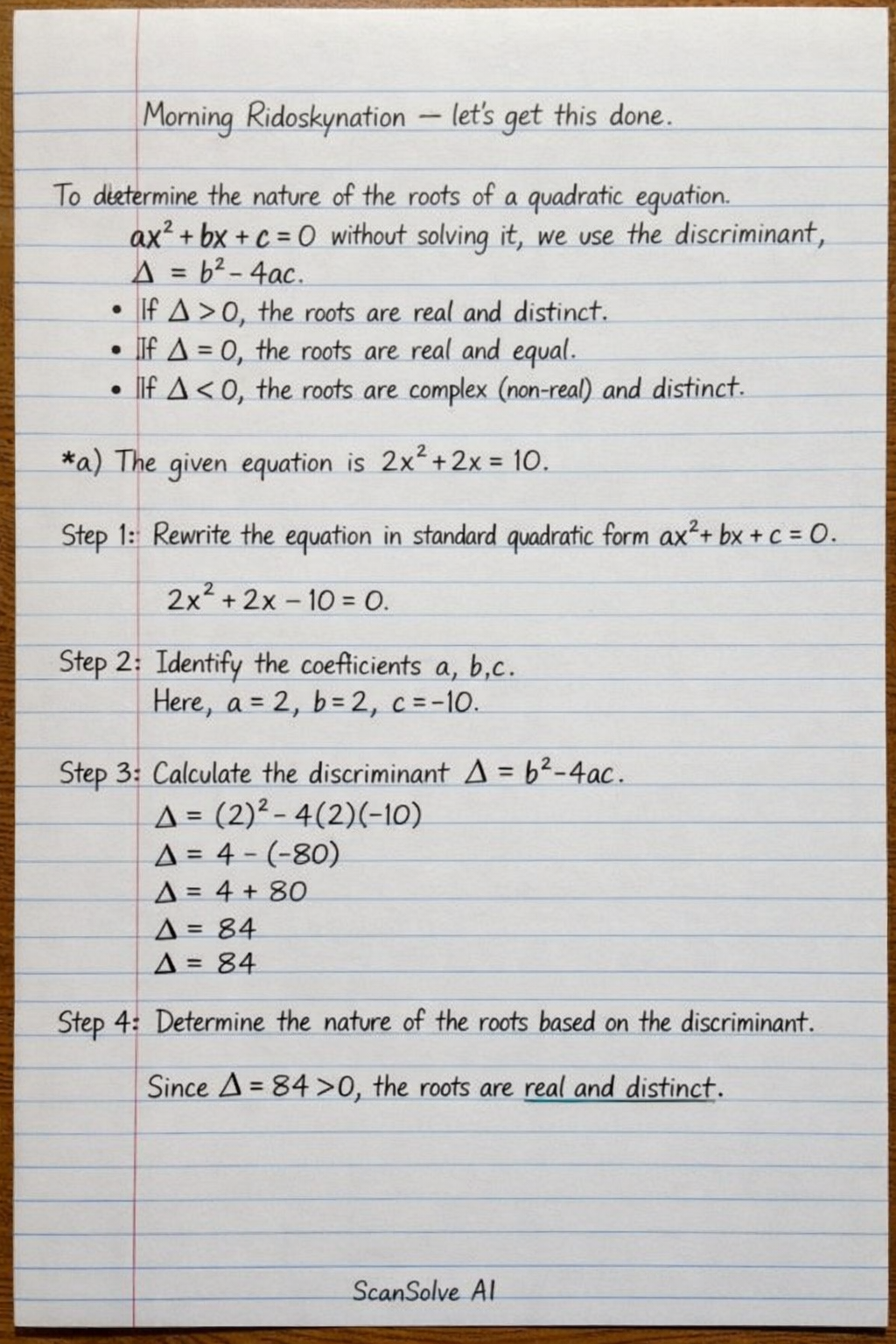
Handwritten Step-by-Step Solution
Get this as a handwritten image on WhatsApp — like a tutor wrote it for you.
Try on WhatsApp