
We read your photo as:
Define and provide examples for the following types of sets: finite, infinite, null, unit, equivalent, equal, element of a set, and cardinality of a set.
ScanSolve AI Answer
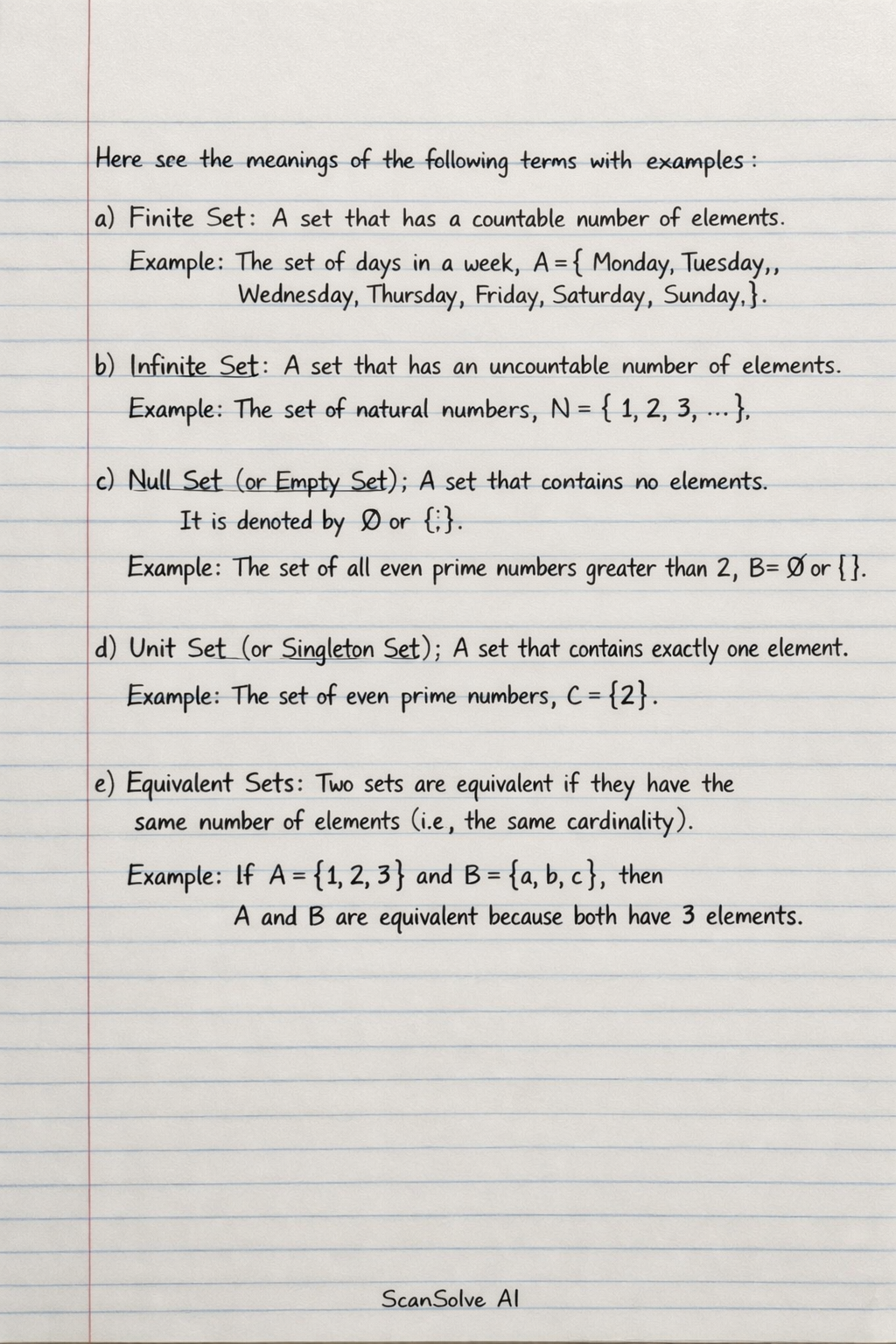
Here are the meanings of the following terms with examples:
*a) Finite Set: A set that has a countable number of elements.
Example: The set of days in a week, .
*b) Infinite Set: A set that has an uncountable number of elements.
Example: The set of natural numbers, .
*c) Null Set (or Empty Set): A set that contains no elements. It is denoted by or .
Example: The set of all even prime numbers greater than 2, .
*d) Unit Set (or Singleton Set): A set that contains exactly one element.
Example: The set of even prime numbers, .
*e) Equivalent Sets: Two sets are equivalent if they have the same number of elements (i.e., the same cardinality).
Example: If and , then and are equivalent because both have 3 elements.
*f) Equal Sets: Two sets are equal if they contain exactly the same elements. The order of elements does not matter.
Example: If and , then .
*g) Element of a Set: An individual member or object belonging to a set.
Example: In the set , the number 1 is an element of set , written as .
*h) Cardinality of a Set: The number of distinct elements in a set. It is denoted by for a set .
Example: If , then the cardinality of is .
*i) Complement of a Set: Given a universal set and a set , the complement of (denoted or ) is the set of all elements in that are not in .
Example: If and , then .
*j) Intersection of a Set: The intersection of two sets and (denoted ) is the set containing all elements that are common to both and .
Example: If and , then .
Still stuck on this one?
Ask a follow-up, and the answer starts from this question.
More Mathematics Questions
Handwritten Step-by-Step Solution
Get this as a handwritten image on WhatsApp — like a tutor wrote it for you.
Try on WhatsApp