
We read your photo as:
Calculate the number of girls next year and advise the head teacher on saving funds for a new dormitory.
ScanSolve AI Answer
Step-by-step solution
6 stepsHere are the solutions for Item 5:
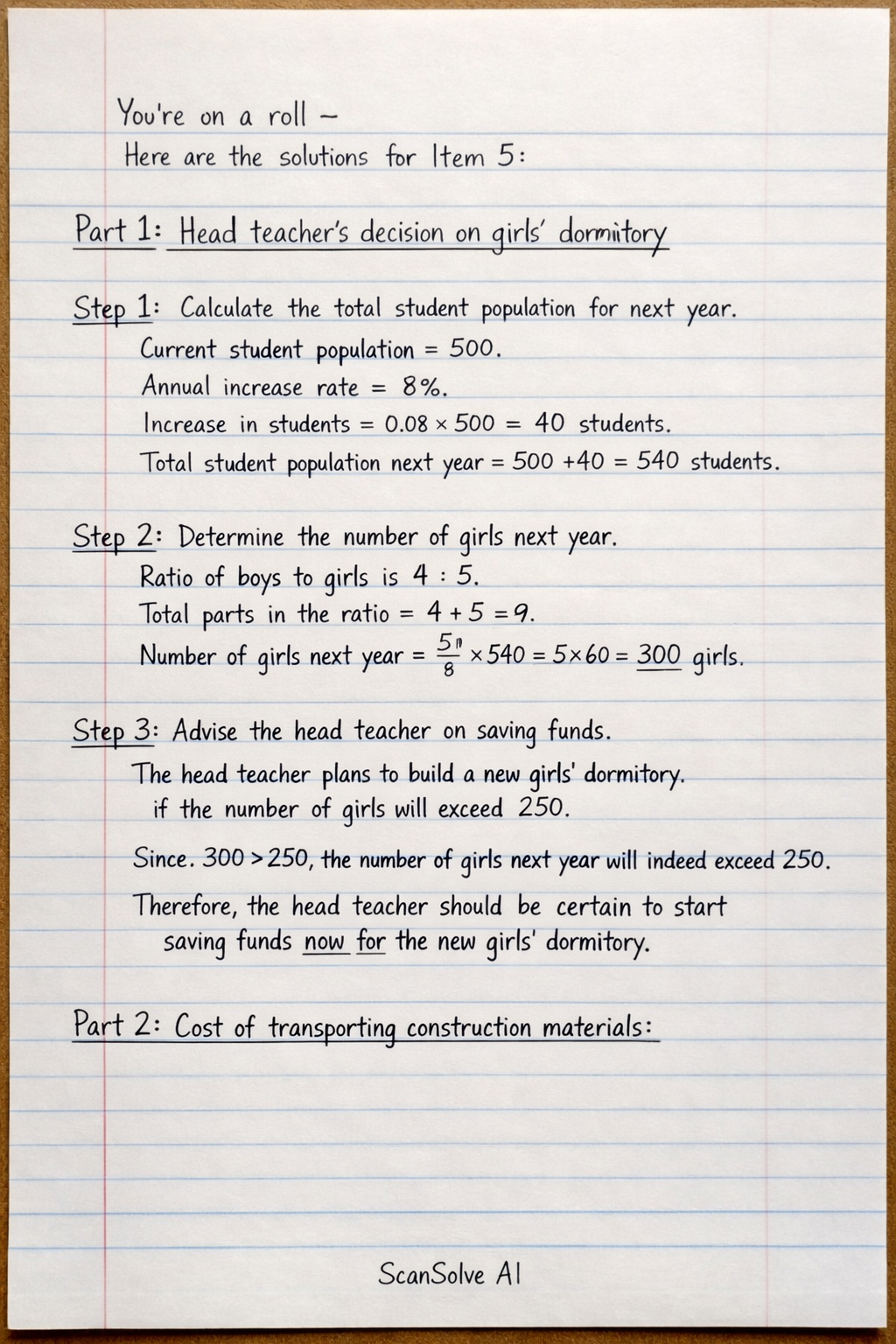
Part 1· 3 steps
Head teacher's decision on girls' dormitory
Calculate the total student population for next year.
Current student population = 500.
Annual increase rate = .
Increase in students = students.
Total student population next year = students.Determine the number of girls next year.
The ratio of boys to girls is .
Total parts in the ratio = .
Number of girls next year = girls.Advise the head teacher on saving funds.
The head teacher plans to build a new girls' dormitory if the number of girls will exceed 250.
Since , the number of girls next year will indeed exceed 250.
Therefore, the head teacher should be certain to start saving funds now for the new girls' dormitory.
Part 2· 3 steps
Cost of transporting construction materials
Find the greatest common divisor (GCD) of the quantities of materials.
The quantities of materials are: 360 bags of cement, of binding wire, and 300 steel rods.
To ensure each trip carries equal quantities of each item with no remainder, the number of trips must be a common divisor of these quantities. To minimize the number of trips (and thus the cost), we find the Greatest Common Divisor (GCD).
Prime factorization of the quantities:The GCD is found by taking the lowest power of each common prime factor:
Determine the number of trips required.
The number of trips required is equal to the GCD of the quantities.
Number of trips = 60.Calculate the total cost of transportation.
Cost per trip = Shs 55,000.
Total cost of transportation = Number of trips Cost per trip
Total cost = .
The
Still stuck on this one?
Ask a follow-up, and the answer starts from this question.
More Mathematics Questions
Handwritten Step-by-Step Solution
Get this as a handwritten image on WhatsApp — like a tutor wrote it for you.
Try on WhatsApp