
We read your photo as:
Which of the following numbers are not perfect squares? (i) 2032 (ii) 2048 (iii) 1027 (iv) 1089
ScanSolve AI Answer
Step-by-step solution
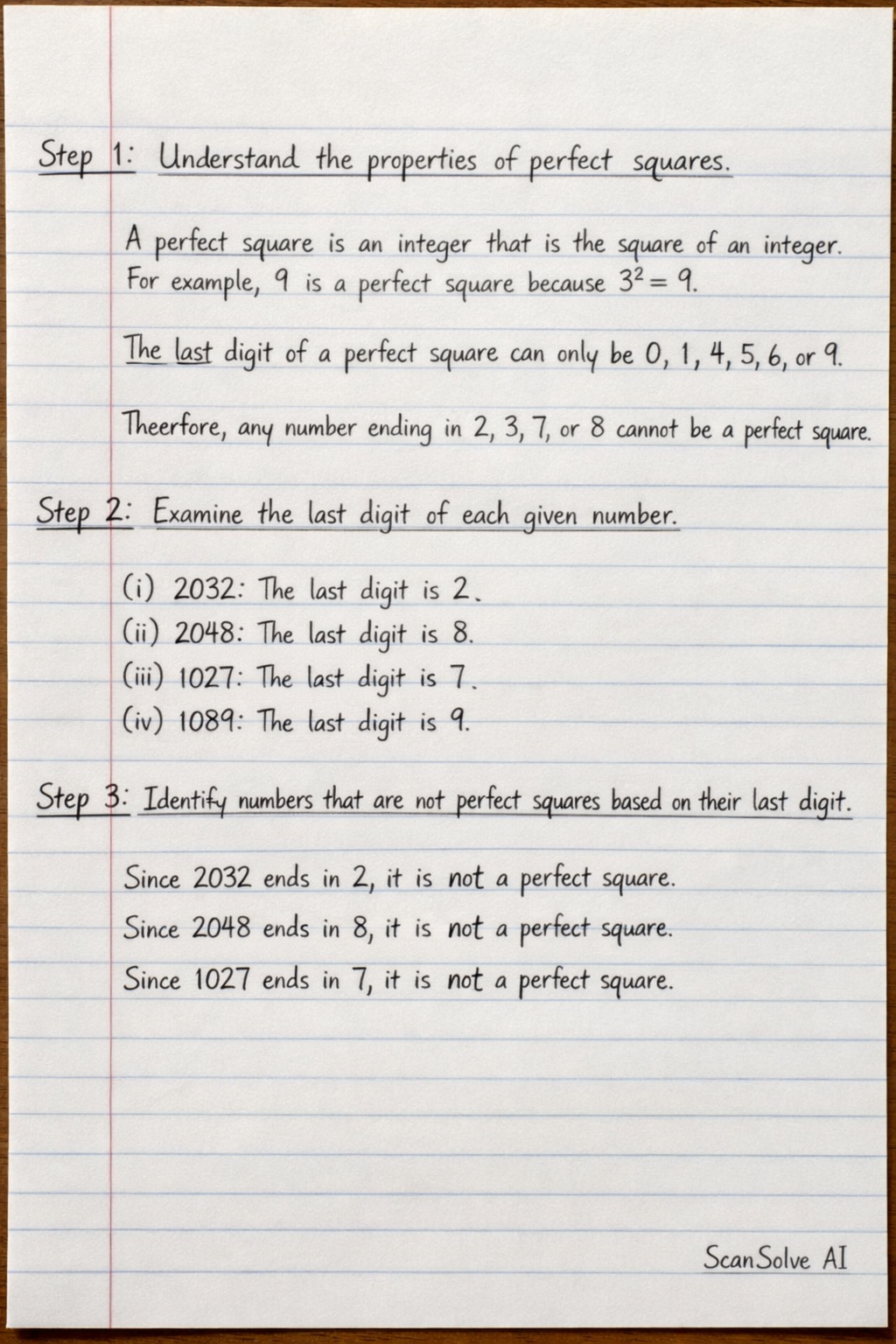
3 stepsStep 1: Understand the properties of perfect squares.
A perfect square is an integer that is the square of an integer. For example, 9 is a perfect square because .
The last digit of a perfect square can only be 0, 1, 4, 5, 6, or 9.
Therefore, any number ending in 2, 3, 7, or 8 cannot be a perfect square.
Step 2: Examine the last digit of each given number.
Part i
2032: The last digit is 2.
Part ii
2048: The last digit is 8.
Part iii
1027: The last digit is 7.
Part iv· 3 steps
1089: The last digit is 9.
Identify numbers that are not perfect squares based on their last digit.
- Since 2032 ends in 2, it is not a perfect square.
- Since 2048 ends in 8, it is not a perfect square.
- Since 1027 ends in 7, it is not a perfect square.
Verify numbers that could be perfect squares.
- 1089 ends in 9, so it could be a perfect square. To check, we can find its square root. We know that and . Since 1089 ends in 9, its square root must end in 3 or 7. Let's try : Thus, 1089 is a perfect square.
Conclude which numbers are not perfect squares.
Based on the analysis, the numbers that are not perfect squares are 2032, 2048, and 1027.
The numbers that are not perfect squares are:
- (i) 2032
- (ii) 2048
- (iii) 1027
Still stuck on this one?
Ask a follow-up, and the answer starts from this question.
More Mathematics Questions
Handwritten Step-by-Step Solution
Get this as a handwritten image on WhatsApp — like a tutor wrote it for you.
Try on WhatsApp