
We read your photo as:
Which of the following represents the union of set A and B? What are the first seven terms of the sequence defined by U1 = 0, U2 = 2, and Ur = Ur−1 − U_r-2? For the equation 3y2 - 2y extsqrt(6) + 2 =
ScanSolve AI Answer
Answer
Step-by-step solution
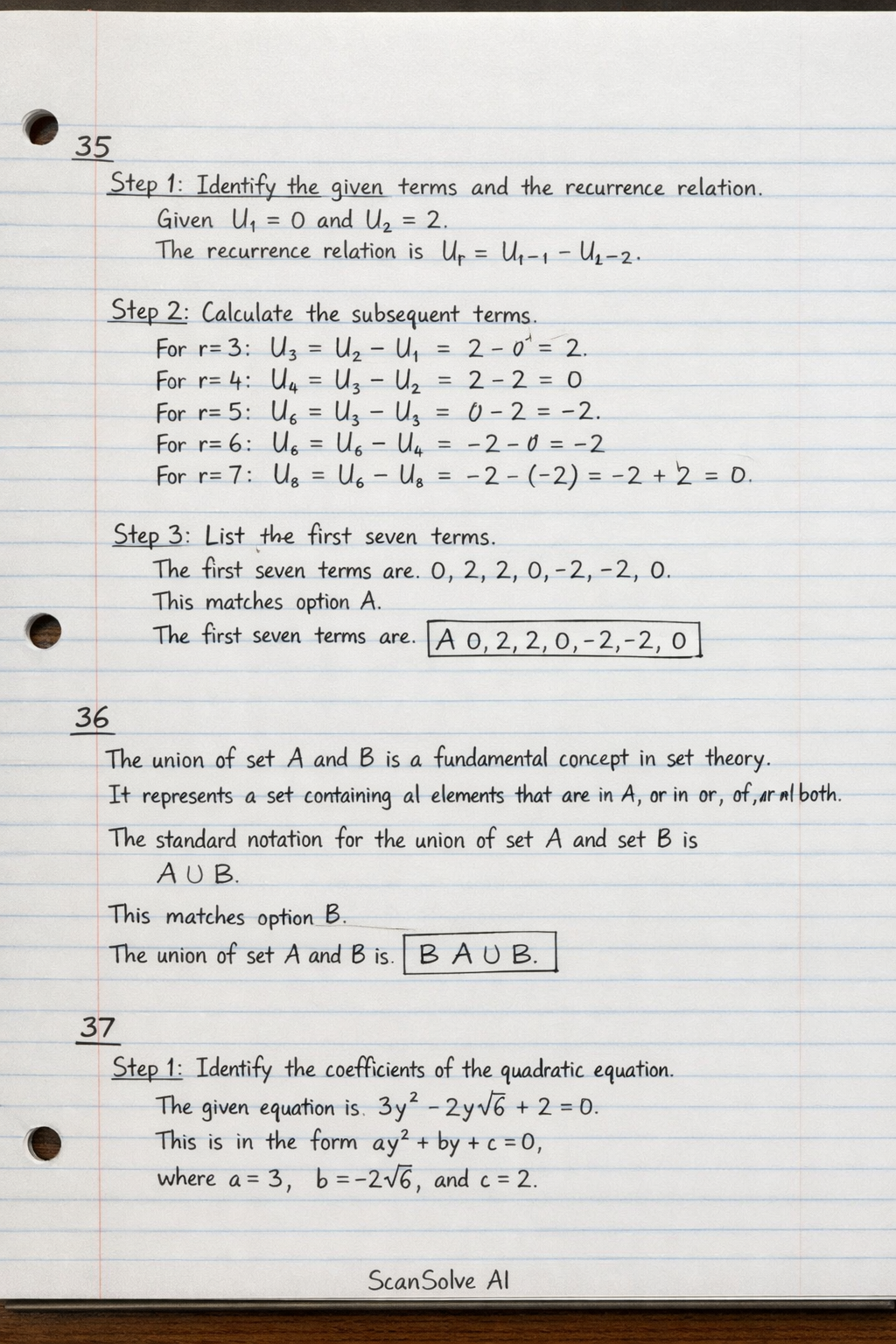
6 steps35
Identify the given terms and the recurrence relation.
Given and .
The recurrence relation is .Calculate the subsequent terms.
For :
For :
For :
For :
For :List the first seven terms.
The first seven terms are .
This matches option A.The first seven terms are .
36
The union of set A and B is a fundamental concept in set theory. It represents a set containing all elements that are in A, or in B, or in both.The standard notation for the union of set A and set B is .
This matches option B.The union of set A and B is .
37
Identify the coefficients of the quadratic equation.
The given equation is .
This is in the form , where , , and .Calculate the discriminant .
The discriminant is given by the formula .
Determine the nature of the roots based on the discriminant.
- If , the roots are real and unequal.
- If , the roots are real and equal.
- If , the roots are complex (non-real).
Since , the roots of the equation are real and equal.
This matches option A.The nature of roots of the equation are .
Try one yourself
A new problem that tests the same skill.
Still stuck on this one?
Ask a follow-up, and the answer starts from this question.
More Mathematics Questions
Handwritten Step-by-Step Solution
Get this as a handwritten image on WhatsApp — like a tutor wrote it for you.
Try on WhatsApp