
We read your photo as:
Which of the following statements is NOT one of Peano's axioms?
ScanSolve AI Answer
Answer
Step-by-step solution
3 stepsAnalyze Question 20.
The question asks which of the given statements is not one of Peano's axioms.
- Statement I: 0 is a natural number. This is the first axiom in the modern formulation of Peano axioms. It states that 0 is an element of the set of natural numbers. Thus, this is one of Peano's axioms.
- Statement II: The set of natural numbers is finite. This statement is incorrect. The Peano axioms define an infinite set of natural numbers. Therefore, this is not one of Peano's axioms; in fact, it contradicts the nature of the set defined by the axioms.
- Statement III: If a property holds for 0 and holds for the successor of a number whenever it holds for that number, then it holds for all natural numbers. This is the principle of mathematical induction, which is the fifth (and crucial) Peano axiom. Thus, this is one of Peano's axioms.
Since only statement II is not one of Peano's axioms, the correct answer should be "II only". As "II only" is not provided as an option among A, B, C, or D, the correct choice is E.
Analyze Question 21.
The question asks which statements are true about the set of integers . The set of integers is .
- Statement I: It is closed under addition and multiplication. If you take any two integers and add them, the result is always an integer (e.g., ). If you take any two integers and multiply them, the result is always an integer (e.g., ). Therefore, this statement is true.
- Statement II: It only contains positive numbers. This statement is false. The set of integers includes zero and negative numbers.
- Statement III: It excludes negative numbers. This statement is false. The set of integers explicitly includes negative numbers.
Only statement I is true. Since "I only" is not provided as an option among A, B, C, or D, the correct choice is E.
Analyze Question 22.
The question asks which statements are true if (meaning " divides ").
The definition of " divides " is that there exists an integer such that .- Statement I: for some integer . This is the direct definition of . Therefore, this statement is true.
- Statement II: is an integer. From the definition , if , then . Since is an integer, is an integer. If , then implies . In this case, is undefined. However, in the context of divisibility, it is generally assumed that . If , this statement is true.
- Statement III: for some real . If , then for some integer . Consider the case where and . For example, is true (since ). If and , then statement III becomes , which simplifies to . This is false. Therefore, statement III is not always true when .
Based on this analysis, only statements I and II are always true when (assuming for statement II, which is standard in divisibility).
The correct option is A.
Try one yourself
A new problem that tests the same skill.
Still stuck on this one?
Ask a follow-up, and the answer starts from this question.
More Mathematics Questions
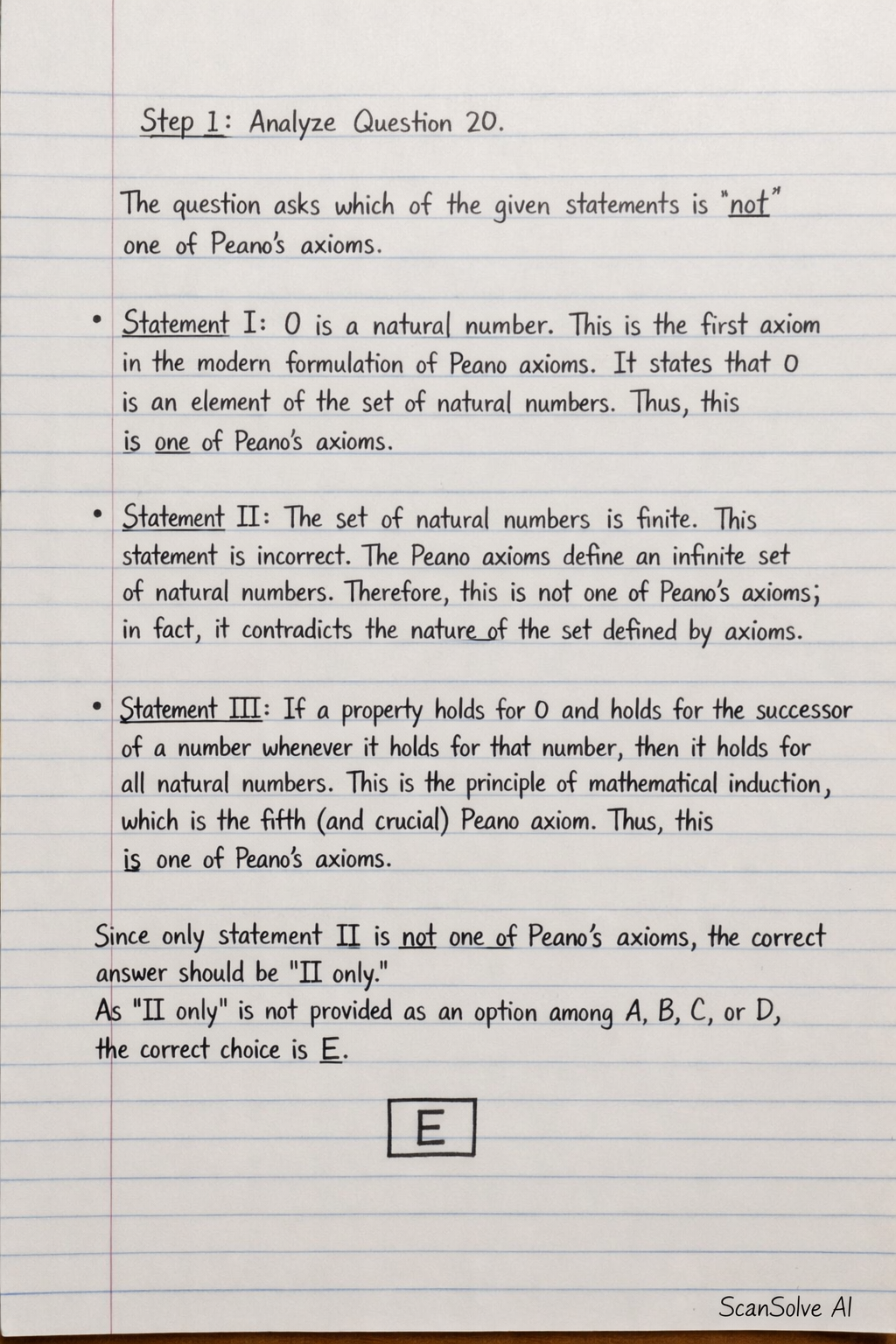
Handwritten Step-by-Step Solution
Get this as a handwritten image on WhatsApp — like a tutor wrote it for you.
Try on WhatsApp