P(3,2) Q(-1,5) and R(2,1) are vertices of a triangle. (i) Find the length of sides of the triangle. (ii) Use the dot product to find angles of the triangle.
|Mathematics
P(3,2) Q(-1,5) and R(2,1) are vertices of a triangle. (i) Find the length of sides of the triangle. (ii) Use the dot product to find angles of the triangle.
ScanSolve AI Answer
Answer
PQ=5,QR=5,RP=2≈1.414
Given the vertices of the triangle P(3,2), Q(−1,5), and R(2,1).
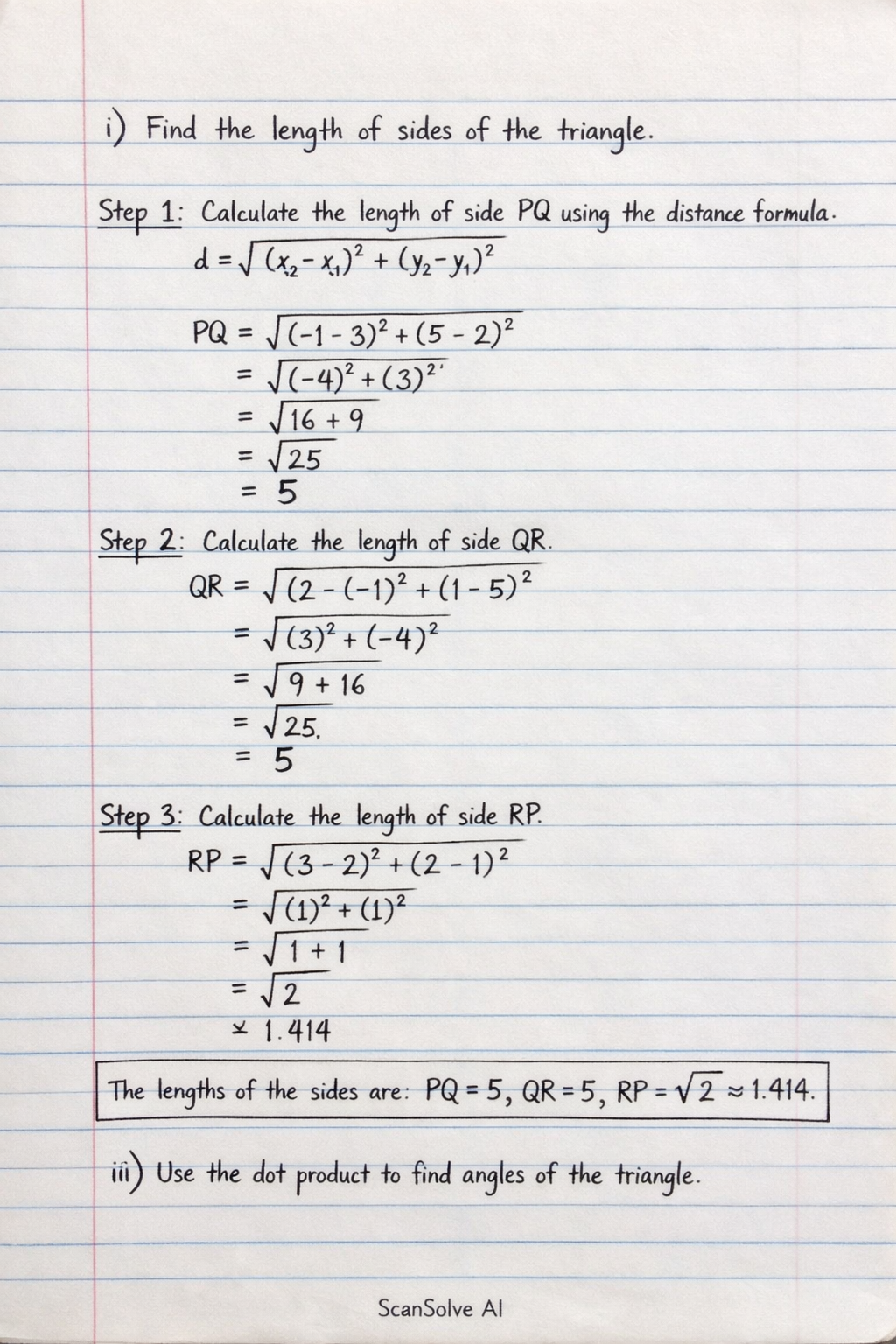
i) Find the length of sides of the triangle.
Step 1: Calculate the length of side PQ using the distance formula d=(x2−x1)2+(y2−y1)2.
PQ=(−1−3)2+(5−2)2=(−4)2+(3)2=16+9=25=5
Step 2: Calculate the length of side QR.
QR=(2−(−1))2+(1−5)2=(3)2+(−4)2=9+16=25=5
Step 3: Calculate the length of side RP.
RP=(3−2)2+(2−1)2=(1)2+(1)2=1+1=2≈1.414
The lengths of the sides are PQ=5,QR=5,RP=2≈1.414.
ii) Use the dot product to find angles of the triangle.
Step 4: Find the angle at P (angle QPR).
First, find the vectors PQ and PR.
PQ=Q−P=(−1−3,5−2)=(−4,3)PR=R−P=(2−3,1−2)=(−1,−1)
Now, calculate their dot product and magnitudes:
PQ⋅PR=(−4)(−1)+(3)(−1)=4−3=1∣PQ∣=5∣PR∣=(−1)2+(−1)2=1+1=2
Using the formula cosθ=∣A∣∣B∣A⋅B:
cosP=5⋅21=521P=arccos(521)≈81.87∘
Step 5: Find the angle at Q (angle PQR).
First, find the vectors QP and QR.
QP=P−Q=(3−(−1),2−5)=(4,−3)QR=R−Q=(2−(−1),1−5)=(3,−4)
Now, calculate their dot product and magnitudes:
QP⋅QR=(4)(3)+(−3)(−4)=12+12=24∣QP∣=42+(−3)2=16+9=25=5∣QR∣=32+(−4)2=9+16=25=5
Using the formula cosθ=∣A∣∣B∣A⋅B:
cosQ=5⋅524=2524Q=arccos(2524)≈16.26∘
Step 6: Find the angle at R (angle PRQ).
First, find the vectors RP and RQ.
RP=P−R=(3−2,2−1)=(1,1)RQ=Q−R=(−1−2,5−1)=(−3,4)
Now, calculate their dot product and magnitudes:
RP⋅RQ=(1)(−3)+(1)(4)=−3+4=1∣RP∣=12+12=2∣RQ∣=(−3)2+42=9+16=25=5
Using the formula cosθ=∣A∣∣B∣A⋅B:
cosR=2⋅51=521R=arccos(521)≈81.87∘
The angles of the triangle are P≈81.87∘,Q≈16.26∘,R≈81.87∘.
3 done, 2 left today. You're making progress.
Was this helpful?
Need help with your own homework?
Get instant step-by-step solutions to any question. Free to start.
Given the vertices of the triangle P(3,2), Q(-1,5), and R(2,1). i) Find the length of sides of the triangle.
P(3,2) Q(-1,5) and R(2,1) are vertices of a triangle. (i) Find the length of sides of the triangle. (ii) Use the dot product to find angles of the triangle.
This mathematics problem involves applying core mathematical principles and formulas. Below you will find a complete step-by-step solution with detailed explanations for each step, helping you understand not just the answer but the method behind it.
ScanSolve AI Answer
Given the vertices of the triangle P(3,2), Q(-1,5), and R(2,1). i) Find the length of sides of the triangle. Step 1: Calculate the length of side PQ using the distance formula d = sqrt((x_2-x_1)^2 + (y_2-y_1)^2). PQ = sqrt((-1-3)^2 + (5-2)^2) = sqrt((-4)^2 + (3)^2) = sqrt(16 + 9) = sqrt(25) = 5 Step 2: Calculate the length of side QR. QR = sqrt((2-(-1))^2 + (1-5)^2) = sqrt((3)^2 + (-4)^2) = sqrt(9 + 16) = sqrt(25) = 5 Step 3: Calculate the length of side RP. RP = sqrt((3-2)^2 + (2-1)^2) = sqrt((1)^2 + (1)^2) = sqrt(1 + 1) = sqrt(2) ≈ 1.414 The lengths of the sides are PQ=5, QR=5, RP=sqrt(2) ≈ 1.414. ii) Use the dot product to find angles of the triangle. Step 4: Find the angle at P (angle QPR). First, find the vectors PQ and PR. PQ = Q - P = (-1-3, 5-2) = (-4, 3) PR = R - P = (2-3, 1-2) = (-1, -1) Now, calculate their dot product and magnitudes: PQ · PR = (-4)(-1) + (3)(-1) = 4 - 3 = 1 |PQ| = 5 |PR| = sqrt((-1)^2 + (-1)^2) = sqrt(1+1) = sqrt(2) Using the formula = A · B|A| |B|: P = (1)/(5 · sqrt(2)) = (1)/(5sqrt(2)) P = ((1)/(5sqrt(2))) ≈ 81.87^ Step 5: Find the angle at Q (angle PQR). First, find the vectors QP and QR. QP = P - Q = (3-(-1), 2-5) = (4, -3) QR = R - Q = (2-(-1), 1-5) = (3, -4) Now, calculate their dot product and magnitudes: QP · QR = (4)(3) + (-3)(-4) = 12 + 12 = 24 |QP| = sqrt(4^2 + (-3)^2) = sqrt(16+9) = sqrt(25) = 5 |QR| = sqrt(3^2 + (-4)^2) = sqrt(9+16) = sqrt(25) = 5 Using the formula = A · B|A| |B|: Q = (24)/(5 · 5) = (24)/(25) Q = ((24)/(25)) ≈ 16.26^ Step 6: Find the angle at R (angle PRQ). First, find the vectors RP and RQ. RP = P - R = (3-2, 2-1) = (1, 1) RQ = Q - R = (-1-2, 5-1) = (-3, 4) Now, calculate their dot product and magnitudes: RP · RQ = (1)(-3) + (1)(4) = -3 + 4 = 1 |RP| = sqrt(1^2 + 1^2) = sqrt(2) |RQ| = sqrt((-3)^2 + 4^2) = sqrt(9+16) = sqrt(25) = 5 Using the formula = A · B|A| |B|: R = (1)/(sqrt(2) · 5) = (1)/(5sqrt(2)) R = ((1)/(5sqrt(2))) ≈ 81.87^ The angles of the triangle are P ≈ 81.87^, Q ≈ 16.26^, R ≈ 81.87^. 3 done, 2 left today. You're making progress.