
We read your photo as:
Find the lettered angles in each of the following.
ScanSolve AI Answer
Step-by-step solution
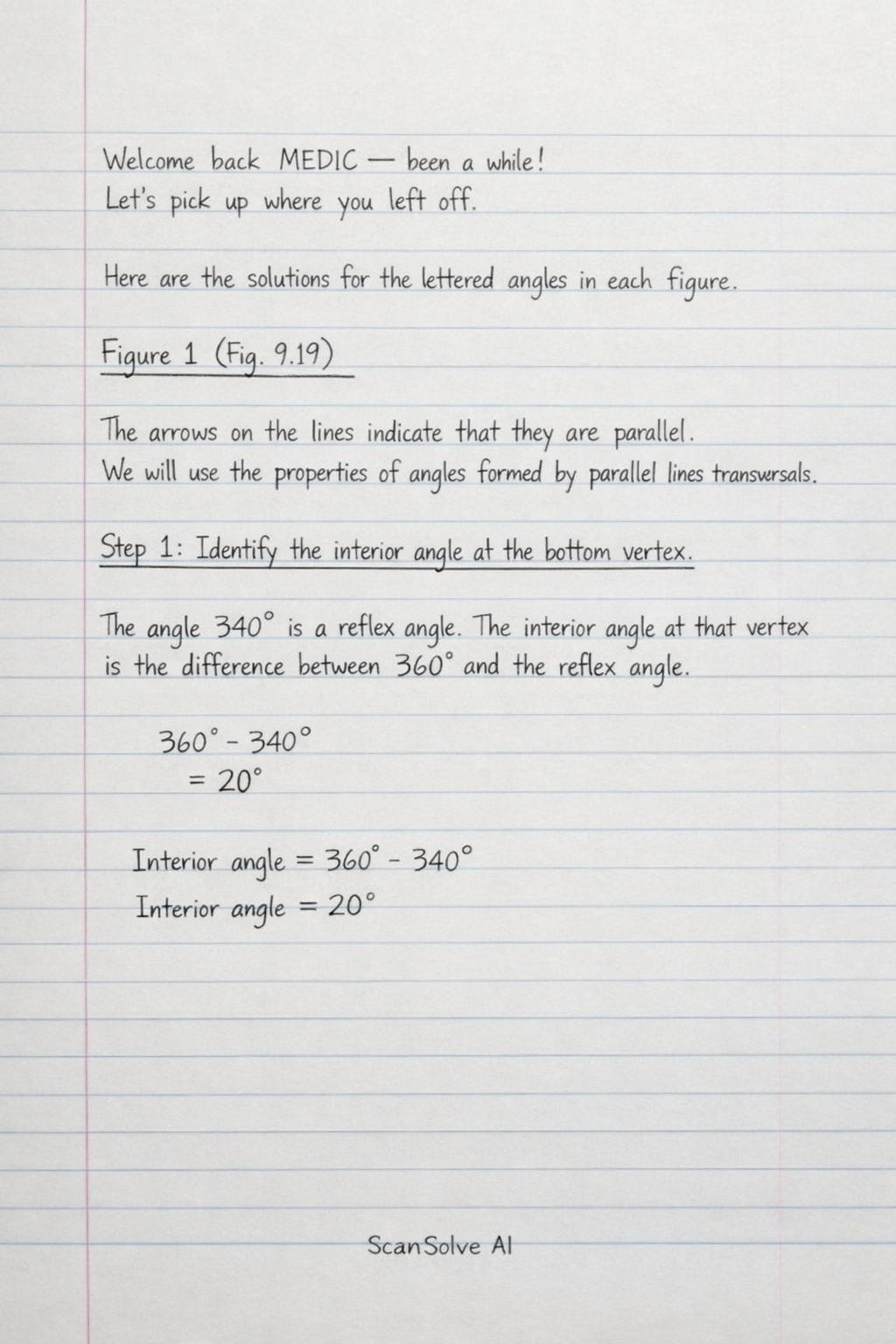
8 stepsHere are the solutions for the lettered angles in each figure.
Figure 1 (Fig. 9.19)
The arrows on the lines indicate that they are parallel. We will use the properties of angles formed by parallel lines and transversals.
Identify the interior angle at the bottom vertex.
The angle is a reflex angle. The interior angle at that vertex is the difference between and the reflex angle.
Apply the "M-rule" (also known as the "zigzag rule").
Draw an auxiliary line through the vertex where angles and are located, parallel to the two main parallel lines. This line divides the angle at that vertex into two parts.
The "M-rule" states that the sum of angles pointing in one direction (e.g., left) equals the sum of angles pointing in the opposite direction (e.g., right).
In this figure, the angles and point to the left, and the angles and (the interior angle at the bottom) point to the right.
Therefore, we have:This equation has two unknowns. Let's re-examine the diagram for a clearer interpretation of and .
Upon closer inspection, the angle is shown adjacent to at the same vertex, and both are inside the "V" shape. This is an unusual way to label. The most common interpretation for such a diagram is that the angle formed by the two transversals at the middle vertex is the sum of and . So, the angle at the middle vertex is .
Let's re-apply the "M-rule" with this interpretation:
Angles pointing left: and the interior angle at the bottom ().
Angles pointing right: The angle at the middle vertex, which is .This still leaves two unknowns.
Let's consider another common interpretation for such diagrams: the is an angle between the top transversal and the middle transversal, and is an angle between the middle transversal and the bottom transversal. In this case, the and are separate angles at different "bends" of the zigzag. However, the diagram clearly shows and at the same vertex.
Given the way and are drawn at the same vertex, with having a circle around it (often indicating the angle itself) and also marked inside, it implies that the angle is . This is the only way to get a unique solution for .
Assume based on the diagram's labeling at the middle vertex.
If , then using the "M-rule" where angles pointing left ( and ) equal angles pointing right ():
Substitute :
Let's verify this with the auxiliary line method.
Draw an auxiliary line through the vertex of parallel to the main parallel lines. This line divides into two parts, (top part) and (bottom part).
is alternate interior to . So .
is alternate interior to the angle at the bottom. So .
Then .
This is consistent with our assumption that .Therefore, for Fig. 9.19:
Figure 2 (Fig. 9.20)
The arrows on the lines indicate that they are parallel.
Identify the angles pointing left and right.
Draw an auxiliary line through the vertex where angles and are located, parallel to the two main parallel lines. This line divides the angle at that vertex into two parts.
The "M-rule" states that the sum of angles pointing in one direction (e.g., left) equals the sum of angles pointing in the opposite direction (e.g., right).
In this figure, the angles and point to the left.
The angle at the middle vertex, which is , points to the right.
Therefore, we have:Determine the individual values of and .
The circle around indicates that is the angle inside the "V" shape at that vertex. The angle is shown adjacent to , also inside the "V" shape. This implies that the total angle at that vertex is .
However, the diagram also shows as a separate angle. In such diagrams, if two letters are at the same vertex, they usually represent parts of the total angle.
Let's assume and are the two parts of the angle at the middle vertex.
The angle is alternate interior to the angle.
The angle is alternate interior to the angle.Calculate .
Draw an auxiliary line through the vertex of and , parallel to the top and bottom parallel lines.
The angle and the angle are alternate interior angles.Calculate .
The angle and the angle are alternate interior angles.
Verify the sum.
This matches the sum derived from the "M-rule" in Step 1.
Therefore, for Fig. 9.20:
Final Answers:
For Fig. 9.19:For Fig. 9.20:
Still stuck on this one?
Ask a follow-up, and the answer starts from this question.
More Mathematics Questions
Handwritten Step-by-Step Solution
Get this as a handwritten image on WhatsApp — like a tutor wrote it for you.
Try on WhatsApp