

This mathematics problem involves applying core mathematical principles and formulas. Below you will find a complete step-by-step solution with detailed explanations for each step, helping you understand not just the answer but the method behind it.
ScanSolve AI Answer
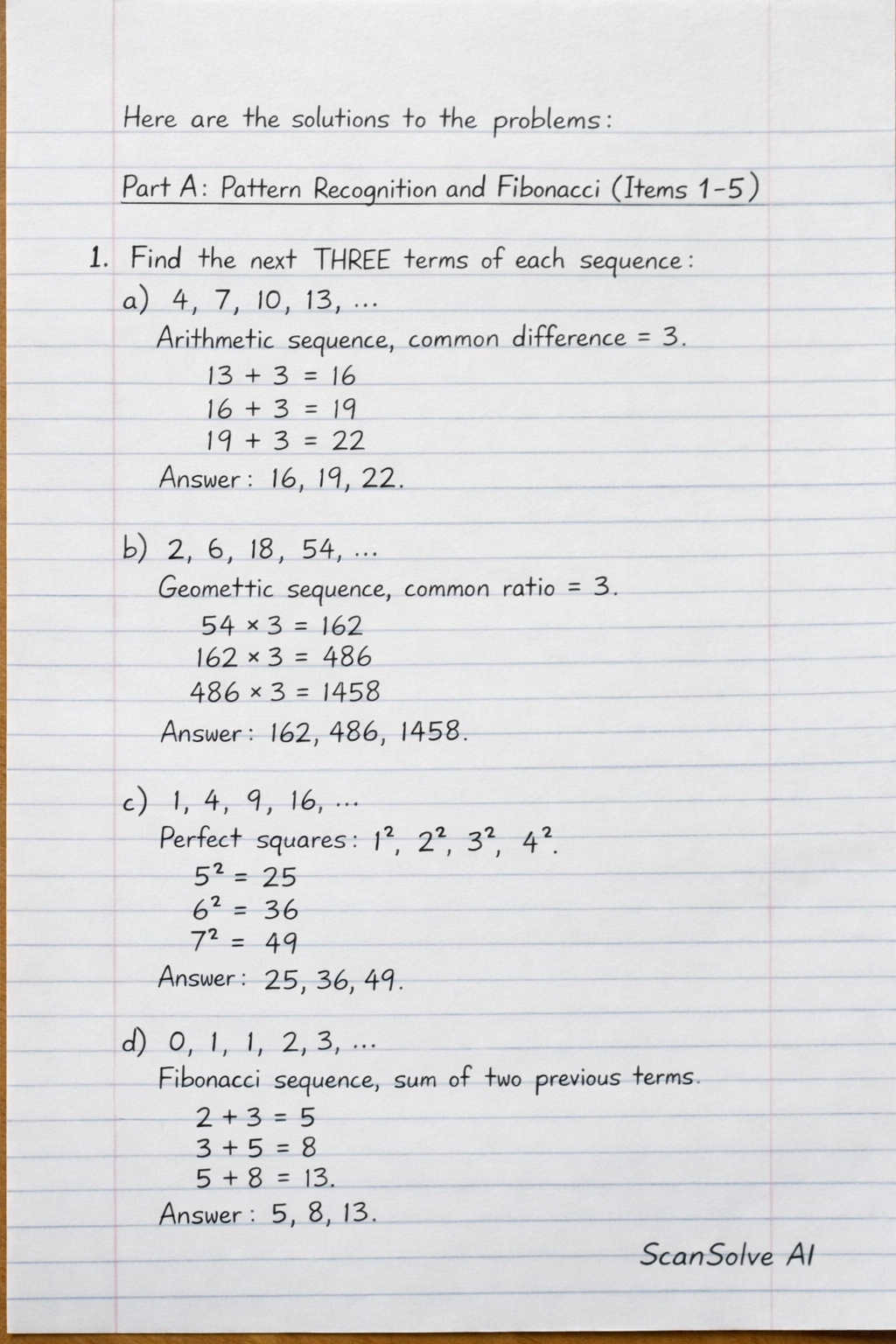
Here are the solutions to the problems: Part A: Pattern Recognition and Fibonacci (Items 1-5) 1. Find the next THREE terms of each sequence: a) 4, 7, 10, 13, ... This is an arithmetic sequence with a common difference of 3. Next terms: 13+3=16, 16+3=19, 19+3=22. Answer: 16, 19, 22 b) 2, 6, 18, 54, ... This is a geometric sequence with a common ratio of 3. Next terms: 54 × 3 = 162, 162 × 3 = 486, 486 × 3 = 1458. Answer: 162, 486, 1458 c) 1, 4, 9, 16, ... These are perfect squares (1^2, 2^2, 3^2, 4^2). Next terms: 5^2=25, 6^2=36, 7^2=49. Answer: 25, 36, 49 d) 0, 1, 1, 2, 3, ... This is the Fibonacci sequence, where each term is the sum of the two preceding ones. Next terms: 2+3=5, 3+5=8, 5+8=13. Answer: 5, 8, 13 2. The 10th Fibonacci number is 34 and the 11th is 55. What is the ratio of the 11th to the 10th? How close is this to the Golden Ratio ( ≈ 1.618)? Step 1: Calculate the ratio of the 11th Fibonacci number to the 10th. F_11F_10 = (55)/(34) Step 2: Convert the ratio to a decimal. (55)/(34) ≈ 1.617647 Step 3: Find the difference between this ratio and the Golden Ratio ( ≈ 1.618). |1.617647 - 1.618| = |-0.000353| ≈ 0.0004 Answer: The ratio is (55)/(34) ≈ 1.6176. This is approximately 0.0004 away from the Golden Ratio. 3. A Philippine pineapple (pinya) has spirals going in two directions. Typically, one direction has 8 spirals and the other has 13. Are these Fibonacci numbers? Explain why this makes biological sense in terms of efficient packing. Yes, 8 and 13 are consecutive Fibonacci numbers* (F_6=8, F_7=13). This arrangement makes biological sense because Fibonacci numbers and the related Golden Angle* (approximately 137.5^) often appear in nature to optimize packing efficiency. This allows each fruitlet or seed to have maximum exposure to sunlight (if it were a plant) or space, minimizing wasted area and ensuring that new elements do not directly overlap older ones. This pattern leads to the most compact and stable arrangement. 4. Draw or describe a geometric pattern using only triangles and squares. Identify: (a) what transformation (flip, slide, or turn/rotation) is used to create the pattern, and (b) whether the pattern has any line of symmetry. Description: Imagine a row of squares. On top of each square, place an equilateral triangle, aligning the base of the triangle with the top side of the square. Repeat this entire row vertically to form a grid. a) The primary transformation used to create this pattern is translation* (slide). A single unit (a square with a triangle on top) is slid horizontally and then vertically to fill the plane. b) Yes, the pattern has lines of symmetry*. There are vertical lines of symmetry passing through the center of each square and triangle, and horizontal lines of symmetry midway between the rows of squares and triangles. 5. A fractal is a shape that is self-similar — it looks the same at every scale. Describe one example of a fractal pattern you might observe in a Filipino environment (e.g., in a plant, coastline, or river tributary). Explain why it can be called a fractal. Example: The coastline of the Philippines*, particularly the intricate shapes of its many islands (e.g., Palawan, Mindanao). Explanation: A coastline is a classic example of a fractal because it exhibits self-similarity*. If you zoom in on a section of the coastline, the smaller bays, inlets, and peninsulas often resemble the larger-scale features of the entire coastline. This irregular, repeating pattern of details at different magnifications is the defining characteristic of a fractal. --- Part B: Mathematical Language (Items 6-15) 6. Classify each of the following as an Expression (E) or a Sentence (S). For sentences, state whether it is TRUE, FALSE, or SOMETIMES TRUE: a) 5+3=8 S - TRUE* b) 2x-7 E c) x^2=25 S - SOMETIMES TRUE* (True if x=5 or x=-5, false otherwise) d) 15+3=6 S - FALSE* (15+3=18) e) The set \2, 4, 6\ \1, 2, 3\ = \2\ S - TRUE* f) 4(x+2)-3 E 7. Let A = vowels in the word MATHEMATICS and B = vowels in the word PHILIPPINES. a) List the elements of set A and set B. A = \A, E, I\ B = \E, I\ b) Find A B (the union of A and B). A B = \A, E, I\ \E, I\ = \A, E, I\ c) Find A B (the intersection of A and B). $A B = \A, E