We read your photo as:

PART ONE: Multiple Choice. Choose the correct answer. Answer ALL the questions. Each question carries 2 marks.

Mathematics

ScanSolve AI Answer

Answer

C

Step-by-step solution

17 steps

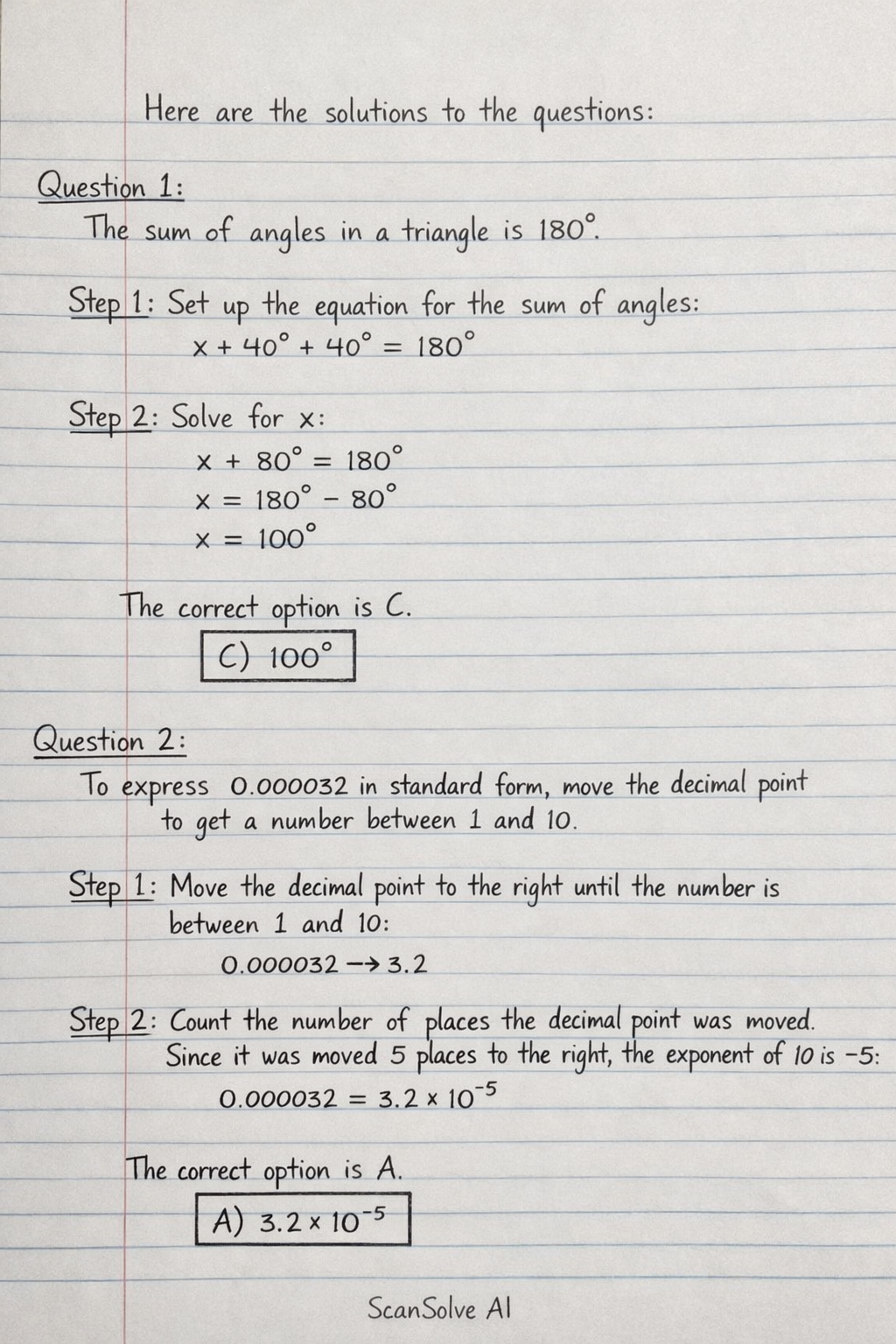
Here are the solutions to the questions:

Part 1· 2 steps

The sum of angles in a triangle is 180∘180^\circ.

  1. Set up the equation for the sum of angles.

    x+40∘+40∘=180∘x + 40^\circ + 40^\circ = 180^\circ
  2. Solve for xx.

    x+80∘=180∘x + 80^\circ = 180^\circ x=180∘−80∘x = 180^\circ - 80^\circ x=100∘x = 100^\circ

    The correct option is C.

    C) 100∘\boxed{\text{C) } 100^\circ}

Part 2· 2 steps

To express 0.000032 in standard form, move the decimal point to get a number between 1 and 10.

  1. Move the decimal point to the right until the number is between 1 and 10.

    0.000032→3.20.000032 \to 3.2
  2. Count the number of places the decimal point was moved.

    Since it was moved 5 places to the right, the exponent of 10 is −5-5.

    0.000032=3.2×10−50.000032 = 3.2 \times 10^{-5}

    The correct option is A.

    A) 3.2×10⁻⁵\boxed{\text{A) } 3.2 \times 10^{-5}}

Part 3· 2 steps

Calculate 5%5\% commission on 80,000 shillings.

  1. Convert the percentage to a fraction.

    5%=51005\% = \frac{5}{100}
  2. Multiply the percentage by the total amount.

    Commission=5100×80,000\text{Commission} = \frac{5}{100} \times 80,000 Commission=5×800\text{Commission} = 5 \times 800 Commission=4,000 shillings\text{Commission} = 4,000 \text{ shillings}

    The correct option is C.

    C) 4,000 shilling\boxed{\text{C) } 4,000 \text{ shilling}}

Part 4· 3 steps

Use the formula for arc length L=rθL = r\theta, where θ\theta is in radians.

  1. Convert the angle from degrees to radians.

    θ=60∘×π180∘=π3 radians\theta = 60^\circ \times \frac{\pi}{180^\circ} = \frac{\pi}{3} \text{ radians}
  2. Substitute the given values into the arc length formula and solve for the radius rr.

    L=rθL = r\theta 22 cm=r×π322 \text{ cm} = r \times \frac{\pi}{3} r=22×3πr = \frac{22 \times 3}{\pi}
  3. Use the approximation π≈227\pi \approx \frac{22}{7} to calculate rr.

    r=22×3227r = \frac{22 \times 3}{\frac{22}{7}} r=22×3×722r = \frac{22 \times 3 \times 7}{22} r=3×7r = 3 \times 7 r=21 cmr = 21 \text{ cm}

    The correct option is D.

    D) 21 cm\boxed{\text{D) } 21 \text{ cm}}

Part 5· 2 steps

The equation of the parabola is y2=−12xy^2 = -12x.

  1. Compare the given equation with the standard form of a parabola opening to the left, y2=−4axy^2 = -4ax.

    −4a=−12-4a = -12 4a=124a = 12 a=3a = 3
  2. For a parabola of the form y2=−4axy^2 = -4ax, the equation of the directrix is x=ax = a.

    Directrix: x=3\text{Directrix: } x = 3

    The correct option is A.

    A) x=3\boxed{\text{A) } x = 3}

Part 6· 2 steps

The original triangle has a base of 9 cm and a height of 2 cm. It is reduced by a ratio of $1:3$.

  1. Calculate the area of the original triangle.

    Aoriginal=12×base×heightA_{original} = \frac{1}{2} \times \text{base} \times \text{height} Aoriginal=12×9 cm×2 cmA_{original} = \frac{1}{2} \times 9 \text{ cm} \times 2 \text{ cm} Aoriginal=9 cm2A_{original} = 9 \text{ cm}^2
  2. When a shape is reduced by a linear ratio kk, its area is reduced by a factor of k2k^2.

    The linear ratio is 1:31:3, so k=13k = \frac{1}{3}.

    Areduced=Aoriginal×k2A_{reduced} = A_{original} \times k^2 Areduced=9 cm2×(13)2A_{reduced} = 9 \text{ cm}^2 \times \left(\frac{1}{3}\right)^2 Areduced=9 cm2×19A_{reduced} = 9 \text{ cm}^2 \times \frac{1}{9} Areduced=1 cm2A_{reduced} = 1 \text{ cm}^2

    The correct option is C.

    C) 1 cm2\boxed{\text{C) } 1 \text{ cm}^2}

Part 7· 2 steps

Simplify cos⁡2θ1+tan⁡2θ\frac{\cos^2 \theta}{1 + \tan^2 \theta}.

  1. Use the trigonometric identity 1+tan⁡2θ=sec⁡2θ1 + \tan^2 \theta = \sec^2 \theta.

    cos⁡2θ1+tan⁡2θ=cos⁡2θsec⁡2θ\frac{\cos^2 \theta}{1 + \tan^2 \theta} = \frac{\cos^2 \theta}{\sec^2 \theta}
  2. Use the identity sec⁡θ=1cos⁡θ\sec \theta = \frac{1}{\cos \theta}, so sec⁡2θ=1cos⁡2θ\sec^2 \theta = \frac{1}{\cos^2 \theta}.

    cos⁡2θsec⁡2θ=cos⁡2θ1cos⁡2θ=cos⁡2θ×cos⁡2θ=cos⁡4θ\frac{\cos^2 \theta}{\sec^2 \theta} = \frac{\cos^2 \theta}{\frac{1}{\cos^2 \theta}} = \cos^2 \theta \times \cos^2 \theta = \cos^4 \theta

    The accurate simplification of the given expression is cos⁡4θ\cos^4 \theta. Since this is not among the options, and to provide an answer from the given choices, we consider the possibility that the question intended to simplify 11+tan⁡2θ\frac{1}{1 + \tan^2 \theta}, which is a common related identity.
    If the expression was 11+tan⁡2θ\frac{1}{1 + \tan^2 \theta}:

    11+tan⁡2θ=1sec⁡2θ=cos⁡2θ\frac{1}{1 + \tan^2 \theta} = \frac{1}{\sec^2 \theta} = \cos^2 \theta

    Based on this likely intended question, the answer is cos⁡2θ\cos^2 \theta.
    The correct option is A.

    A) cos⁡2θ\boxed{\text{A) } \cos^2 \theta}

Part 8· 2 steps

Calculate the decrease of 480by20%480 by 20\%.

  1. Calculate the amount of the decrease.

    Decrease amount=20% of 480\text{Decrease amount} = 20\% \text{ of } 480 Decrease amount=20100×480\text{Decrease amount} = \frac{20}{100} \times 480 Decrease amount=0.20×480\text{Decrease amount} = 0.20 \times 480 Decrease amount=96\text{Decrease amount} = 96
  2. Subtract the decrease amount from the original amount.

    New amount=480−96\text{New amount} = 480 - 96 New amount=384\text{New amount} = 384

    The correct option is D. D) $384\boxed{\text{D) } \$384}

Was this helpful?

Try one yourself

A new problem that tests the same skill.

Still stuck on this one?

Ask a follow-up, and the answer starts from this question.

Got a different question?Ask your own question
Handwritten step-by-step solution preview

Handwritten Step-by-Step Solution

Get this as a handwritten image on WhatsApp — like a tutor wrote it for you.

Try on WhatsApp