
We read your photo as:
Solve the partial differential equation (d u)/(d t) = (d2 u)/(d x2) with boundary conditions u(0, t) = 0 and u(1, t) = 0 using the method of separation of variables.
ScanSolve AI Answer
This answer stops before the end.
It was cut off when it was first written. Ask ScanSolve this question again for the full working.
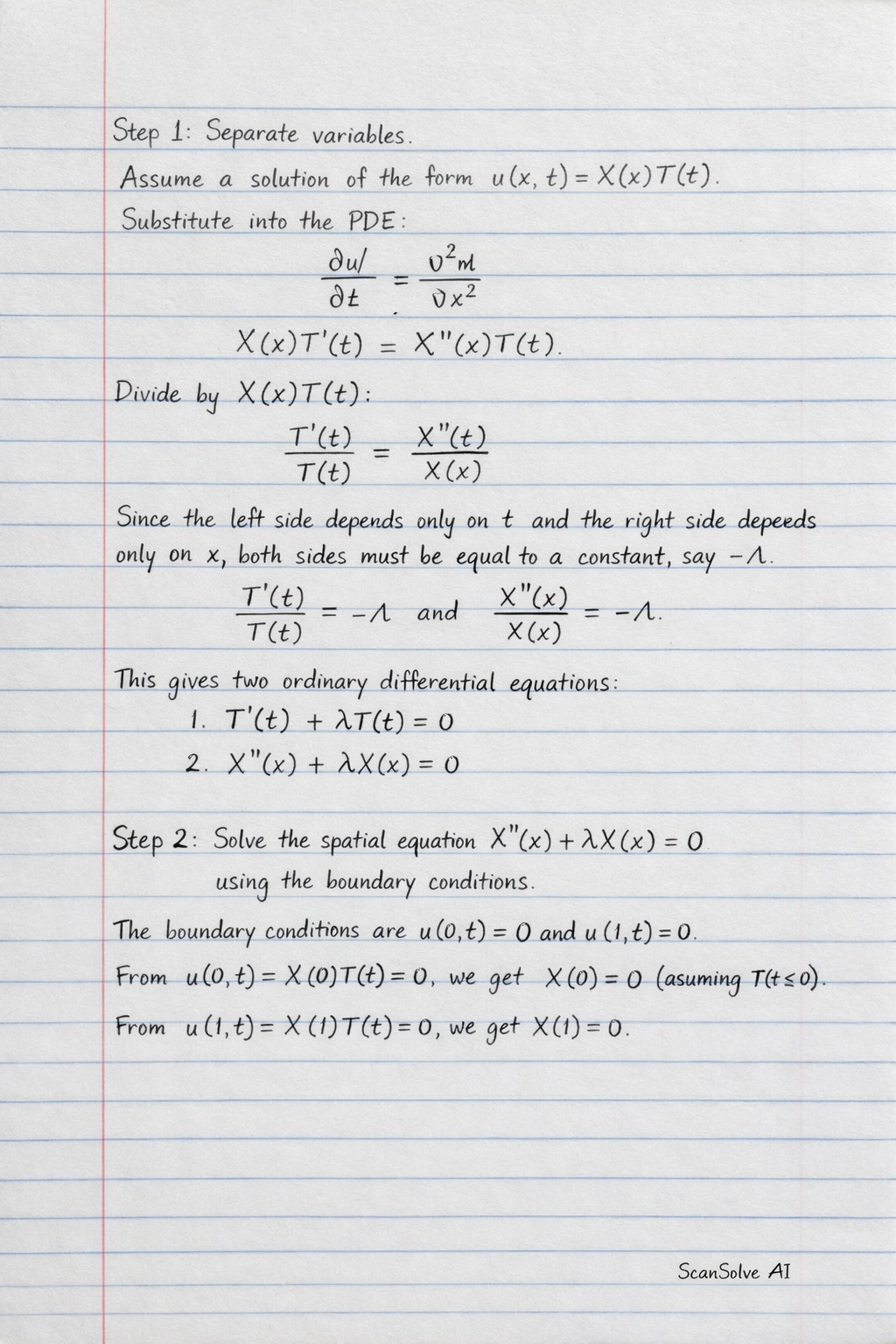
Step 1: Separate variables.
Assume a solution of the form .
Substitute this into the given partial differential equation :
Divide by to separate the variables:
Since the left side depends only on and the right side depends only on , both sides must be equal to a constant, say .
This gives two ordinary differential equations:
Step 2: Solve the spatial equation using the boundary conditions.
The boundary conditions are and .
From , we get (assuming is not identically zero).
From , we get .
Consider the possible values for :
- If : . . . This gives , a trivial solution.
- If : Let for . . The general solution is . . . . Since , , so . This again gives a trivial solution.
- If : Let for . . The general solution is . . So, . . For a non-trivial solution, , so . This implies for . The eigenvalues are . The eigenfunctions are (we absorb the constant into the general solution coefficients).
Step 3: Solve the temporal equation .
For each eigenvalue , the equation becomes .
This is a first-order linear ODE.
Integrating both sides:
Step 4: Form the general solution.
The general solution is a superposition of all possible solutions:
Still stuck on this one?
Ask a follow-up, and the answer starts from this question.
More Mathematics Questions
Handwritten Step-by-Step Solution
Get this as a handwritten image on WhatsApp — like a tutor wrote it for you.
Try on WhatsApp