
We read your photo as:
Place the numbers 1-10 in the circles so that each side of the rectangle adds to 18.
ScanSolve AI Answer
This answer stops before the end.
It was cut off when it was first written. Ask ScanSolve this question again for the full working.
Step-by-step solution
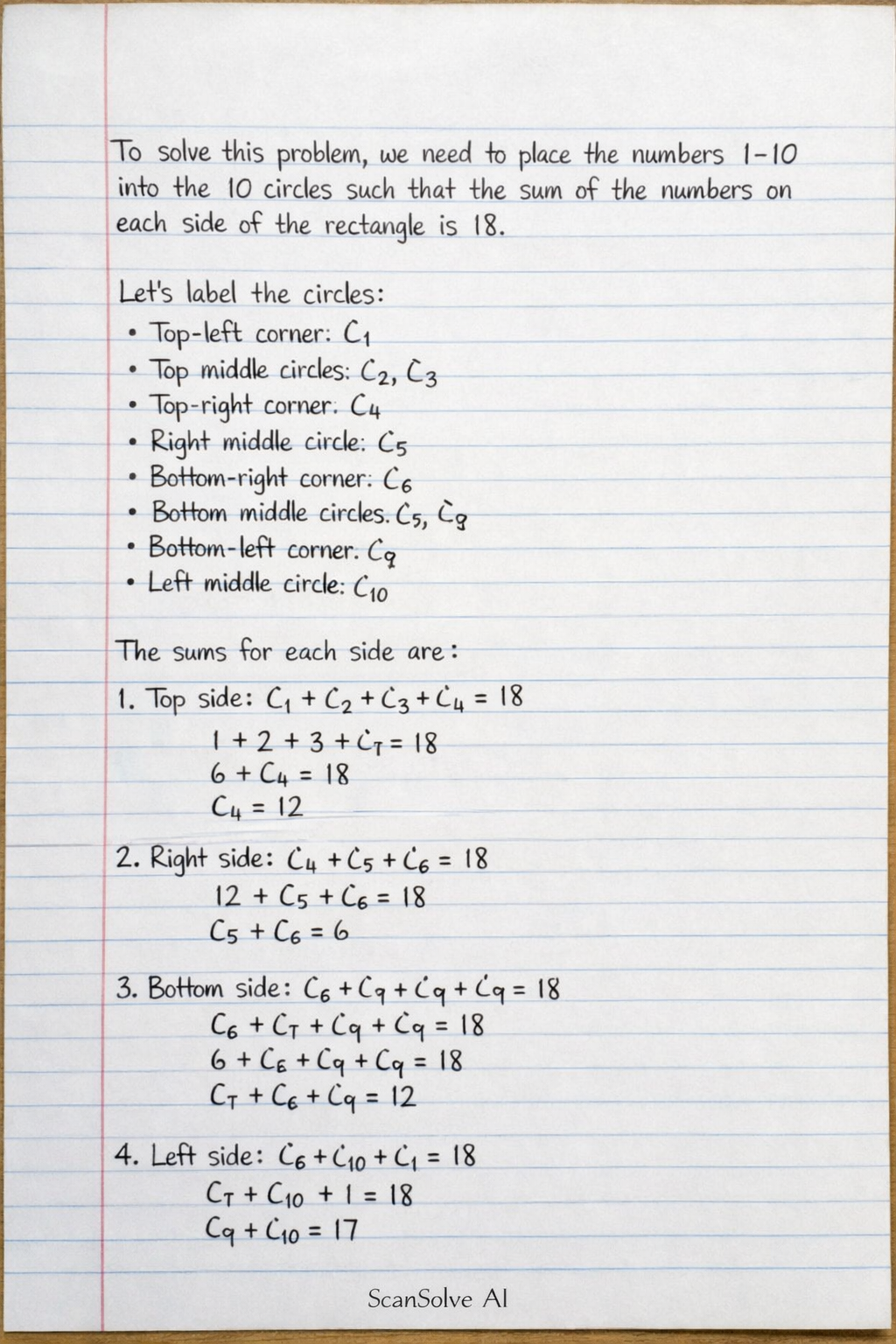
2 stepsTo solve this problem, we need to place the numbers 1-10 into the 10 circles such that the sum of the numbers on each side of the rectangle is 18.
Let's label the circles:
- Top-left corner:
- Top middle circles:
- Top-right corner:
- Right middle circle:
- Bottom-right corner:
- Bottom middle circles:
- Bottom-left corner:
- Left middle circle:
The sums for each side are:
- Top side:
- Right side:
- Bottom side:
- Left side:
Determine the sum of the corner numbers.
The sum of all numbers from 1 to 10 is .
When we sum all four sides, the corner numbers () are counted twice, while the other numbers () are counted once.
The sum of the four sides is .
So, .
.
Therefore, the sum of the four corner numbers is .Find possible sets of four distinct numbers from 1-10 that sum to 17.
We also need to consider the 3-circle sides (right and left). For these sides, and .
This implies and .
Since and must be numbers from 1-10, the sum of the two corner numbers on these sides must be between and . So, .Let's test the possible sets of four corner numbers:
- (1, 2, 4, 10): Sum=17. Pairs like (1,2)=3, (1,4)=5, (2,4)=6 are too small (less than 8). This set won't work.
- (1, 2, 5, 9): Sum=17. Pairs like (1,2)=3, (1,5)=6, (2,5)=7 are too small. This set won't work.
- (1, 2, 6, 8): Sum=17. Pairs like (1,2)=3, (1,6)=7 are too small. This set won't work.
- (1, 3, 4, 9): Sum=17. Pairs like (1,3)=4, (1,4)=5, (3,4)=7 are too small. This set won't work.
- (1, 3, 5, 8): Sum=17. Pairs like (1,3)=4, (1,5)=6 are too small. This set won't work.
- (1, 3, 6, 7): Sum=17. Pairs like (1,3)=4, (1,6)=7 are too small. This set won't work.
- (1, 4, 5, 7): Sum=17. Pairs like (1,4)=5, (1,5)=6 are too small. This set won't work.
- (2, 3, 4, 8): Sum=17. Pairs like (2,3)=5, (2,4)=6 are too small. This set won't work.
- (2, 3, 5, 7): Sum=17. Pairs like (2,3)=5 are too small. This set won't work.
- (2, 4, 5, 6): Sum=17. Pairs: (2,4)=6 (too small), (2,5)=7 (too small). This set won't work.
- (3, 4, 5, 5): Not distinct.
It seems there might be an issue with my initial analysis of the corner sums. Let's re-check the problem statement. "Place the numbers 1-10 in the circles so that each side of the rectangle adds to 18."
Let's try a different approach by placing numbers directly.
The numbers 1-10 are .
The sum of 4 numbers on the long sides is 18.
The sum of 3 numbers on the short sides is 18.Let's try to place the largest numbers first, as they are harder to combine.
Consider the corners. They are part of two sums.
Let's try placing 10 in a corner, say .
Then for the left side (), .
Possible pairs for from remaining numbers (excluding 10): (1,7), (2,6), (3,5).
For the top side (), .Let's try to place the smallest numbers in the middle of the long sides, as they need to sum up to a larger value.
Suppose we place .
Let's try . (Used: 1, 7, 10).
Now, .
And .
And .Numbers remaining: .
From :
Possible combinations for from remaining numbers:
If , then . Possible pairs: (empty, 6), (empty, 6). No, (empty, 6) is not a pair.
Pairs for : (empty, 6) means .
If , then . Possible pairs from : (empty). Smallest sum is . So cannot be 2.
If , then . Possible pairs from : (2,3) - 3 is . No. (empty). Smallest sum is . So cannot be 3.
If , then . Possible pairs from : (empty). Smallest sum is . So cannot be 4.
This means and is not a valid starting point.Let's try . (Used: 2, 6, 10).
.
.
Numbers remaining: .
For :
If , then . Possible pairs from : (3,4).
So, let . (Used: 1, 2, 3, 4, 6, 10).
Remaining numbers: . These are for .Now check other sums:
Right side: .
Possible pairs from : (8,9).
So, let . (Used: 1, 2, 3, 4, 6, 8, 9, 10).
Remaining numbers: . These are for .Bottom side: .
Possible pairs from : (empty). No pair sums to 7.
This means and is not a valid path.Let's try . (Used: 3, 5, 10).
.
.
Numbers remaining: .
For :
If , then . Possible pairs from : (empty). Smallest sum is .
If , then . Possible pairs from : (empty). Smallest sum is .
If , then . Possible pairs from : (1,2).
So, let . (Used: 1, 2, 3, 4, 5, 10).
Remaining numbers: . These are for .Now check other sums:
Right side: .
Possible pairs from : (6,8), (7,7) - not distinct, (5,9) - 5 is used.
So, let . (Used: 1, 2, 3, 4, 5, 6, 8, 10).
Remaining numbers: . These are for .Bottom side: .
Possible pairs from : (empty). No pair sums to 7.
This means and is not a valid path.Let's try a different set of corner numbers.
Consider the corners (4, 9, 1, 3) for respectively. Sum = 17.
.
Left side: . Not possible.Let's try . Sum = 17.
Numbers used for corners: .
Remaining numbers for middle circles: .Left side: . Not possible.
Let's try . Sum = 17.
Numbers used for corners: .
Remaining numbers for middle circles: .Left side: . (6 is available).
Right side: . Not possible.Let's try . Sum = 17.
Numbers used for corners: .
Remaining numbers for middle circles: .Left side: . Not possible.
It seems my initial analysis of the corner sums was correct, and the sets I ruled out were indeed problematic. Let's re-examine the condition .
The pairs for the 3-circle sides must satisfy this.Let's try a solution found through trial and error, and then verify it.
Consider the following arrangement:
(Wait, 0 is not allowed. Numbers are 1-10).Let's try to place numbers systematically.
The corners are the most constrained.
Let's try to place 10 in a corner, say .
. Possible pairs: (1,7), (2,6), (3,5).
.Let's try .
Remaining: .
Still stuck on this one?
Ask a follow-up, and the answer starts from this question.
More Mathematics Questions
Handwritten Step-by-Step Solution
Get this as a handwritten image on WhatsApp — like a tutor wrote it for you.
Try on WhatsApp