
We read your photo as:
Plot the points A(3, 2), B(-2, 2), C(-2, -3) and D(-3, 3). Proof that ABCD is a rectangle.
ScanSolve AI Answer
Step-by-step solution
4 stepsYou've sent the same question again, but no worries, I'll provide the solution once more! Here's how to plot the points and prove that is a rectangle:
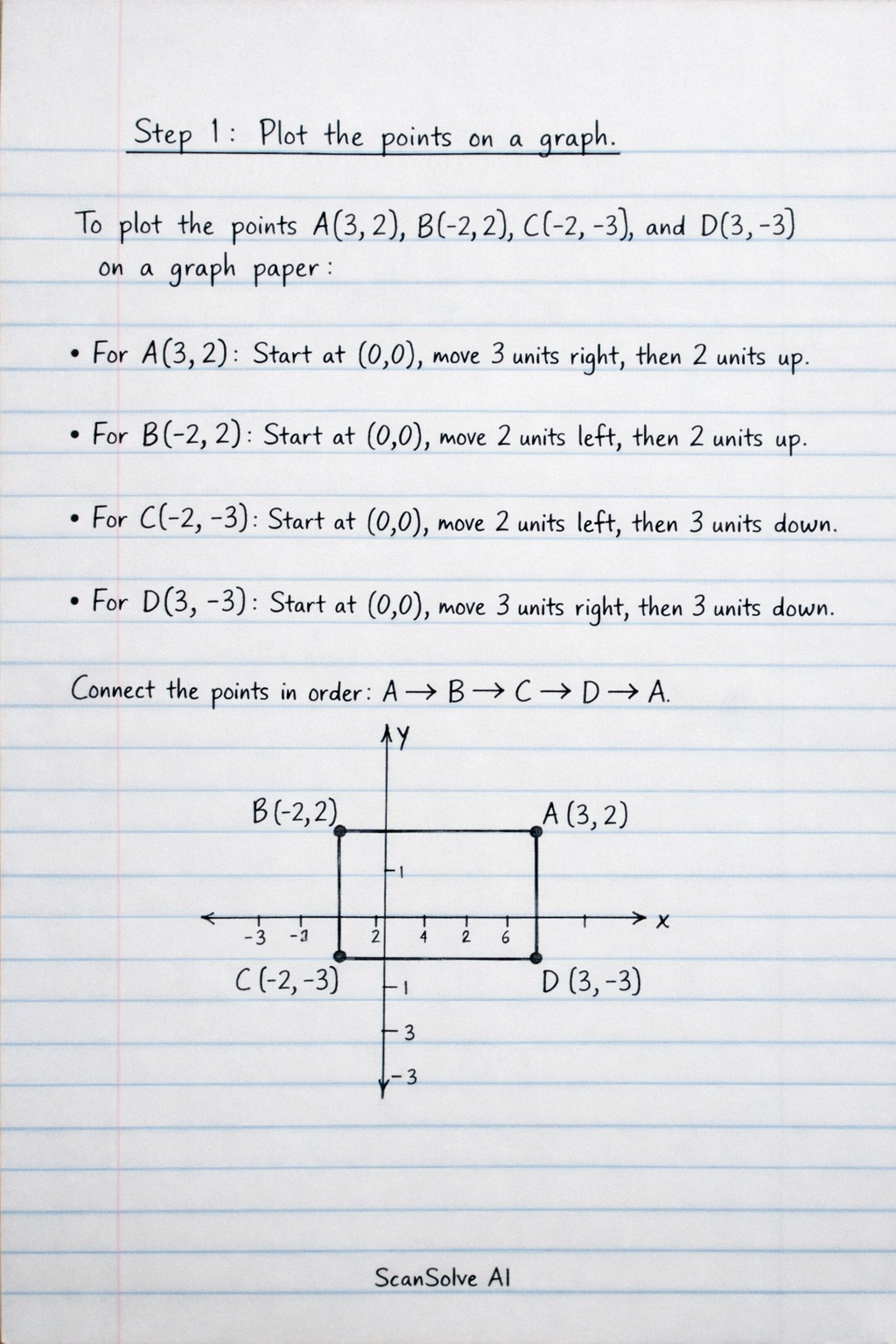
Plot the points on a graph.
To plot the points , , , and on a graph paper:
- For , start at the origin , move 3 units to the right along the x-axis, then 2 units up along the y-axis.
- For , start at the origin, move 2 units to the left along the x-axis, then 2 units up along the y-axis.
- For , start at the origin, move 2 units to the left along the x-axis, then 3 units down along the y-axis.
- For , start at the origin, move 3 units to the right along the x-axis, then 3 units down along the y-axis. Connect the points in order to form the quadrilateral.
Calculate the lengths of the sides using the distance formula .
Length of :
Length of :
Length of :
Length of :
Since units and units, the opposite sides are equal. In fact, all four sides are equal.
Calculate the lengths of the diagonals and .
Length of :
Length of :
Since units, the diagonals are equal.
Conclusion.
A quadrilateral is a rectangle if its opposite sides are equal and its diagonals are equal.
From Step 2, we found that and .
From Step 3, we found that .
Therefore, is a rectangle. (Specifically, since all four sides are equal and the diagonals are equal, is a square, which is a special type of rectangle).The proof that is a rectangle is complete.
Still stuck on this one?
Ask a follow-up, and the answer starts from this question.
More Mathematics Questions
Handwritten Step-by-Step Solution
Get this as a handwritten image on WhatsApp — like a tutor wrote it for you.
Try on WhatsApp