
We read your photo as:
Given points A(9, 1), B(4, 13), C(-8, 8), and D(-3, -4) in the complex plane, prove that ABCD is a square.
ScanSolve AI Answer
Answer
Step-by-step solution
2 stepsTo prove that ABCD is a square, we need to show that all four sides are equal in length and that one of the interior angles is .
Let the complex numbers representing the points be:
Calculate the length of each side.
The length of a segment between two complex numbers and is given by .
Length of AB:
Length of BC:
Length of CD:
Length of DA:
Since , all four sides are equal. This means ABCD is a rhombus.
Check for a right angle.
We can determine the angle between two adjacent sides, for example, and , by examining the ratio of the complex numbers representing these vectors.
The vector is represented by .
The vector is represented by .Consider the ratio :
Multiply the numerator and denominator by the conjugate of the denominator:
Since the ratio , this means that the vector is obtained by rotating the vector by counter-clockwise. Therefore, .
Since all four sides of the quadrilateral ABCD are equal in length and one of its interior angles is , ABCD is a square.
Try one yourself
A new problem that tests the same skill.
Still stuck on this one?
Ask a follow-up, and the answer starts from this question.
More Mathematics Questions
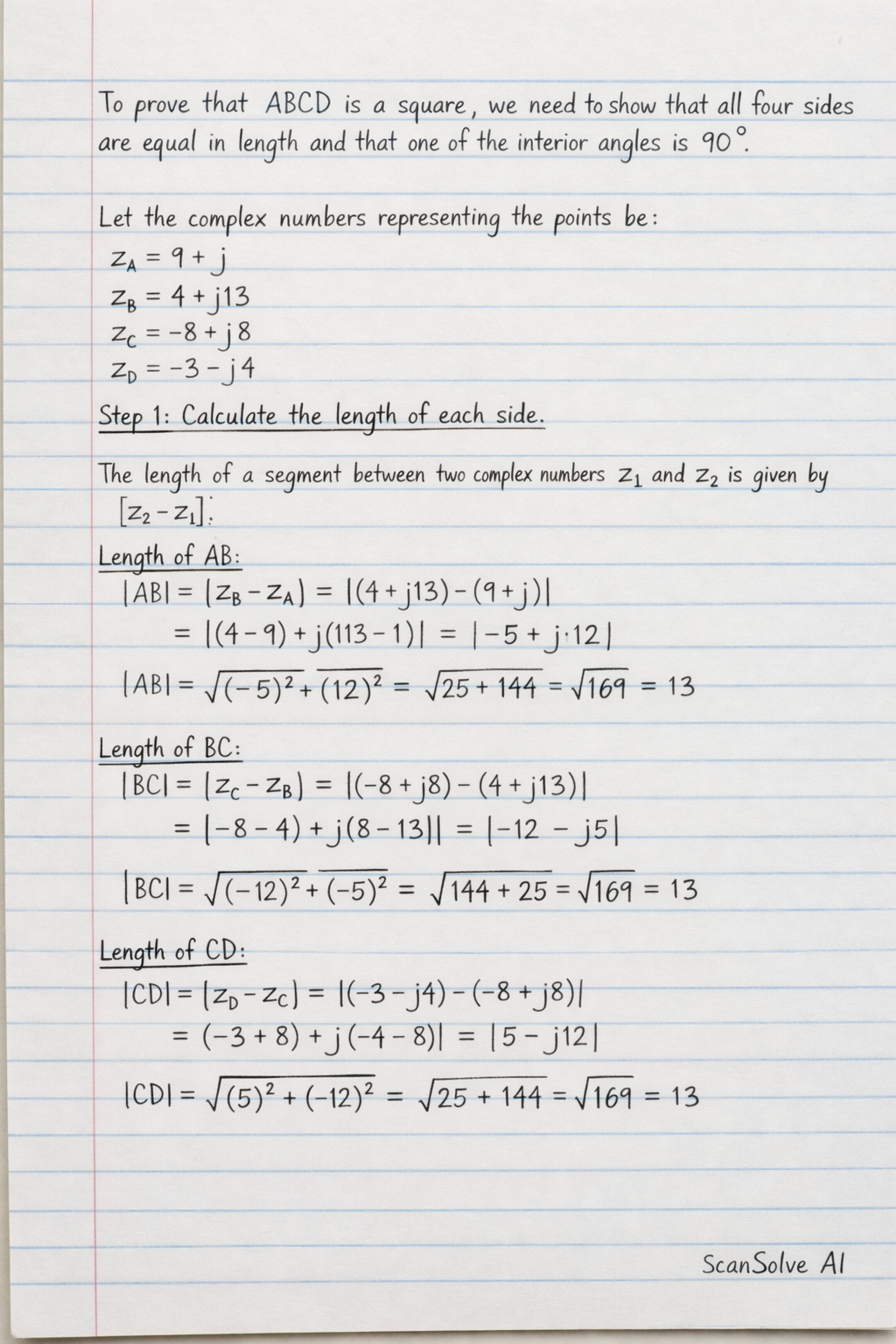
Handwritten Step-by-Step Solution
Get this as a handwritten image on WhatsApp — like a tutor wrote it for you.
Try on WhatsApp