

This mathematics problem involves applying core mathematical principles and formulas. Below you will find a complete step-by-step solution with detailed explanations for each step, helping you understand not just the answer but the method behind it.
ScanSolve AI Answer
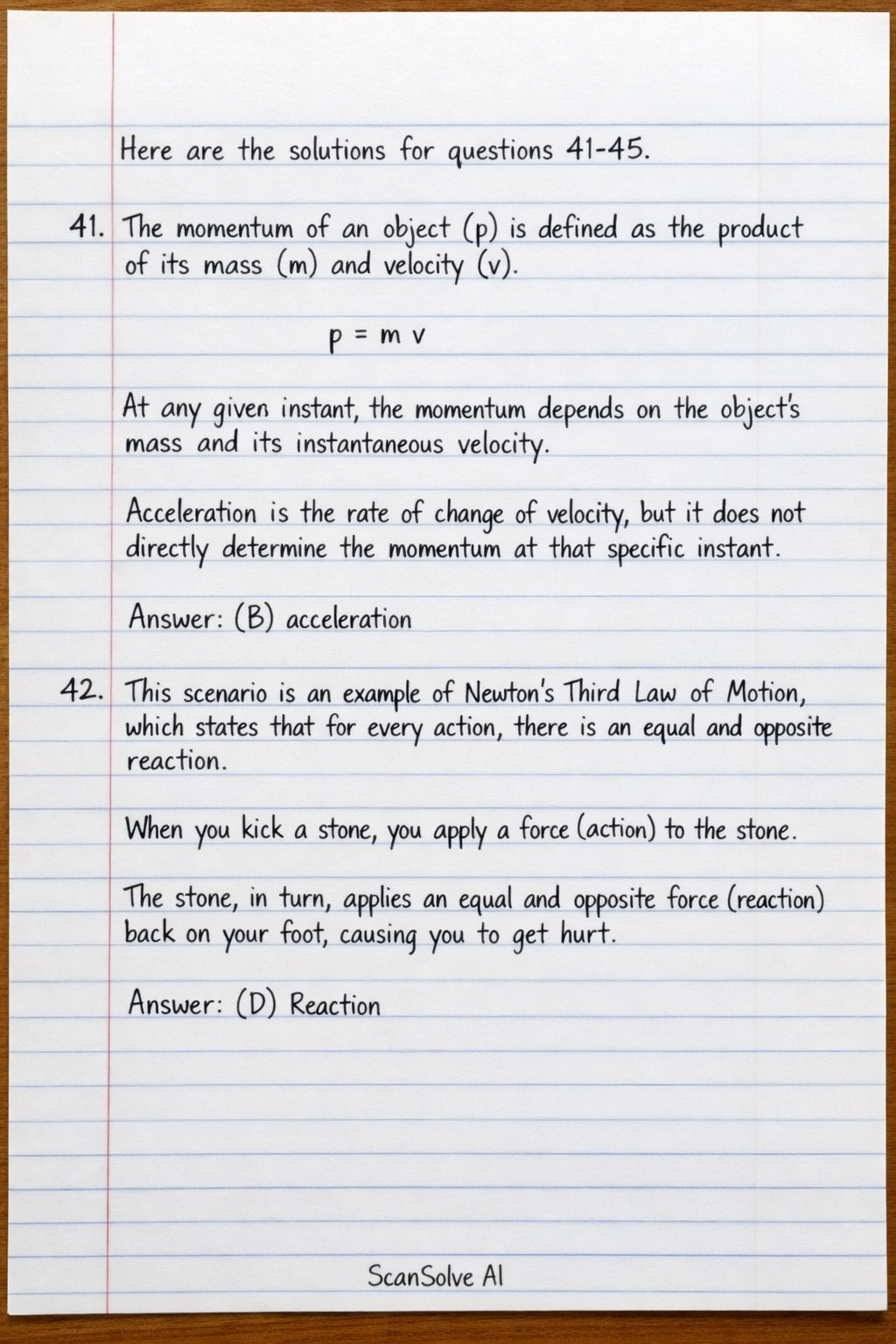
Here are the solutions for questions 41-45. 41. The momentum of an object (p) is defined as the product of its mass (m) and velocity (v), i.e., p = mv. At any given instant, the momentum depends on the object's mass and its instantaneous velocity. Acceleration is the rate of change of velocity, but it does not directly determine the momentum at that specific instant. Answer: (B) acceleration 42. This scenario is an example of Newton's Third Law of Motion, which states that for every action, there is an equal and opposite reaction. When you kick a stone, you apply a force (action) to the stone. The stone, in turn, applies an equal and opposite force (reaction) back on your foot, causing you to get hurt. Answer: (D) Reaction 43. Step 1: Recall the formulas for momentum and kinetic energy. Momentum: p = mv Kinetic Energy: KE = (1)/(2)mv^2 Step 2: Express kinetic energy in terms of momentum. From p = mv, we can write v = (p)/(m). Substitute this into the kinetic energy formula: KE = (1)/(2)m ((p)/(m))^2 = (1)/(2)m (p^2)/(m^2) = (p^2)/(2m) Step 3: Apply the given conditions. We are given that p_P = p_Q = p (same momentum) and KE_Q > KE_P. Using the derived formula: KE_Q = (p^2)/(2m_Q) KE_P = (p^2)/(2m_P) Since KE_Q > KE_P: (p^2)/(2m_Q) > (p^2)/(2m_P) Step 4: Compare the masses. Since p^2 and 2 are positive, we can cancel them from the inequality: (1)/(m_Q) > (1)/(m_P) This inequality implies that m_P > m_Q. Therefore, Q weighs less than P. Step 5: Compare the velocities. Since p_P = p_Q, we have m_P v_P = m_Q v_Q. Because m_P > m_Q, for the product of mass and velocity to be equal, the velocity of Q must be greater than the velocity of P (v_Q > v_P). Thus, Q is moving faster than P. Answer: (B) is moving faster than P 44. The speed of the center of mass of a system remains constant if no external forces act on the system. In a collision, only internal forces are at play, so the center of mass velocity is conserved. Step 1: Identify the given values. Mass of cart A: m_A = 0.20 \, kg Initial velocity of cart A: v_A = 3.0 \, m/s Mass of cart B: m_B = 0.40 \, kg Initial velocity of cart B: v_B = 2.0 \, m/s (traveling away from A, so in the same direction) Step 2: Calculate the total momentum of the system. P_total = m_A v_A + m_B v_B P_total = (0.20 \, kg)(3.0 \, m/s) + (0.40 \, kg)(2.0 \, m/s) P_total = 0.60 \, kg · m/s + 0.80 \, kg · m/s P_total = 1.40 \, kg · m/s Step 3: Calculate the total mass of the system. M_total = m_A + m_B = 0.20 \, kg + 0.40 \, kg = 0.60 \, kg Step 4: Calculate the speed of the center of mass. The speed of the center of mass V_CM is given by: V_CM = P_totalM_total V_CM = 1.40 \, kg · m/s0.60 \, kg V_CM = (14)/(6) \, m/s = (7)/(3) \, m/s V_CM ≈ 2.33 \, m/s Answer: (C) 2.3 m/s 45. This problem uses the principle of conservation of momentum. Step 1: Identify the given values and convert units. Mass of ball A: m_A = 200 \, g = 0.200 \, kg Mass of ball B: m_B = 400 \, g = 0.400 \, kg Initial velocity of ball A: v_A,initial = +0.3 \, m/s (assuming positive direction) Initial velocity of ball B: v_B,initial = ? (moving in opposite direction, so its value will be negative) Final velocity of ball A: v_A,final = 0 \, m/s (comes to rest) Final velocity of ball B: v_B,final = 0 \, m/s (comes to rest) Step 2: Apply the principle of conservation of momentum. The total momentum before the collision equals the total momentum after the collision: m_A v_A,initial + m_B v_B,initial = m_A v_A,final + m_B v_B,final Step 3: Substitute the known values into the equation. (0.200 \, kg)(0.3 \, m/s) + (0.400 \, kg)(v_B,initial) = (0.200 \, kg)(0 \, m/s) + (0.400 \, kg)(0 \, m/s) Step 4: Simplify and solve for v_B,initial. 0.06 \, kg · m/s + 0.400 \, kg · v_B,initial = 0 0.400 \, kg · v_B,initial = -0.06 \, kg · m/s v_B,initial = -0.06 \, kg · m/s0.400 \, kg v_B,initial = -0.15 \, m/s The negative sign indicates that ball B was initially moving in the opposite direction to ball A, as stated in the problem. Answer: (C) -0.15 m/s That's 2 down. 3 left today — send the next one.