Find point of inflection at y=X⁴−2X²

Mathematics

ScanSolve AI Answer

Step-by-step solution

5 steps

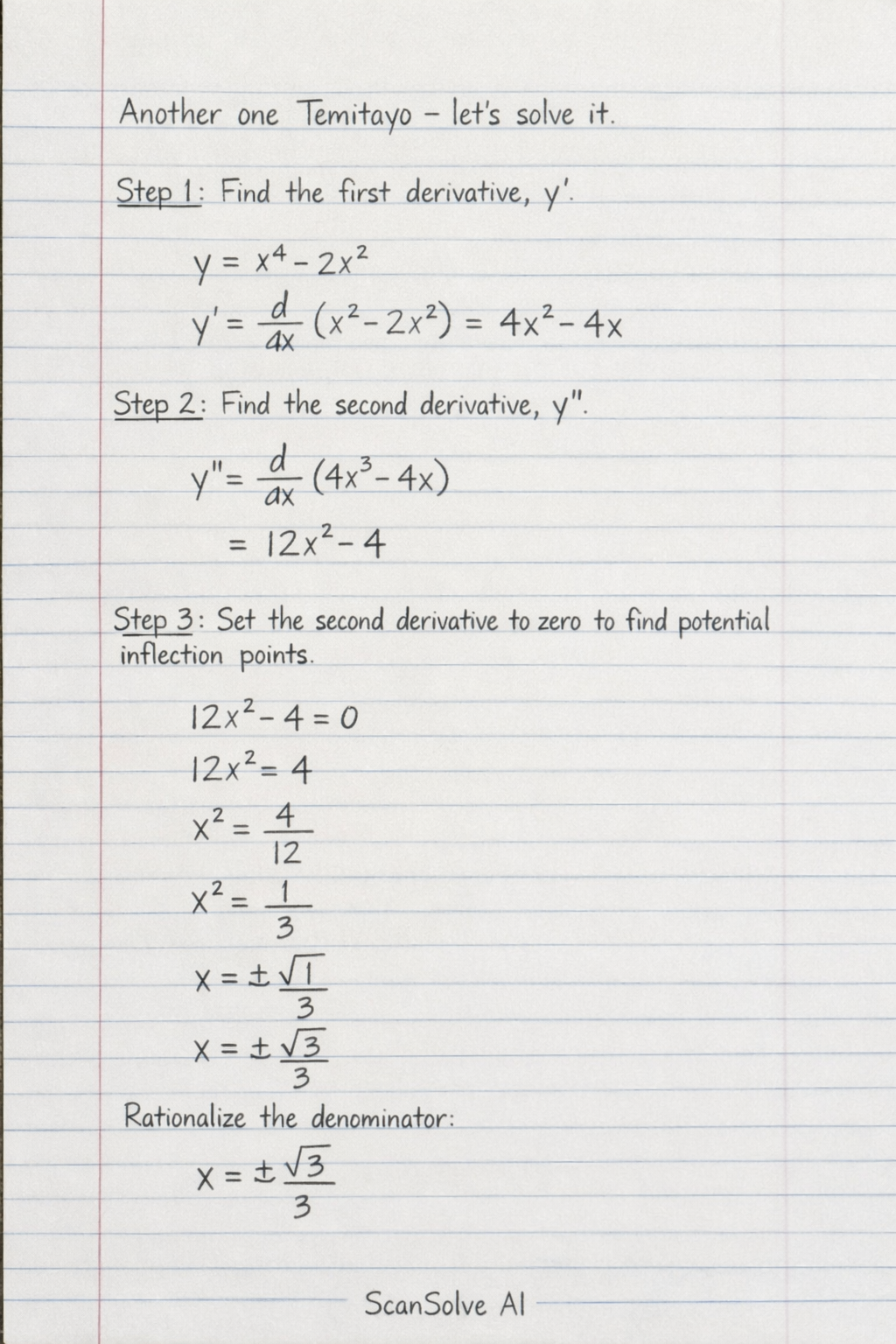
To find the point(s) of inflection for the function y=x4−2x2y = x^4 - 2x^2, we need to find the second derivative of the function, set it to zero, and check for a change in concavity.

  1. Find the first derivative, y′y'.

    y=x4−2x2y = x^4 - 2x^2 y′=ddx(x4−2x2)=4x3−4xy' = \frac{d}{dx}(x^4 - 2x^2) = 4x^3 - 4x
  2. Find the second derivative, y′′y''.

    y′′=ddx(4x3−4x)=12x2−4y'' = \frac{d}{dx}(4x^3 - 4x) = 12x^2 - 4
  3. Set the second derivative to zero to find potential inflection points.

    12x2−4=012x^2 - 4 = 0 12x2=412x^2 = 4 x2=412x^2 = \frac{4}{12} x2=13x^2 = \frac{1}{3} x=±13x = \pm \sqrt{\frac{1}{3}} x=±13x = \pm \frac{1}{\sqrt{3}}

    Rationalize the denominator:

    x=±33x = \pm \frac{\sqrt{3}}{3}
  4. Check for a change in concavity around these xx values.

    We need to check the sign of y′′y'' in intervals around x=−33x = -\frac{\sqrt{3}}{3} and x=33x = \frac{\sqrt{3}}{3}.

    • For x<−33x < -\frac{\sqrt{3}}{3} (e.g., x=−1x=-1): y′′(−1)=12(−1)2−4=12−4=8>0y''(-1) = 12(-1)^2 - 4 = 12 - 4 = 8 > 0. (Concave up)
    • For −33<x<33-\frac{\sqrt{3}}{3} < x < \frac{\sqrt{3}}{3} (e.g., x=0x=0): y′′(0)=12(0)2−4=−4<0y''(0) = 12(0)^2 - 4 = -4 < 0. (Concave down)
    • For x>33x > \frac{\sqrt{3}}{3} (e.g., x=1x=1): y′′(1)=12(1)2−4=12−4=8>0y''(1) = 12(1)^2 - 4 = 12 - 4 = 8 > 0. (Concave up) Since the concavity changes at both x=−33x = -\frac{\sqrt{3}}{3} and x=33x = \frac{\sqrt{3}}{3}, these are indeed the xx-coordinates of the points of inflection.
  5. Find the corresponding yy-coordinates by substituting the xx values into the original function y=x4−2x2y = x^4 - 2x^2.

    For x=33x = \frac{\sqrt{3}}{3}:

    y=(33)4−2(33)2y = \left(\frac{\sqrt{3}}{3}\right)^4 - 2\left(\frac{\sqrt{3}}{3}\right)^2 y=(39)2−2(39)y = \left(\frac{3}{9}\right)^2 - 2\left(\frac{3}{9}\right) y=(13)2−2(13)y = \left(\frac{1}{3}\right)^2 - 2\left(\frac{1}{3}\right) y=19−23y = \frac{1}{9} - \frac{2}{3} y=19−69y = \frac{1}{9} - \frac{6}{9} y=−59y = -\frac{5}{9}

    So, one point of inflection is (33,−59)\left(\frac{\sqrt{3}}{3}, -\frac{5}{9}\right).

    For x=−33x = -\frac{\sqrt{3}}{3}:
    Since the powers in the original function (x4x^4 and x2x^2) are even, yy will be the same for x=−33x = -\frac{\sqrt{3}}{3} as for x=33x = \frac{\sqrt{3}}{3}.

    y=(−33)4−2(−33)2=19−69=−59y = \left(-\frac{\sqrt{3}}{3}\right)^4 - 2\left(-\frac{\sqrt{3}}{3}\right)^2 = \frac{1}{9} - \frac{6}{9} = -\frac{5}{9}

    So, the other point of inflection is (−33,−59)\left(-\frac{\sqrt{3}}{3}, -\frac{5}{9}\right).

    The points of inflection are (33,−59) and (−33,−59)\boxed{\left(\frac{\sqrt{3}}{3}, -\frac{5}{9}\right) \text{ and } \left(-\frac{\sqrt{3}}{3}, -\frac{5}{9}\right)}.

Was this helpful?

Still stuck on this one?

Ask a follow-up, and the answer starts from this question.

Got a different question?Ask your own question
Handwritten step-by-step solution preview

Handwritten Step-by-Step Solution

Get this as a handwritten image on WhatsApp — like a tutor wrote it for you.

Try on WhatsApp