

This mathematics problem involves applying core mathematical principles and formulas. Below you will find a complete step-by-step solution with detailed explanations for each step, helping you understand not just the answer but the method behind it.
ScanSolve AI Answer
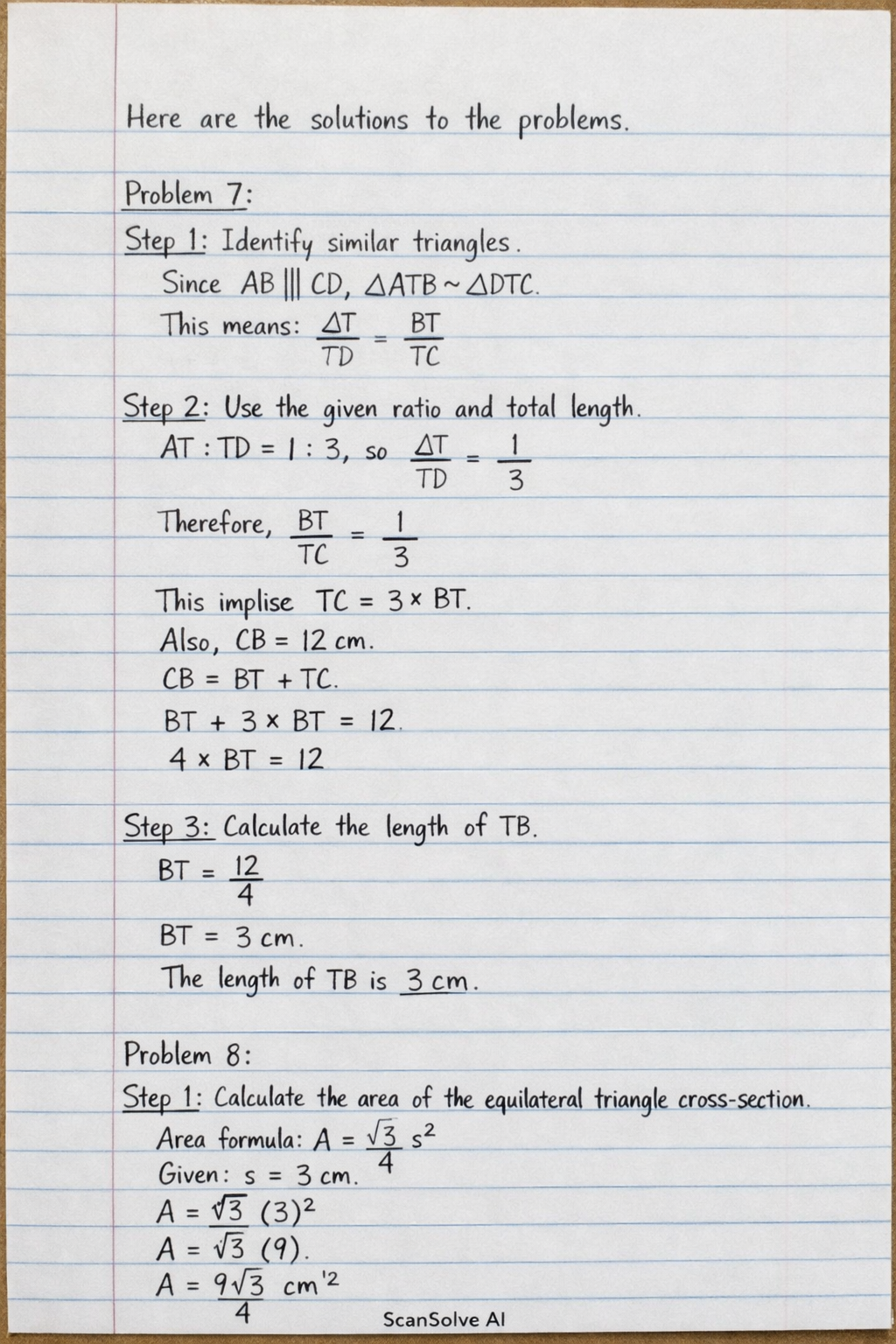
Here are the solutions to the problems. Problem 7: Step 1: Identify similar triangles. Since AB is parallel to CD, triangles ATB and DTC are similar. This means that the ratio of corresponding sides is equal. (AT)/(TD) = (BT)/(TC) Step 2: Use the given ratio and total length. We are given AT : TD = 1 : 3, so (AT)/(TD) = (1)/(3). Therefore, (BT)/(TC) = (1)/(3). This implies TC = 3 × BT. We are also given that CB = 12 cm. We know that CB = BT + TC. Substitute TC = 3 × BT into the equation: BT + 3 × BT = 12 4 × BT = 12 Step 3: Calculate the length of TB. BT = (12)/(4) BT = 3 cm The length of TB is 3 cm. Problem 8: Step 1: Calculate the area of the equilateral triangle cross-section. The formula for the area of an equilateral triangle with side s is A = sqrt(3)4s^2. Given side s = 3 cm. A = sqrt(3)4(3)^2 A = sqrt(3)4(9) A = 9sqrt(3)4 cm^2 Step 2: Calculate the volume of the prism. The volume of a prism is given by the formula V = Area of cross-section × Length. Given length = 25 cm. V = 9sqrt(3)4 × 25 V = 225sqrt(3)4 cm^3 As a decimal, V ≈ (225 × 1.73205)/(4) ≈ (389.71125)/(4) ≈ 97.4278 cm^3. The volume of the prism is 225sqrt(3)4 cm^3 or approximately 97.43 cm^3. Problem 9: Step 1: Find the prime factorization of each capacity. We need to find the greatest common divisor (GCD) of 36, 84, and 90. 36 = 2 × 18 = 2 × 2 × 9 = 2^2 × 3^2 84 = 2 × 42 = 2 × 2 × 21 = 2^2 × 3 × 7 90 = 2 × 45 = 2 × 3 × 15 = 2 × 3 × 3 × 5 = 2 × 3^2 × 5 Step 2: Identify the common prime factors and their lowest powers. The common prime factors are 2 and 3. The lowest power of 2 present in all factorizations is 2^1. The lowest power of 3 present in all factorizations is 3^1. Step 3: Multiply the common prime factors with their lowest powers. GCD(36, 84, 90) = 2^1 × 3^1 = 2 × 3 = 6 The capacity of the greatest vessel is 6 litres. That's 2 down. 3 left today — send the next one.