
We read your photo as:
Find the product: (i) 73.92 x 10 (ii) 7.54 x 10 (iii) 84.003 x 10 (iv) 2.397 x 100 (v) 6.83 x 100 (vi) 2.9 x 100 (vii) 6.7314 x 1000 (viii) 0.182 x 1000 (ix) 0.076 x 1000
ScanSolve AI Answer
Step-by-step solution
6 stepsHere are the solutions to the problems.
1. Find the product:
-
(i) To multiply 73.92 by 10, move the decimal point one place to the right.
-
(ii) To multiply 7.54 by 10, move the decimal point one place to the right.
-
(iii) To multiply 84.003 by 10, move the decimal point one place to the right.
-
(iv) To multiply 2.397 by 100, move the decimal point two places to the right.
-
(v) To multiply 6.83 by 100, move the decimal point two places to the right.
-
(vi) To multiply 2.9 by 100, move the decimal point two places to the right, adding a zero.
-
(vii) To multiply 6.7314 by 1000, move the decimal point three places to the right.
-
(viii) To multiply 0.182 by 1000, move the decimal point three places to the right.
-
(ix) To multiply 0.076 by 1000, move the decimal point three places to the right.
2. A bus can cover 62.5 km in one hour. How much distance can it cover in 18 hours?
Identify the given rate and time.
The bus covers per hour.
The time is .Calculate the total distance by multiplying the distance covered in one hour by the total number of hours.
Perform the multiplication.
The bus can cover in 18 hours.
3. A tin of oil weighs 16.8 kg. What is the weight of 45 such tins?
Identify the weight of one tin and the number of tins.
Weight of one tin .
Number of tins .Calculate the total weight by multiplying the weight of one tin by the number of tins.
Perform the multiplication.
The weight of 45 tins is .
Still stuck on this one?
Ask a follow-up, and the answer starts from this question.
More Mathematics Questions
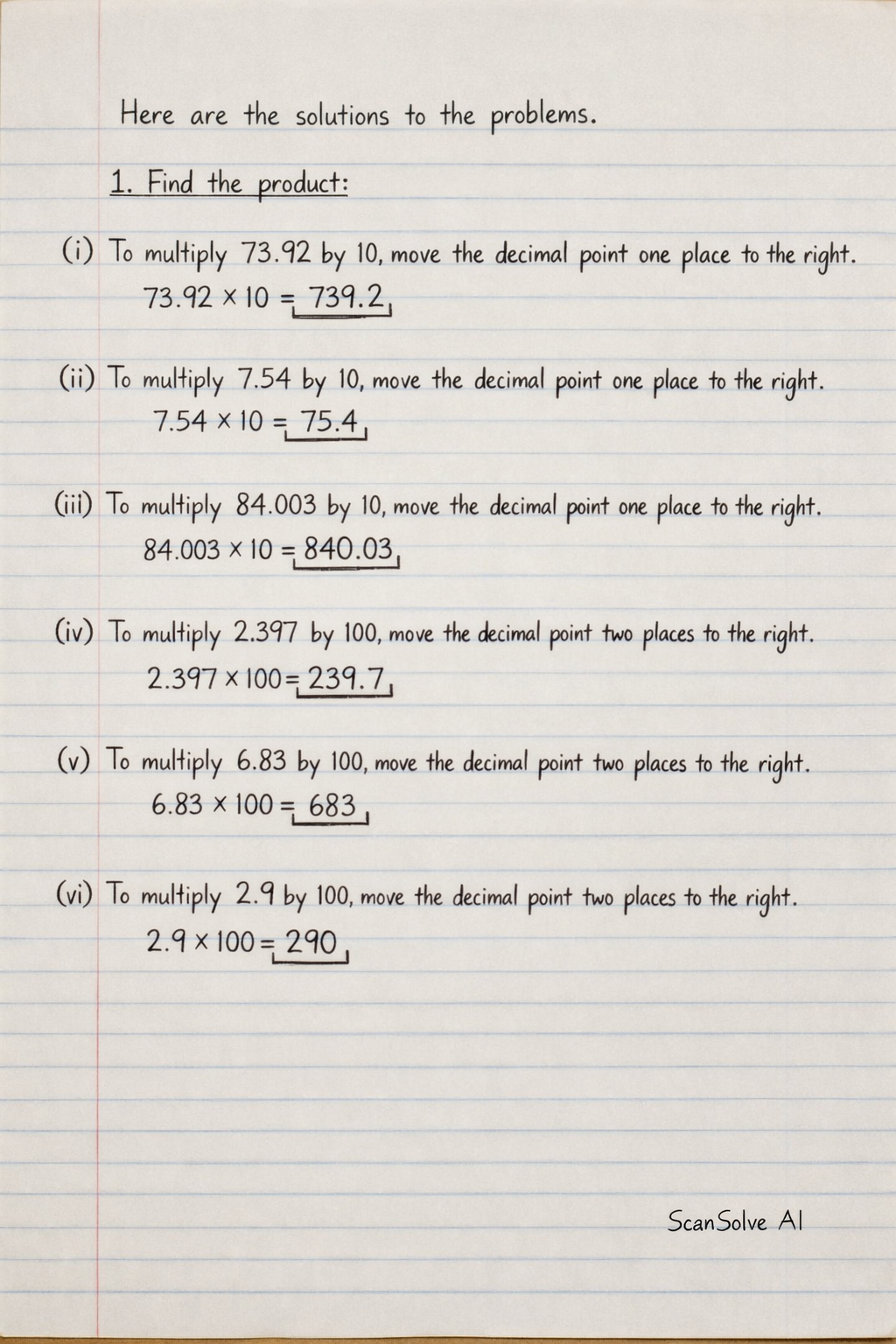
Handwritten Step-by-Step Solution
Get this as a handwritten image on WhatsApp — like a tutor wrote it for you.
Try on WhatsApp