We read your photo as:

Q4. Evaluate limy->1 (y2 - 1) / (y - 1). Q5. Find limx->inf (5x2 + 3x - 1) / (2x3 - 7). Q6. Evaluate limx->0 (1-cosx)/x2 * limx->0 (1-cosx)/x2. Q7. Determine lim_x->-2 (x2+5x+6)/(x+2).

Mathematics

ScanSolve AI Answer

Step-by-step solution

11 steps

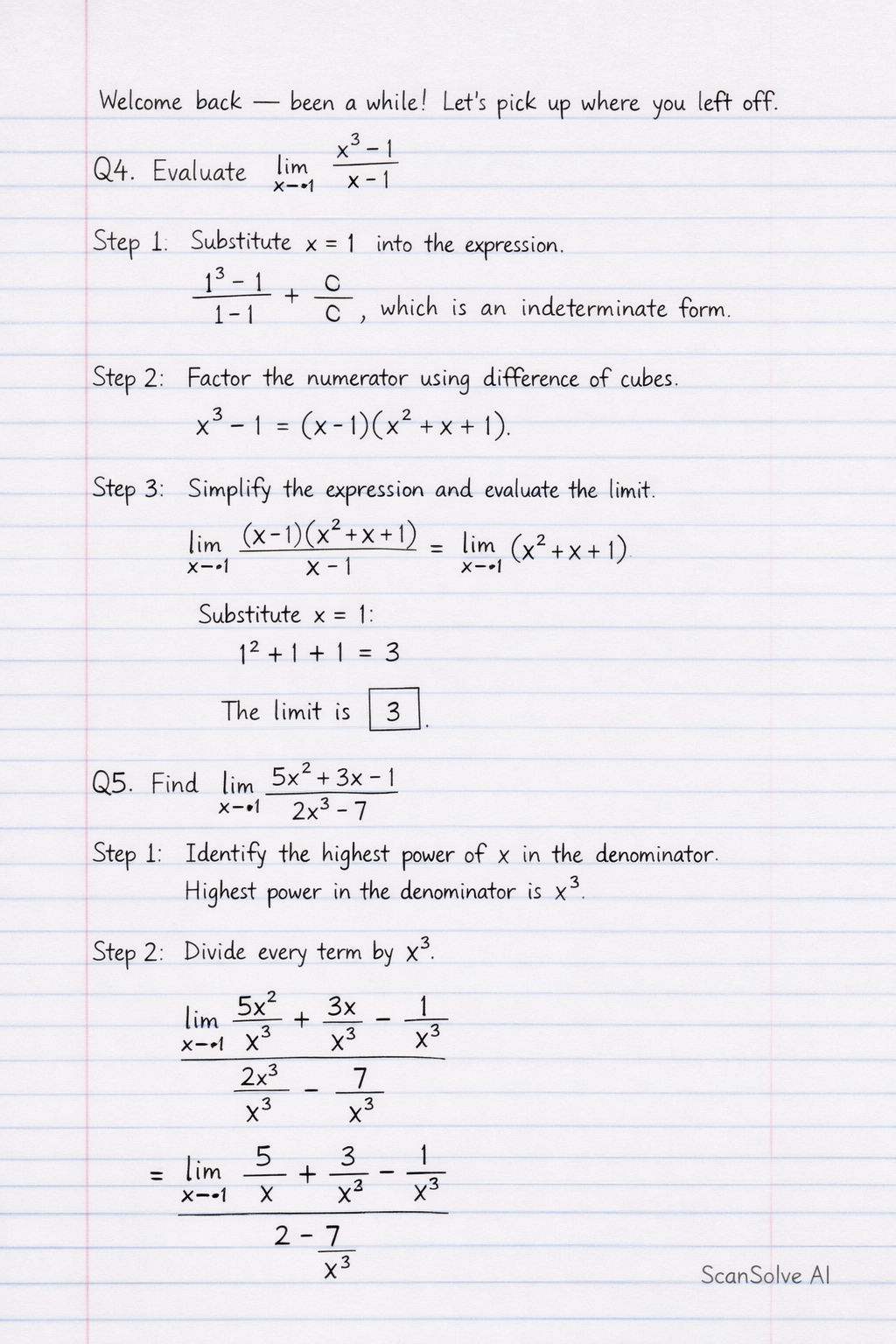
Q4. Evaluate lim⁡x→1x3−1x−1\lim_{x \to 1} \frac{x^3 - 1}{x - 1}

  1. Substitute x=1x=1 into the expression.

    Substituting x=1x=1 gives 13−11−1=00\frac{1^3 - 1}{1 - 1} = \frac{0}{0}, which is an indeterminate form.

  2. Factor the numerator using the difference of cubes formula a3−b3=(a−b)(a2+ab+b2)a^3 - b^3 = (a-b)(a^2+ab+b^2).

    Here, a=xa=x and b=1b=1, so x3−1=(x−1)(x2+x+1)x^3 - 1 = (x-1)(x^2+x+1).

  3. Simplify the expression and evaluate the limit.

    lim⁡x→1(x−1)(x2+x+1)x−1=lim⁡x→1(x2+x+1)\lim_{x \to 1} \frac{(x-1)(x^2+x+1)}{x-1} = \lim_{x \to 1} (x^2+x+1)

    Now, substitute x=1x=1:

    12+1+1=1+1+1=31^2 + 1 + 1 = 1 + 1 + 1 = 3

    The limit is 3\boxed{3}.

    Q5. Find lim⁡x→∞5x2+3x−12x3−7\lim_{x \to \infty} \frac{5x^2 + 3x - 1}{2x^3 - 7}

  4. Identify the highest power of xx in the denominator.

    The highest power of xx in the denominator is x3x^3.

  5. Divide every term in the numerator and denominator by x3x^3.

    lim⁡x→∞5x2x3+3xx3−1x32x3x3−7x3=lim⁡x→∞5x+3x2−1x32−7x3\lim_{x \to \infty} \frac{\frac{5x^2}{x^3} + \frac{3x}{x^3} - \frac{1}{x^3}}{\frac{2x^3}{x^3} - \frac{7}{x^3}} = \lim_{x \to \infty} \frac{\frac{5}{x} + \frac{3}{x^2} - \frac{1}{x^3}}{2 - \frac{7}{x^3}}
  6. Apply the limit property lim⁡x→∞cxn=0\lim_{x \to \infty} \frac{c}{x^n} = 0 for n>0n > 0.

    As x→∞x \to \infty, terms like 5x\frac{5}{x}, 3x2\frac{3}{x^2}, 1x3\frac{1}{x^3}, and 7x3\frac{7}{x^3} all approach 0.

    0+0−02−0=02=0\frac{0 + 0 - 0}{2 - 0} = \frac{0}{2} = 0

    The limit is 0\boxed{0}.

    Q6. Evaluate lim⁡x→01−cos⁡xx2−lim⁡x→0(1−cos⁡xx2)\lim_{x \to 0} \frac{1 - \cos x}{x^2} - \lim_{x \to 0} \left(\frac{1 - \cos x}{x^2}\right)

  7. Recognize the structure of the expression.

    The expression is in the form A−AA - A, where A=lim⁡x→01−cos⁡xx2A = \lim_{x \to 0} \frac{1 - \cos x}{x^2}.

  8. Evaluate the expression.

    Since any quantity subtracted from itself is zero, the result is 0.

    lim⁡x→01−cos⁡xx2−lim⁡x→0(1−cos⁡xx2)=0\lim_{x \to 0} \frac{1 - \cos x}{x^2} - \lim_{x \to 0} \left(\frac{1 - \cos x}{x^2}\right) = 0

    The value is 0\boxed{0}.

    Q7. Determine lim⁡x→−2x2+5x+6x+2\lim_{x \to -2} \frac{x^2 + 5x + 6}{x + 2}

  9. Substitute x=−2x=-2 into the expression.

    Substituting x=−2x=-2 gives (−2)2+5(−2)+6−2+2=4−10+60=00\frac{(-2)^2 + 5(-2) + 6}{-2 + 2} = \frac{4 - 10 + 6}{0} = \frac{0}{0}, which is an indeterminate form.

  10. Factor the numerator.

    The quadratic expression x2+5x+6x^2 + 5x + 6 can be factored into (x+2)(x+3)(x+2)(x+3).

  11. Simplify the expression and evaluate the limit.

    lim⁡x→−2(x+2)(x+3)x+2=lim⁡x→−2(x+3)\lim_{x \to -2} \frac{(x+2)(x+3)}{x+2} = \lim_{x \to -2} (x+3)

    Now, substitute x=−2x=-2:

    −2+3=1-2 + 3 = 1

    The limit is 1\boxed{1}.

Was this helpful?

Still stuck on this one?

Ask a follow-up, and the answer starts from this question.

Got a different question?Ask your own question
Handwritten step-by-step solution preview

Handwritten Step-by-Step Solution

Get this as a handwritten image on WhatsApp — like a tutor wrote it for you.

Try on WhatsApp