We read your photo as:

Question 2: a) Express 216 as a product of prime factors. Hence evaluate (216)2/3. b) Solve the inequality 1/2(x+1) >= 1/3(2x+2) and illustrate the answer on a number line.

Mathematics

ScanSolve AI Answer

Answers

3 parts
a(i)

23×33\textbf{2}^\textbf{3} \times \textbf{3}^\textbf{3}

a(ii)

36\textbf{36}

b

x≤-1\textbf{x} \le \textbf{-1}

Step-by-step solution

7 steps

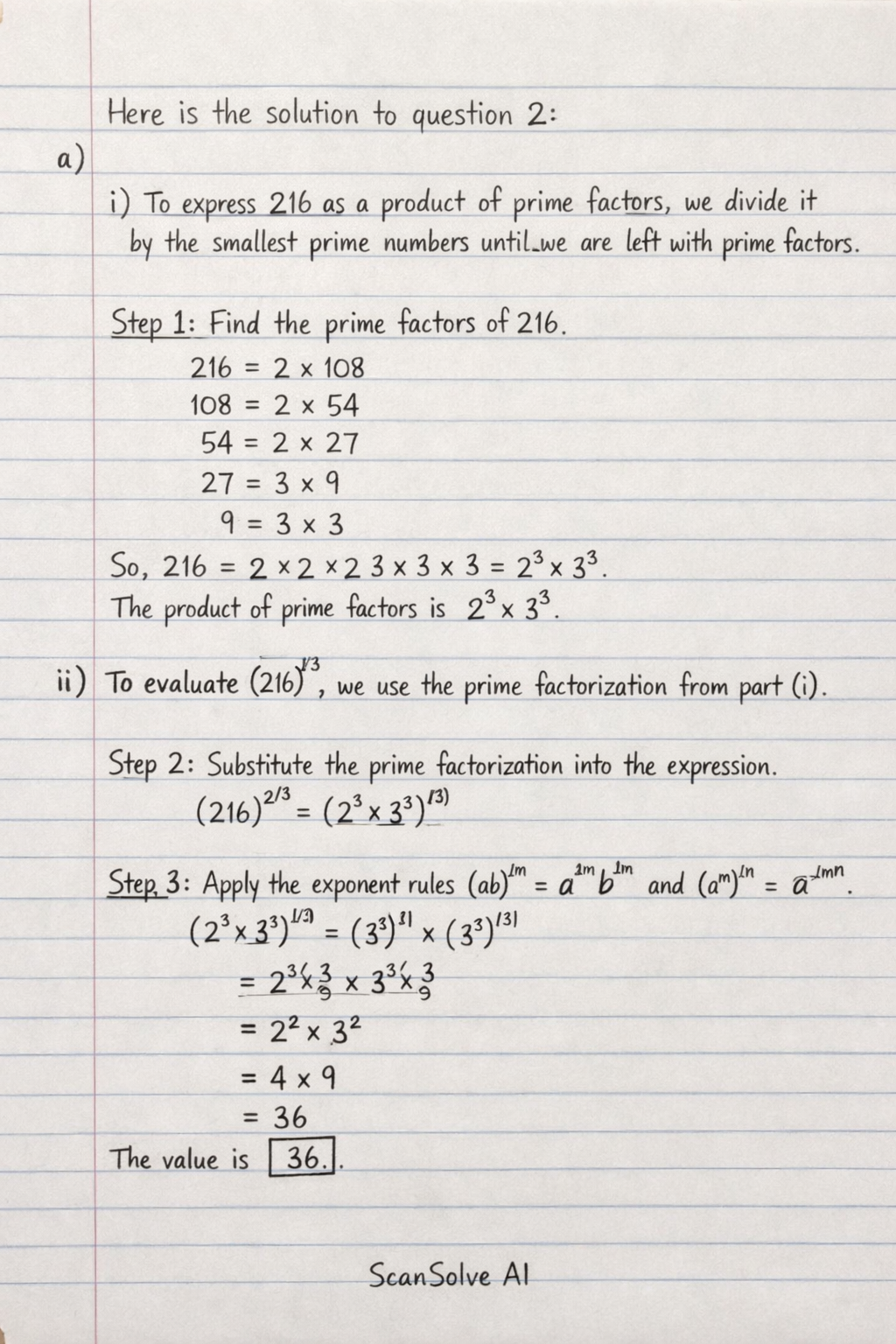
Here is the solution to question 2:

Part a(i)· 1 step

To express 216 as a product of prime factors, we divide it by the smallest prime numbers until we are left with prime factors.

  1. Find the prime factors of 216.

    216=2×108216 = 2 \times 108 108=2×54108 = 2 \times 54 54=2×2754 = 2 \times 27 27=3×927 = 3 \times 9 9=3×39 = 3 \times 3

    So, 216=2×2×2×3×3×3=23×33216 = 2 \times 2 \times 2 \times 3 \times 3 \times 3 = 2^3 \times 3^3.
    The product of prime factors is 23×33\boxed{\textbf{2}^\textbf{3} \times \textbf{3}^\textbf{3}}.

Part a(ii)

36\textbf{36}

To evaluate (216)23(216)^{\frac{2}{3}}, we use the prime factorization from part (i).

  1. Substitute the prime factorization into the expression.

    (216)23=(23×33)23(216)^{\frac{2}{3}} = (2^3 \times 3^3)^{\frac{2}{3}}
  2. Apply the exponent rule (ab)m=ambm(ab)^m = a^m b^m and (am)n=amn(a^m)^n = a^{mn}.

    (23×33)23=(23)23×(33)23(2^3 \times 3^3)^{\frac{2}{3}} = (2^3)^{\frac{2}{3}} \times (3^3)^{\frac{2}{3}} =23×23×33×23= 2^{3 \times \frac{2}{3}} \times 3^{3 \times \frac{2}{3}} =22×32= 2^2 \times 3^2 =4×9= 4 \times 9 =36= 36

    The value is 36\boxed{\textbf{36}}.

Part b

x≤-1\textbf{x} \le \textbf{-1}

To solve the inequality 12(x+1)≥13(2x+2)\frac{1}{2}(x+1) \ge \frac{1}{3}(2x+2) and illustrate the answer on a number line.

  1. Clear the denominators by multiplying both sides by the least common multiple (LCM) of 2 and 3, which is 6.

    6×12(x+1)≥6×13(2x+2)6 \times \frac{1}{2}(x+1) \ge 6 \times \frac{1}{3}(2x+2) 3(x+1)≥2(2x+2)3(x+1) \ge 2(2x+2)
  2. Distribute the numbers on both sides.

    3x+3≥4x+43x + 3 \ge 4x + 4
  3. Gather xx terms on one side and constant terms on the other.

    Subtract 3x3x from both sides:

    3≥4x−3x+43 \ge 4x - 3x + 4 3≥x+43 \ge x + 4

    Subtract 4 from both sides:

    3−4≥x3 - 4 \ge x −1≥x-1 \ge x

    This can be rewritten as x≤−1x \le -1.

  4. Illustrate the solution on a number line.

    The solution x≤−1x \le -1 means all real numbers less than or equal to -1. This is represented by a closed circle at -1 and an arrow extending to the left.

    Number Line:⟵∙——————–−101\text{Number Line:} \quad \longleftarrow \bullet \text{--------------------} \\ \quad \quad \quad \quad -1 \quad \quad \quad 0 \quad \quad \quad 1

    The solution is x≤-1\boxed{\textbf{x} \le \textbf{-1}}.

Was this helpful?

Try one yourself

A new problem that tests the same skill.

Still stuck on this one?

Ask a follow-up, and the answer starts from this question.

Got a different question?Ask your own question
Handwritten step-by-step solution preview

Handwritten Step-by-Step Solution

Get this as a handwritten image on WhatsApp — like a tutor wrote it for you.

Try on WhatsApp