
We read your photo as:
Question 6. a) Write the cardinalities of the given sets in set notational forms. Show the above information in Venn-diagram.
ScanSolve AI Answer
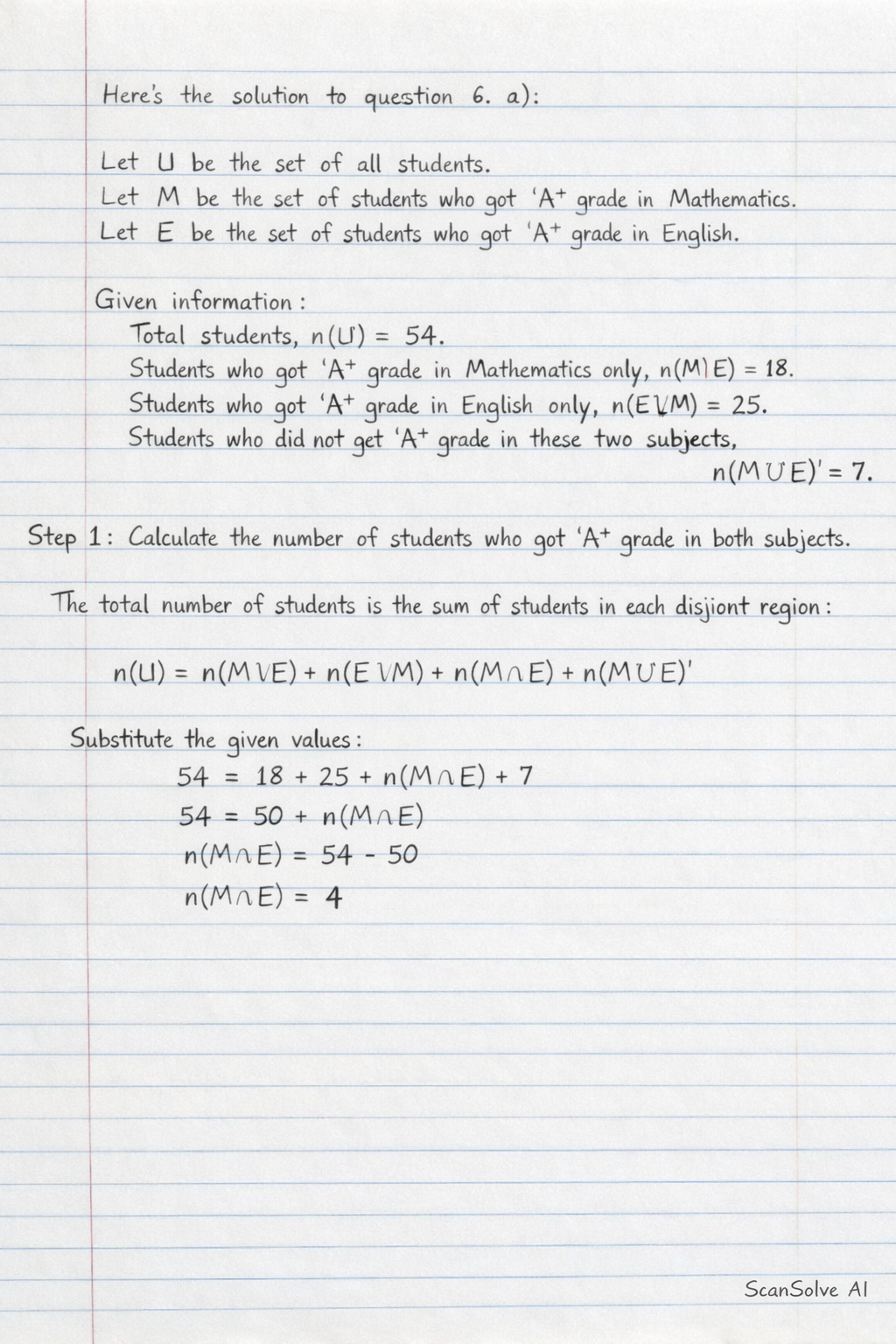
Here's the solution to question 6. a):
Let be the set of all students.
Let be the set of students who got 'A+' grade in Mathematics.
Let be the set of students who got 'A+' grade in English.
Given information:
Total students, .
Students who got 'A+' grade in Mathematics only, .
Students who got 'A+' grade in English only, .
Students who did not get 'A+' grade in these two subjects, .
Step 1: Calculate the number of students who got 'A+' grade in both subjects.
The total number of students is the sum of students in each disjoint region:
Substitute the given values:
a) (i) Write the cardinalities of the given sets in set notational forms.
- Total students:
- Students with 'A+' in Mathematics only:
- Students with 'A+' in English only:
- Students with 'A+' in neither subject:
- Students with 'A+' in both subjects:
a) (ii) Show the above information in Venn-diagram.
A Venn diagram would show two overlapping circles, M and E, inside a rectangle U.
- The region for only (left crescent) contains 18 students.
- The region for only (right crescent) contains 25 students.
- The intersection region () contains 4 students.
- The region outside both circles () contains 7 students.
a) (iii) How many students got 'A+' grade in Mathematics?
The number of students who got 'A+' grade in Mathematics is the sum of those who got it in Mathematics only and those who got it in both subjects:
The number of students who got 'A+' grade in Mathematics is .
a) (iv) How many more or less students got 'A+' grade not in English than not in Mathematics?
First, find the number of students who got 'A+' grade not in English ():
Next, find the number of students who got 'A+' grade not in Mathematics ():
Now, compare these two numbers. We want to know how many more or less students got 'A+' grade not in English than not in Mathematics. This is :
Since the result is negative, there are 7 less students who got 'A+' grade not in English than not in Mathematics.
There are who got 'A+' grade not in English than not in Mathematics.
Still stuck on this one?
Ask a follow-up, and the answer starts from this question.
More Mathematics Questions
Handwritten Step-by-Step Solution
Get this as a handwritten image on WhatsApp — like a tutor wrote it for you.
Try on WhatsApp