

This mathematics problem involves applying core mathematical principles and formulas. Below you will find a complete step-by-step solution with detailed explanations for each step, helping you understand not just the answer but the method behind it.
ScanSolve AI Answer
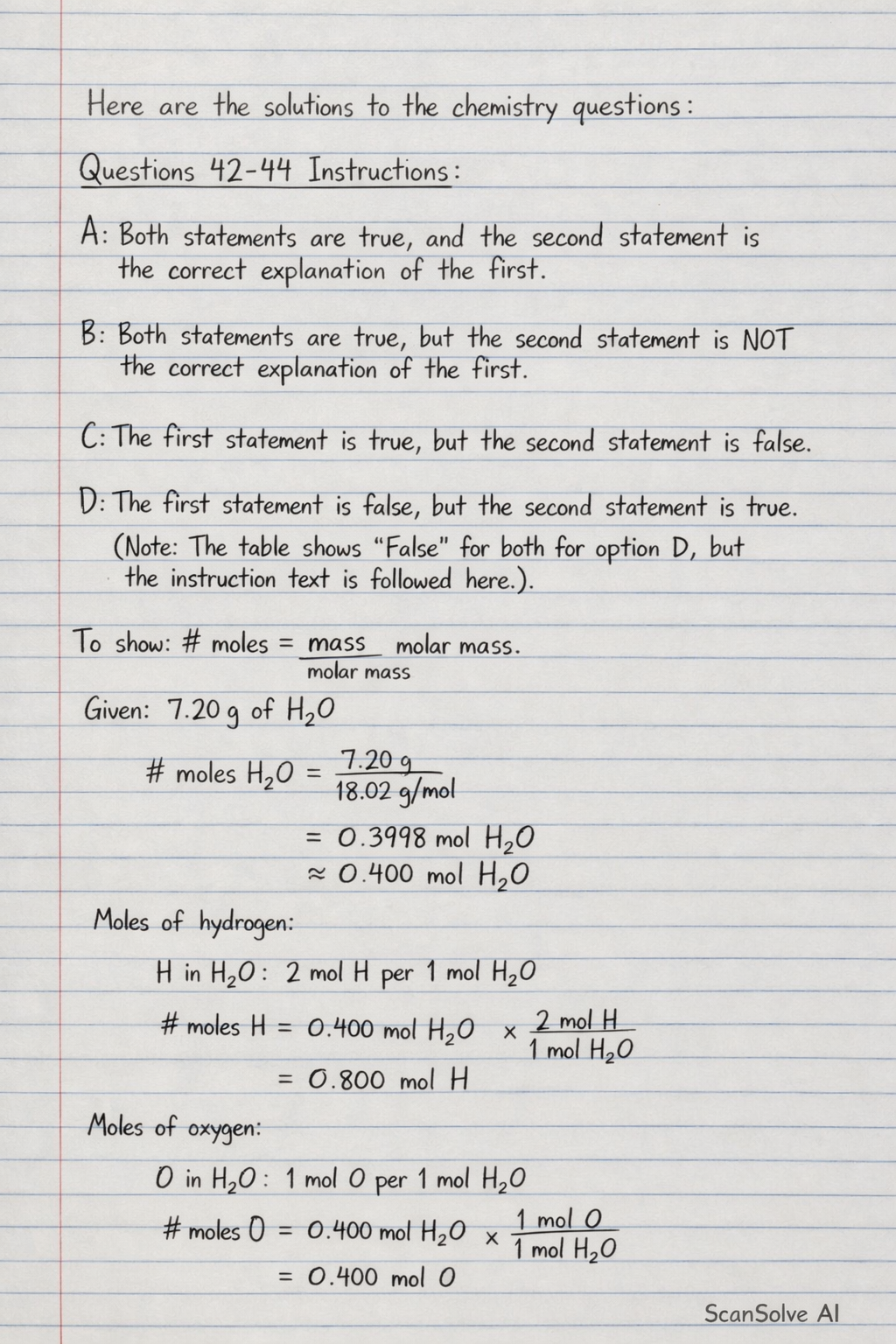
Here are the solutions to the chemistry questions from the image: Questions 42-44 Instructions: A: Both statements are true, and the second statement is the correct explanation of the first. B: Both statements are true, but the second statement is NOT the correct explanation of the first. C: The first statement is true, but the second statement is false. D: The first statement is false, but the second statement is true. (Note: The table shows "False" for both for option D, but the instruction text is followed here). Question 42: First Statement: Ammonium sulphate is a common fertilizer used by Cameroonian farmers. Ammonium sulphate ((NH_4)_2SO_4) is indeed a widely used fertilizer, providing nitrogen and sulfur to plants. This statement is True. Second Statement: Ammonium sulphate contains Nitrogen, oxygen and sulphur chemically combined together. The chemical formula (NH_4)_2SO_4 shows that it contains nitrogen (N), hydrogen (H), sulfur (S), and oxygen (O). The statement correctly identifies nitrogen, oxygen, and sulfur as being chemically combined within the compound. This statement is True. Explanation: The presence of essential nutrients like nitrogen and sulfur (as mentioned in the second statement) is precisely why ammonium sulphate is a common fertilizer (first statement). Thus, the second statement correctly explains the first. The final answer is A. Question 43: First Statement: Both C_2H_5OH and CH_3COOH evolve steamy white fumes with Phosphorus pentachloride (PCl_5). Both ethanol (C_2H_5OH, an alcohol) and ethanoic acid (CH_3COOH, a carboxylic acid) contain a hydroxyl (-OH) group. PCl_5 reacts with compounds containing -OH groups to produce hydrogen chloride (HCl) gas, which forms steamy white fumes in moist air. This statement is True. Second Statement: C_2H_5OH and CH_3COOH are alcohols. C_2H_5OH (ethanol) is an alcohol. However, CH_3COOH (ethanoic acid) is a carboxylic acid, not an alcohol. This statement is False. The final answer is C. Question 44: First Statement: During the electrolysis of dilute NaCl a colourless neutral gas is evolved at the anode. In the electrolysis of dilute sodium chloride solution, water is preferentially oxidized at the anode over chloride ions (due to lower concentration of Cl^- and/or overpotential effects). The oxidation of water produces oxygen gas (O_2), which is a colourless gas. This statement is True. Second Statement: OH^- ions are discharged in preference to Cl^- ions at the anode. In dilute NaCl solution, water (