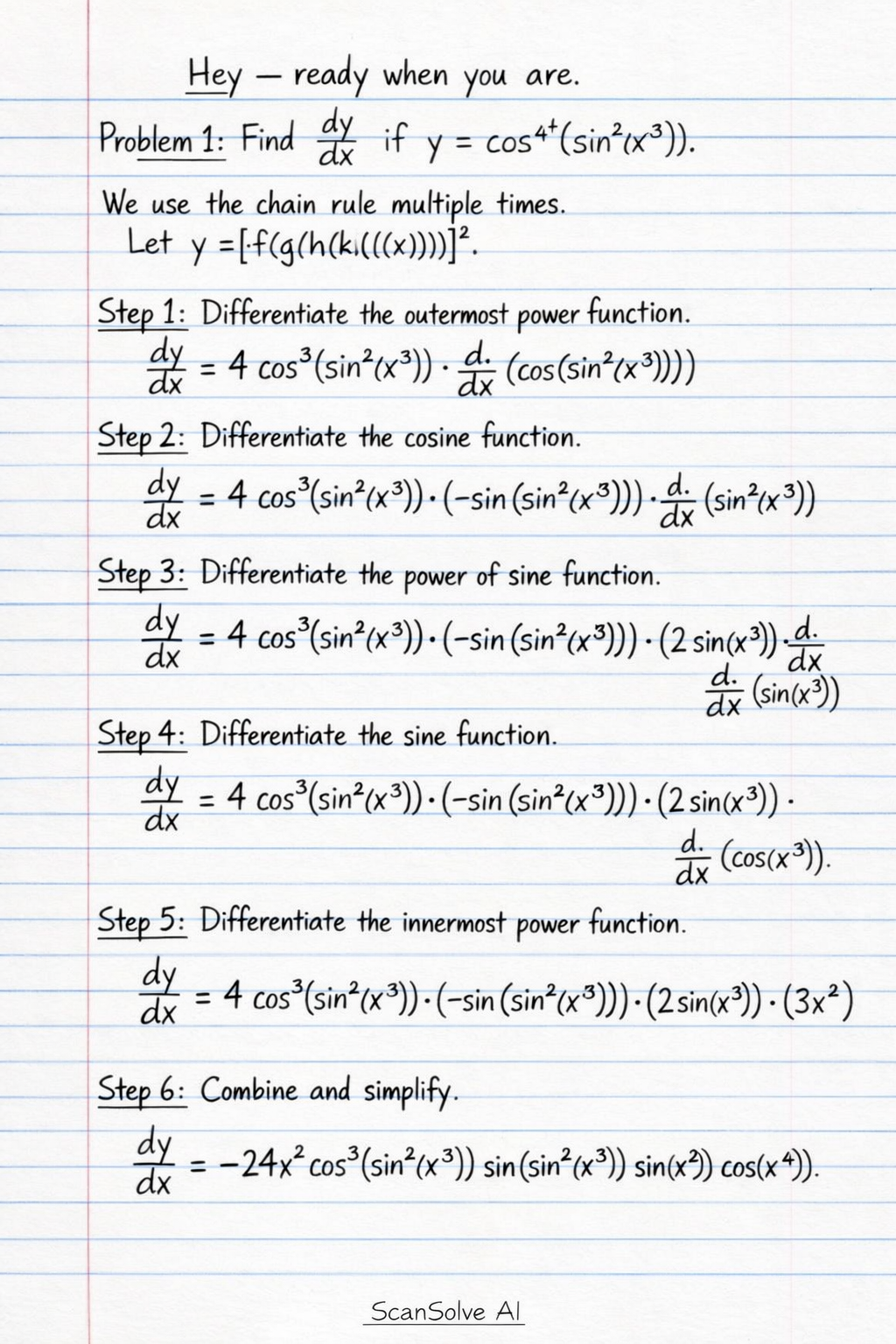
We use the chain rule multiple times.
Let y=[f(g(h(k(l(x)))))]4.
Step 1: Differentiate the outermost power function.
dxdy=4cos3(sin2(x3))⋅dxd(cos(sin2(x3)))
Step 2: Differentiate the cosine function.
dxdy=4cos3(sin2(x3))⋅(−sin(sin2(x3)))⋅dxd(sin2(x3))
Step 3: Differentiate the power of sine function.
dxdy=4cos3(sin2(x3))⋅(−sin(sin2(x3)))⋅(2sin(x3))⋅dxd(sin(x3))
Step 4: Differentiate the sine function.
dxdy=4cos3(sin2(x3))⋅(−sin(sin2(x3)))⋅(2sin(x3))⋅(cos(x3))⋅dxd(x3)
Step 5: Differentiate the innermost power function.
dxdy=4cos3(sin2(x3))⋅(−sin(sin2(x3)))⋅(2sin(x3))⋅(cos(x3))⋅(3x2)
Step 6: Combine and simplify.
dxdy=−24x2cos3(sin2(x3))sin(sin2(x3))sin(x3)cos(x3)
Using the identity 2sinAcosA=sin(2A):
dxdy=−12x2cos3(sin2(x3))sin(sin2(x3))(2sin(x3)cos(x3))dxdy=−12x2cos3(sin2(x3))sin(sin2(x3))sin(2x3)
The derivative is:
dxdy=−24x2cos3(sin2(x3))sin(sin2(x3))sin(x3)cos(x3)
: Find f′(x) if f(x)=x2+x2+1.
We use the chain rule.
Step 1: Differentiate the outermost square root.
f′(x)=2x2+x2+11⋅dxd(x2+x2+1)
Step 2: Differentiate the term inside the first square root.
f′(x)=2x2+x2+11⋅(dxd(x2)+dxd(x2+1))f′(x)=2x2+x2+11⋅(2x+2x2+11⋅dxd(x2+1))
Step 3: Differentiate the innermost term.
f′(x)=2x2+x2+11⋅(2x+2x2+11⋅(2x))f′(x)=2x2+x2+11⋅(2x+x2+1x)
Step 4: Simplify the expression.
f′(x)=2x2+x2+11⋅(x2+12xx2+1+x)f′(x)=2x2+x2+1x2+1x(2x2+1+1)
The derivative is:
f′(x)=2x2+1x2+x2+1x(2x2+1+1)
: Differentiate y=(x2+1)sinx with respect to x.
We use logarithmic differentiation.
Step 1: Take the natural logarithm of both sides.
lny=ln((x2+1)sinx)
Use the logarithm property ln(ab)=blna:
lny=sinx⋅ln(x2+1)
Step 2: Differentiate both sides with respect to x implicitly. Use the product rule on the right side.
y1dxdy=dxd(sinx)⋅ln(x2+1)+sinx⋅dxd(ln(x2+1))
We know dxd(sinx)=cosx.
For dxd(ln(x2+1)), use the chain rule: x2+11⋅dxd(x2+1)=x2+12x.
So,
y1dxdy=cosx⋅ln(x2+1)+sinx⋅x2+12x
Step 3: Solve for dxdy.
dxdy=y(cosxln(x2+1)+x2+12xsinx)
Substitute y=(x2+1)sinx back into the equation:
dxdy=(x2+1)sinx(cosxln(x2+1)+x2+12xsinx)
: Find dxdy for the equation sin(x+y)=y2cosx.
We use implicit differentiation with respect to x.
Step 1: Differentiate both sides of the equation.
dxd(sin(x+y))=dxd(y2cosx)
Step 2: Apply the chain rule on the left side and the product rule on the right side.
cos(x+y)⋅dxd(x+y)=dxd(y2)⋅cosx+y2⋅dxd(cosx)cos(x+y)(1+dxdy)=2ydxdycosx+y2(−sinx)cos(x+y)+cos(x+y)dxdy=2ycosxdxdy−y2sinx
Step 3: Group terms containing dxdy on one side and other terms on the other side.
cos(x+y)dxdy−2ycosxdxdy=−y2sinx−cos(x+y)
Step 4: Factor out dxdy and solve for it.
dxdy(cos(x+y)−2ycosx)=−(y2sinx+cos(x+y))dxdy=cos(x+y)−2ycosx−(y2sinx+cos(x+y))=2ycosx−cos(x+y)y2sinx+cos(x+y)
: Find the derivative of y=(2x+3)4x53x−1 using logarithmic differentiation.
Step 1: Take the natural logarithm of both sides.
lny=ln((2x+3)4x5(x−1)1/3)
Step 2: Use logarithm properties to expand the expression.
lny=ln(x5)+ln((x−1)1/3)−ln((2x+3)4)lny=5lnx+31ln(x−1)−4ln(2x+3)
Step 3: Differentiate both sides with respect to x implicitly.
y1dxdy=5⋅x1+31⋅x−11⋅dxd(x−1)−4⋅2x+31⋅dxd(2x+3)y1dxdy=x5+3(x−1)1⋅1−2x+34⋅2y1dxdy=x5+3(x−1)1−2x+38
Step 4: Solve for dxdy.
dxdy=y(x5+3(x−1)1−2x+38)
Substitute y=(2x+3)4x53x−1 back into the equation:
dxdy=(2x+3)4x53x−1(x5+3(x−1)1−2x+38)
What's next?
Was this helpful?
Need help with your own homework?
Get instant step-by-step solutions to any question. Free to start.
This mathematics problem involves applying core mathematical principles and formulas. Below you will find a complete step-by-step solution with detailed explanations for each step, helping you understand not just the answer but the method behind it.
ScanSolve AI Answer
Hey — ready when you are. Problem 1: Find (dy)/(dx) if y = ^4(^2(x^3)). We use the chain rule multiple times. Let y = [f(g(h(k(l(x))))) ]^4. Step 1: Differentiate the outermost power function. (dy)/(dx) = 4 ^3(^2(x^3)) · (d)/(dx)((^2(x^3))) Step 2: Differentiate the cosine function. (dy)/(dx) = 4 ^3(^2(x^3)) · (-(^2(x^3))) · (d)/(dx)(^2(x^3)) Step 3: Differentiate the power of sine function. (dy)/(dx) = 4 ^3(^2(x^3)) · (-(^2(x^3))) · (2 (x^3)) · (d)/(dx)((x^3)) Step 4: Differentiate the sine function. (dy)/(dx) = 4 ^3(^2(x^3)) · (-(^2(x^3))) · (2 (x^3)) · ((x^3)) · (d)/(dx)(x^3) Step 5: Differentiate the innermost power function. (dy)/(dx) = 4 ^3(^2(x^3)) · (-(^2(x^3))) · (2 (x^3)) · ((x^3)) · (3x^2) Step 6: Combine and simplify. (dy)/(dx) = -24x^2 ^3(^2(x^3)) (^2(x^3)) (x^3) (x^3) Using the identity 2 A A = (2A): (dy)/(dx) = -12x^2 ^3(^2(x^3)) (^2(x^3)) (2 (x^3) (x^3)) (dy)/(dx) = -12x^2 ^3(^2(x^3)) (^2(x^3)) (2x^3) The derivative is: (dy)/(dx) = -24x^2 ^3(^2(x^3)) (^2(x^3)) (x^3) (x^3) Problem 2: Find f'(x) if f(x) = sqrt(x^2 + x^2 + 1). We use the chain rule. Step 1: Differentiate the outermost square root. f'(x) = (1)/(2sqrt(x^2 + x^2 + 1)) · (d)/(dx)(x^2 + sqrt(x^2 + 1)) Step 2: Differentiate the term inside the first square root. f'(x) = (1)/(2sqrt(x^2 + x^2 + 1)) · ( (d)/(dx)(x^2) + (d)/(dx)(sqrt(x^2 + 1)) ) f'(x) = (1)/(2sqrt(x^2 + x^2 + 1)) · ( 2x + (1)/(2sqrt(x^2 + 1)) · (d)/(dx)(x^2 + 1) ) Step 3: Differentiate the innermost term. f'(x) = (1)/(2sqrt(x^2 + x^2 + 1)) · ( 2x + (1)/(2sqrt(x^2 + 1)) · (2x) ) f'(x) = (1)/(2sqrt(x^2 + x^2 + 1)) · ( 2x + (x)/(sqrt(x^2 + 1)) ) Step 4: Simplify the expression. f'(x) = (1)/(2sqrt(x^2 + x^2 + 1)) · ( 2xsqrt(x^2 + 1) + xsqrt(x^2 + 1) ) f'(x) = x(2sqrt(x^2 + 1) + 1)2sqrt(x^2 + x^2 + 1)sqrt(x^2 + 1) The derivative is: f'(x) = x(2sqrt(x^2 + 1) + 1)2sqrt(x^2 + 1)sqrt(x^2 + x^2 + 1) Problem 3: Differentiate y = (x^2 + 1)^ x with respect to x. We use logarithmic differentiation. Step 1: Take the natural logarithm of both sides. y = ((x^2 + 1)^ x) Use the logarithm property (a^b) = b a: y = x · (x^2 + 1) Step 2: Differentiate both sides with respect to x implicitly. Use the product rule on the right side. (1)/(y) (dy)/(dx) = (d)/(dx)( x) · (x^2 + 1) + x · (d)/(dx)((x^2 + 1)) We know (d)/(dx)( x) = x. For (d)/(dx)((x^2 + 1)), use the chain rule: (1)/(x^2 + 1) · (d)/(dx)(x^2 + 1) = (2x)/(x^2 + 1). So, (1)/(y) (dy)/(dx) = x · (x^2 + 1) + x · (2x)/(x^2 + 1) Step 3: Solve for (dy)/(dx). (dy)/(dx) = y ( x (x^2 + 1) + (2x x)/(x^2 + 1) ) Substitute y = (x^2 + 1)^ x back into the equation: (dy)/(dx) = (x^2 + 1)^ x ( x (x^2 + 1) + (2x x)/(x^2 + 1) ) Problem 4: Find (dy)/(dx) for the equation (x+y) = y^2 x. We use implicit differentiation with respect to x. Step 1: Differentiate both sides of the equation. (d)/(dx)((x+y)) = (d)/(dx)(y^2 x) Step 2: Apply the chain rule on the left side and the product rule on the right side. (x+y) · (d)/(dx)(x+y) = (d)/(dx)(y^2) · x + y^2 · (d)/(dx)( x) (x+y) (1 + (dy)/(dx)) = 2y (dy)/(dx) x + y^2 (- x) (x+y) + (x+y) (dy)/(dx) = 2y x (dy)/(dx) - y^2 x Step 3: Group terms containing (dy)/(dx) on one side and other terms on the other side. (x+y) (dy)/(dx) - 2y x (dy)/(dx) = -y^2 x - (x+y) Step 4: Factor out (dy)/(dx) and solve for it. (dy)/(dx) ((x+y) - 2y x) = -(y^2 x + (x+y)) (dy)/(dx) = (-(y^2 x + (x+y)))/((x+y) - 2y x) = (y^2 x + (x+y))/(2y x - (x+y)) Problem 5: Find the derivative of y = x^5 [3]x-1(2x+3)^4 using logarithmic differentiation. Step 1: Take the natural logarithm of both sides. y = (x^5 (x-1)^1/3(2x+3)^4) Step 2: Use logarithm properties to expand the expression. y = (x^5) + ((x-1)^1/3) - ((2x+3)^4) y = 5 x + (1)/(3) (x-1) - 4 (2x+3) Step 3: Differentiate both sides with respect to x implicitly. (1)/(y) (dy)/(dx) = 5 · (1)/(x) + (1)/(3) · (1)/(x-1) · (d)/(dx)(x-1) - 4 · (1)/(2x+3) · (d)/(dx)(2x+3) (1)/(y) (dy)/(dx) = (5)/(x) + (1)/(3(x-1)) · 1 - (4)/(2x+3) · 2 (1)/(y) (dy)/(dx) = (5)/(x) + (1)/(3(x-1)) - (8)/(2x+3) Step 4: Solve for (dy)/(dx). (dy)/(dx) = y ( (5)/(x) + (1)/(3(x-1)) - (8)/(2x+3) ) Substitute y = x^5 [3]x-1(2x+3)^4 back into the equation: (dy)/(dx) = x^5 [3]x-1(2x+3)^4 ( (5)/(x) + (1)/(3(x-1)) - (8)/(2x+3) ) What's next?