
We read your photo as:
Find (i) the amount and (ii) the compound interest of N500,000 for 2 years at 8% per annum
ScanSolve AI Answer
Step-by-step solution
17 stepsHere are the solutions to the questions:
Part 1· 6 steps
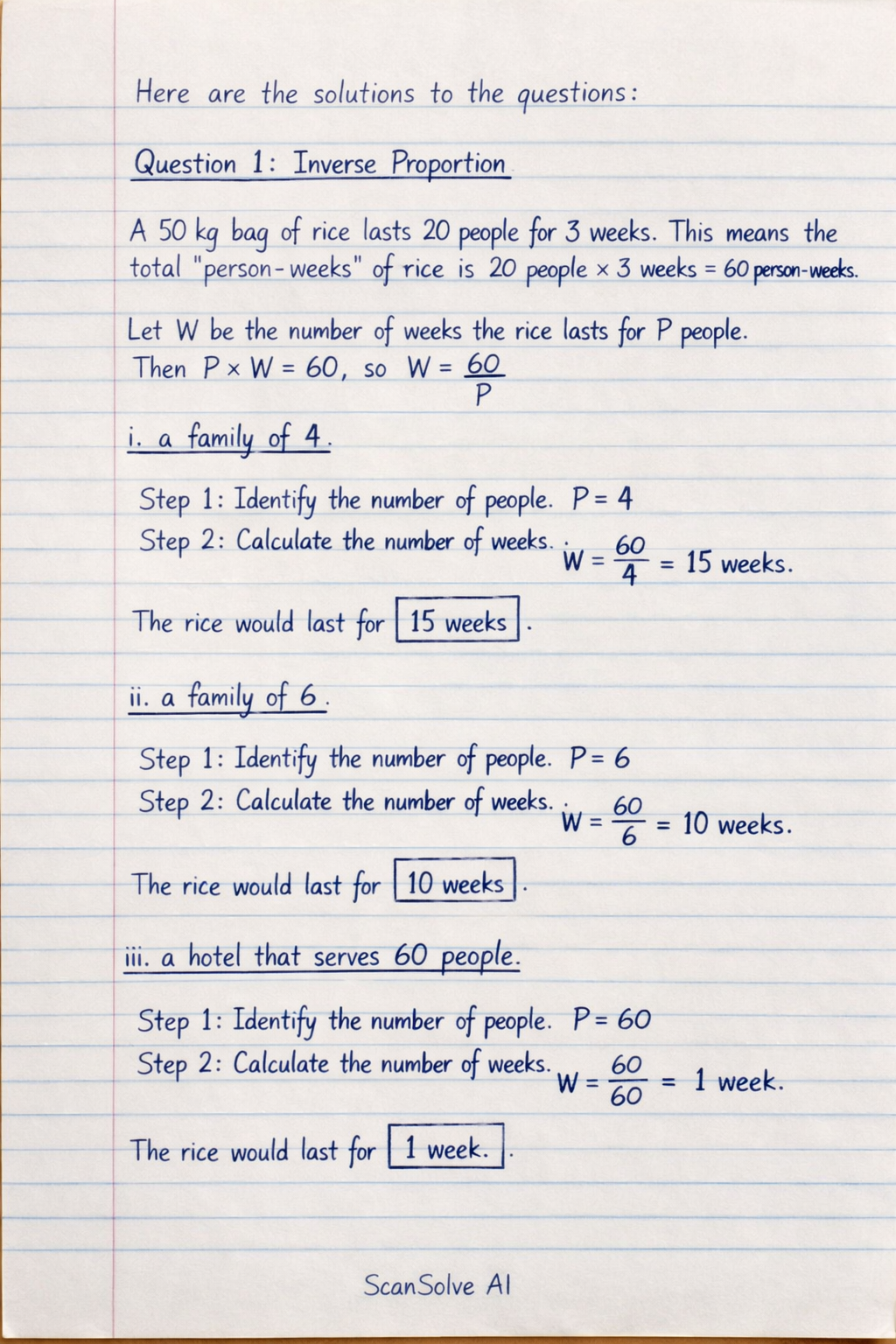
Inverse Proportion
A 50kg bag of rice lasts 20 people for 3 weeks. This means the total "person-weeks" of rice is .
Let be the number of weeks the rice lasts for people. Then , so .
- i. a family of 4
Identify the number of people.
$P = 4$Calculate the number of weeks.
$W = \frac{60}{4} = 15$ weeks. The rice would last for $\boxed{\text{15 weeks}}$.- ii. a family of 6
Identify the number of people.
$P = 6$Calculate the number of weeks.
$W = \frac{60}{6} = 10$ weeks. The rice would last for $\boxed{\text{10 weeks}}$.- iii. a hotel that serves 60 people
Identify the number of people.
$P = 60$Calculate the number of weeks.
$W = \frac{60}{60} = 1$ week.
The rice would last for $\boxed{\text{1 week}}$.
Part 2· 11 steps
Solve the equation
Multiply both sides by to eliminate the denominator.
Distribute the 5 on the right side.
Subtract $5P$ from both sides.
Subtract 5 from both sides.
The solution is .
Question 3a: Find the sizes of the lettered angles in the following diagram.
The diagram shows a triangle with an altitude drawn from the top vertex to the base.
The square symbol indicates that the line segment is perpendicular to the base, forming a angle.
The tick marks on the base indicate that the altitude bisects the base.
When an altitude bisects the base of a triangle, the triangle is an isosceles triangle.
This means the two base angles are equal, and the altitude also bisects the top angle.Determine angle .
Since the triangle is isosceles, the base angles are equal. One base angle is , and the other is .
Determine angles and .
Since the triangle is isosceles, the altitude bisects the top angle, so .
Consider the right-angled triangle on the right side. The angles are , , and .
The sum of angles in a triangle is .Since , then .
Determine angle .
The placement of and is ambiguous in the diagram. However, if we assume the is an angle within the left small triangle, and is the angle adjacent to the angle at the base, this would imply , which is redundant with the square symbol.
Given the common conventions for such diagrams, the label is likely intended to be the angle , but this contradicts the isosceles property ().
Assuming the geometric properties (altitude bisects base isosceles triangle) take precedence over potentially misleading numerical labels, we proceed with .
The letter is placed at the base, to the left of the altitude, adjacent to the angle. This is the position of the angle at the foot of the altitude, which is .
Therefore, .The sizes of the lettered angles are:
Question 3b: Find (i) the amount and (ii) the compound interest of N500,000 for 2 years at 8% per annum.
Given: Principal () = N500,000, Time () = 2 years, Rate () = 8% = 0.08.Calculate the Amount () using the compound interest formula.
The amount is .
Calculate the Compound Interest ().
The compound interest is .
Question 4a: Copy and complete the table below for .
Calculate for each value.
- For :
- For :
- For :
- For :
- For :
Calculate for each value.
- For :
- For :
- For :
- For :
- For :
The completed table is:
x -1 0 1 2 3 3x -3 0 3 6 9 2 2 2 2 2 2 y -1 2 5 8 11
Still stuck on this one?
Ask a follow-up, and the answer starts from this question.
More Mathematics Questions
Handwritten Step-by-Step Solution
Get this as a handwritten image on WhatsApp — like a tutor wrote it for you.
Try on WhatsApp