We read your photo as:

Calculate the monthly payment for a loan of N8000 at 7% annual interest over 2 years, paid monthly.

Mathematics

ScanSolve AI Answer

Answers

2 parts
a

(5−94−234)\begin{pmatrix} 5 & -\frac{9}{4} \\ -2 & \frac{3}{4} \end{pmatrix}

b

(10−219)\begin{pmatrix} 10 & -2 \\ 1 & 9 \end{pmatrix}

9

Step-by-step solution

9 steps

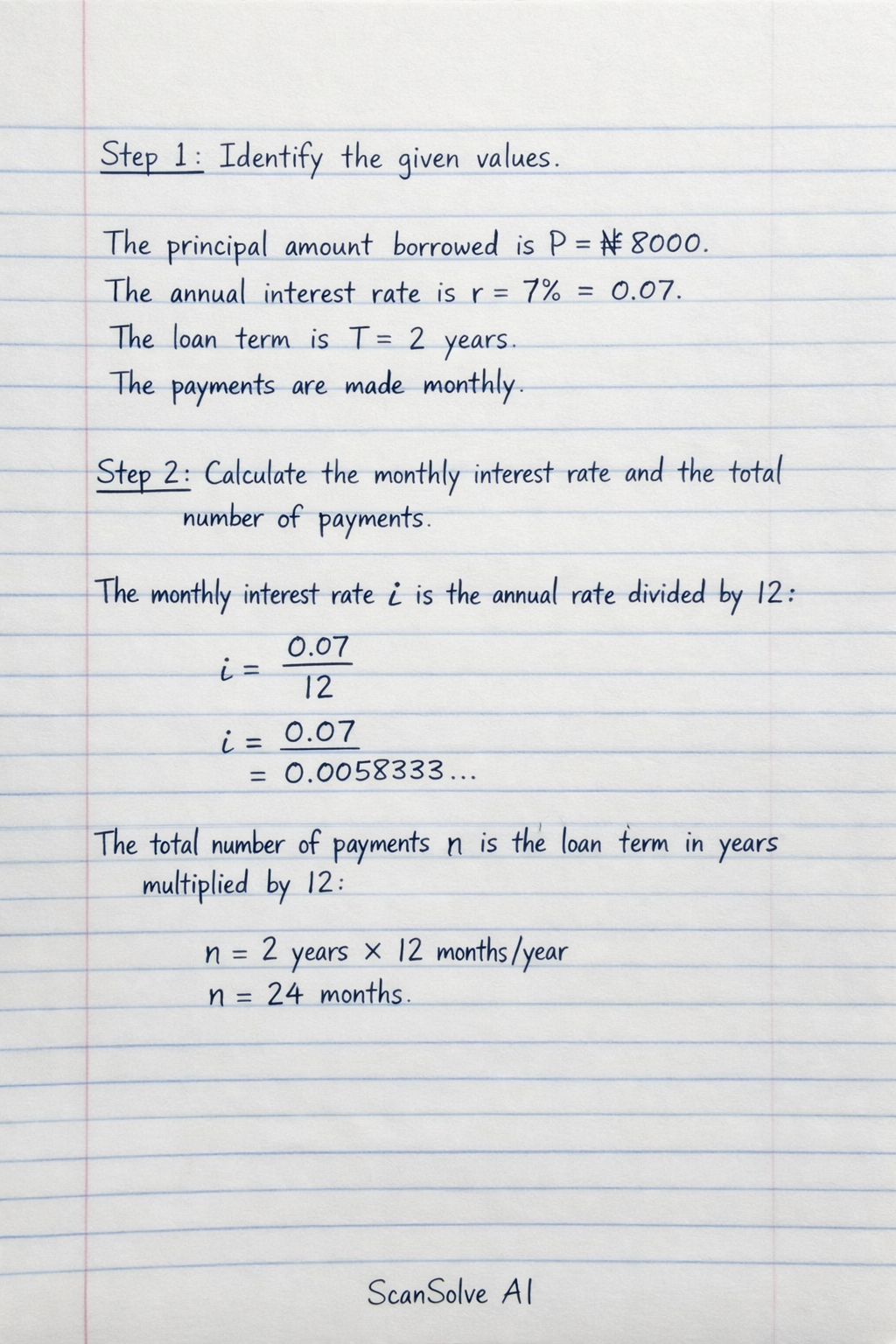
Step 1: Identify the given values.
The principal amount borrowed is P=N8000P = \text{N}8000.
The annual interest rate is r=7%=0.07r = 7\% = 0.07.
The loan term is T=2T = 2 years.
The payments are made monthly.

Step 2: Calculate the monthly interest rate and the total number of payments.
The monthly interest rate ii is the annual rate divided by 12:

i=0.0712i = \frac{0.07}{12}

The total number of payments nn is the loan term in years multiplied by 12:

n=2 years×12 months/year=24 monthsn = 2 \text{ years} \times 12 \text{ months/year} = 24 \text{ months}

Step 3: Use the loan payment formula for an amortizing loan.
The formula for the monthly payment MM is:

M=Pi(1+i)n(1+i)n−1M = P \frac{i(1+i)^n}{(1+i)^n - 1}

Substitute the values:

M=80000.0712(1+0.0712)24(1+0.0712)24−1M = 8000 \frac{\frac{0.07}{12}(1+\frac{0.07}{12})^{24}}{(1+\frac{0.07}{12})^{24} - 1}

Calculate the value of 1+0.07121+\frac{0.07}{12}:

1+0.0712≈1+0.005833333=1.0058333331+\frac{0.07}{12} \approx 1 + 0.005833333 = 1.005833333

Calculate (1+0.0712)24(1+\frac{0.07}{12})^{24}:

(1.005833333)24≈1.149716(1.005833333)^{24} \approx 1.149716

Now substitute these values back into the formula for MM:

M=80000.005833333×1.1497161.149716−1M = 8000 \frac{0.005833333 \times 1.149716}{1.149716 - 1} M=80000.0067066760.149716M = 8000 \frac{0.006706676}{0.149716} M=8000×0.044795M = 8000 \times 0.044795 M≈358.36M \approx 358.36

The monthly payment is approximately N358.36.

The monthly payment is N358.36\boxed{\text{N}358.36}.

Part a· 3 steps

Evaluate 14A−2B\frac{1}{4}A - 2B.

  1. Calculate 14A\frac{1}{4}A.

    14A=14(4−103)=(14×414×(−1)14×014×3)=(1−14034)\frac{1}{4}A = \frac{1}{4} \begin{pmatrix} 4 & -1 \\ 0 & 3 \end{pmatrix} = \begin{pmatrix} \frac{1}{4} \times 4 & \frac{1}{4} \times (-1) \\ \frac{1}{4} \times 0 & \frac{1}{4} \times 3 \end{pmatrix} = \begin{pmatrix} 1 & -\frac{1}{4} \\ 0 & \frac{3}{4} \end{pmatrix}
  2. Calculate $2B$.

    2B=2(−2110)=(2×(−2)2×12×12×0)=(−4220)2B = 2 \begin{pmatrix} -2 & 1 \\ 1 & 0 \end{pmatrix} = \begin{pmatrix} 2 \times (-2) & 2 \times 1 \\ 2 \times 1 & 2 \times 0 \end{pmatrix} = \begin{pmatrix} -4 & 2 \\ 2 & 0 \end{pmatrix}
  3. Subtract 2B2B from 14A\frac{1}{4}A.

    14A−2B=(1−14034)−(−4220)\frac{1}{4}A - 2B = \begin{pmatrix} 1 & -\frac{1}{4} \\ 0 & \frac{3}{4} \end{pmatrix} - \begin{pmatrix} -4 & 2 \\ 2 & 0 \end{pmatrix} =(1−(−4)−14−20−234−0)= \begin{pmatrix} 1 - (-4) & -\frac{1}{4} - 2 \\ 0 - 2 & \frac{3}{4} - 0 \end{pmatrix} =(1+4−14−84−234)= \begin{pmatrix} 1 + 4 & -\frac{1}{4} - \frac{8}{4} \\ -2 & \frac{3}{4} \end{pmatrix} =(5−94−234)= \begin{pmatrix} 5 & -\frac{9}{4} \\ -2 & \frac{3}{4} \end{pmatrix}

    The result is (5−94−234)\boxed{\begin{pmatrix} 5 & -\frac{9}{4} \\ -2 & \frac{3}{4} \end{pmatrix}}.

Part b

(10−219)\begin{pmatrix} 10 & -2 \\ 1 & 9 \end{pmatrix}

Evaluate B+3AB + 3A.

  1. Calculate $3A$.

    3A=3(4−103)=(3×43×(−1)3×03×3)=(12−309)3A = 3 \begin{pmatrix} 4 & -1 \\ 0 & 3 \end{pmatrix} = \begin{pmatrix} 3 \times 4 & 3 \times (-1) \\ 3 \times 0 & 3 \times 3 \end{pmatrix} = \begin{pmatrix} 12 & -3 \\ 0 & 9 \end{pmatrix}
  2. Add BB to 3A3A.

    B+3A=(−2110)+(12−309)B + 3A = \begin{pmatrix} -2 & 1 \\ 1 & 0 \end{pmatrix} + \begin{pmatrix} 12 & -3 \\ 0 & 9 \end{pmatrix} =(−2+121+(−3)1+00+9)= \begin{pmatrix} -2 + 12 & 1 + (-3) \\ 1 + 0 & 0 + 9 \end{pmatrix} =(10−219)= \begin{pmatrix} 10 & -2 \\ 1 & 9 \end{pmatrix}

    The result is (10−219)\boxed{\begin{pmatrix} 10 & -2 \\ 1 & 9 \end{pmatrix}}.

  3. Apply the logarithm property log⁡bM−log⁡bN=log⁡b(MN)\log_b M - \log_b N = \log_b \left(\frac{M}{N}\right).

    The given equation is:

    log⁡3(x2)−log⁡3x=2\log_3(x^2) - \log_3 x = 2

    Applying the property:

    log⁡3(x2x)=2\log_3 \left(\frac{x^2}{x}\right) = 2
  4. Simplify the expression inside the logarithm.

    log⁡3x=2\log_3 x = 2
  5. Convert the logarithmic equation to an exponential equation.

    If log⁡bY=X\log_b Y = X, then bX=Yb^X = Y.
    Here, b=3b=3, Y=xY=x, and X=2X=2.

    x=32x = 3^2
  6. Calculate the value of xx.

    x=9x = 9

    For the logarithms to be defined, x2>0x^2 > 0 and x>0x > 0. Our solution x=9x=9 satisfies these conditions.

    The value of xx is 9\boxed{9}.

Was this helpful?

Try one yourself

A new problem that tests the same skill.

Still stuck on this one?

Ask a follow-up, and the answer starts from this question.

Got a different question?Ask your own question
Handwritten step-by-step solution preview

Handwritten Step-by-Step Solution

Get this as a handwritten image on WhatsApp — like a tutor wrote it for you.

Try on WhatsApp