
We read your photo as:
A. Without the use of valuation tables, calculate: the present value of N1=500,000 for 40 years @ 8% is 21.7743. b. Find i, given that (A-1)/i x N1,200,000.00 = N2,520,000.00 (5 marks)
ScanSolve AI Answer
Step-by-step solution
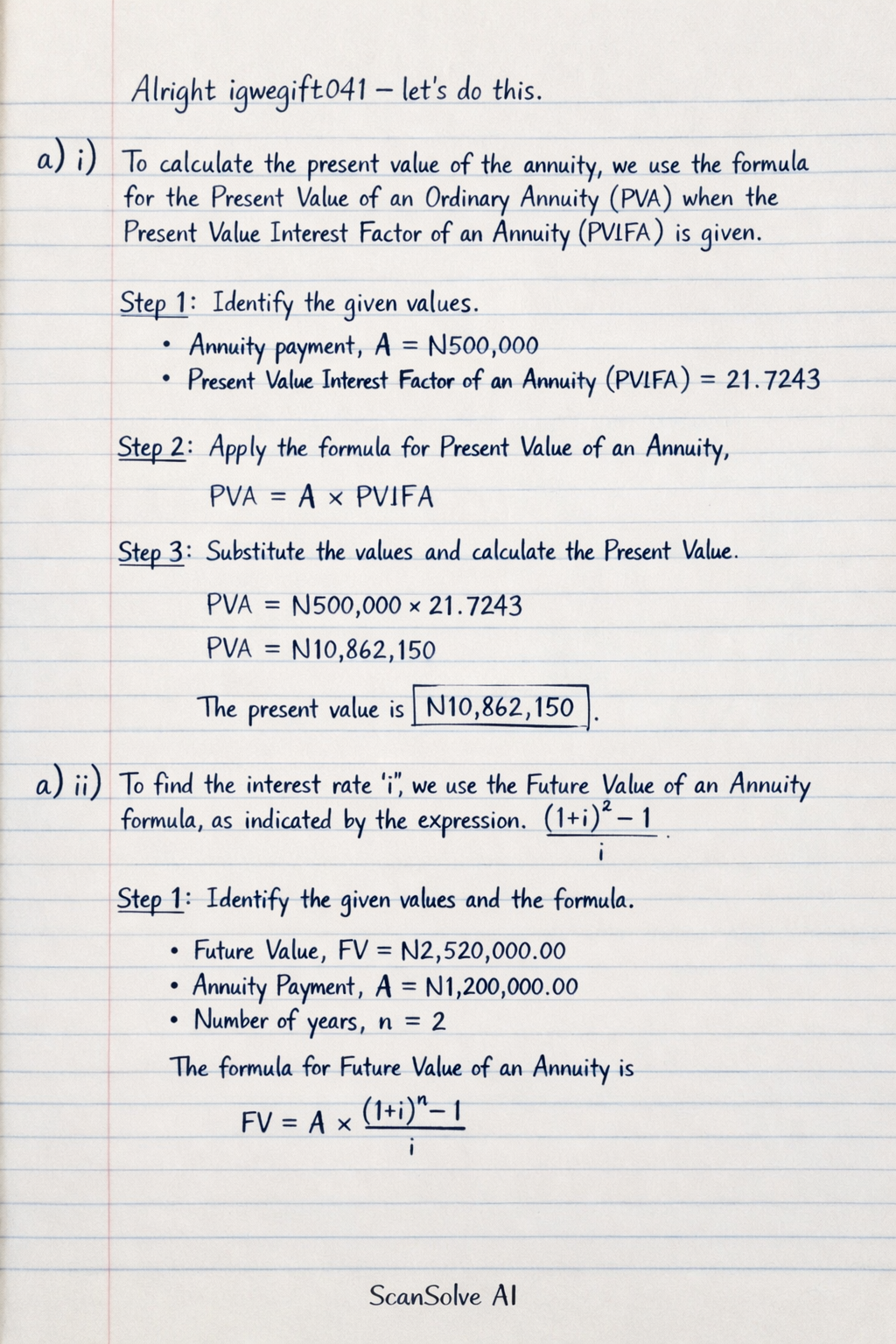
9 stepsa) i)
To calculate the present value of the annuity, we use the formula for the present value of an ordinary annuity (PVA) when the Present Value Interest Factor of an Annuity (PVIFA) is given.
Identify the given values.
Annuity payment,
Present Value Interest Factor of an Annuity (PVIFA)Apply the formula for Present Value of an Annuity.
Substitute the values and calculate the Present Value.
The present value is .
a) ii)
To find the interest rate 'i', we use the Future Value of an Annuity formula, as indicated by the expression .Identify the given values and the formula.
Future Value,
Annuity Payment,
Number of years,
The formula for Future Value of an Annuity is .Substitute the given values into the formula.
Isolate the Future Value Interest Factor of an Annuity (FVIFA) term.
Expand the numerator and simplify the equation.
We know that .
So, the equation becomes:Since cannot be zero for an interest rate, we can divide the numerator by :
Solve for .
Convert the decimal interest rate to a percentage.
The interest rate is .
Still stuck on this one?
Ask a follow-up, and the answer starts from this question.
More Mathematics Questions
Handwritten Step-by-Step Solution
Get this as a handwritten image on WhatsApp — like a tutor wrote it for you.
Try on WhatsApp