
We read your photo as:
Solve the radical equation: 3sqrt(4x−3) − sqrt(5x+1) = 5
ScanSolve AI Answer
Answer
Step-by-step solution
7 stepsIsolate one of the radical terms.
We start with the given equation:
Add to both sides to isolate the first radical term:
Square both sides of the equation.
Squaring both sides eliminates the outermost radical on the left and expands the right side using :
Simplify the equation and isolate the remaining radical term.
Combine like terms on the right side:
Move all non-radical terms to the left side:
For this equation to have real solutions, we must have , which means .
Square both sides again to eliminate the last radical.
Expand the left side using :
Rearrange the equation into a standard quadratic form .
Solve the quadratic equation for .
We use the quadratic formula .
Here, , , .
Calculate the discriminant :Now find :
Substitute these values into the quadratic formula:
This gives two potential solutions:
Check the solutions against the domain restrictions and the original equation.
The problem states that must be an integer. From our solutions, is an integer, while is not.
Also, recall the condition .
satisfies this condition.
, which does not satisfy , so it is an extraneous solution.Let's verify in the original equation:
The solution is correct.
The final answer is .
Try one yourself
A new problem that tests the same skill.
Still stuck on this one?
Ask a follow-up, and the answer starts from this question.
More Mathematics Questions
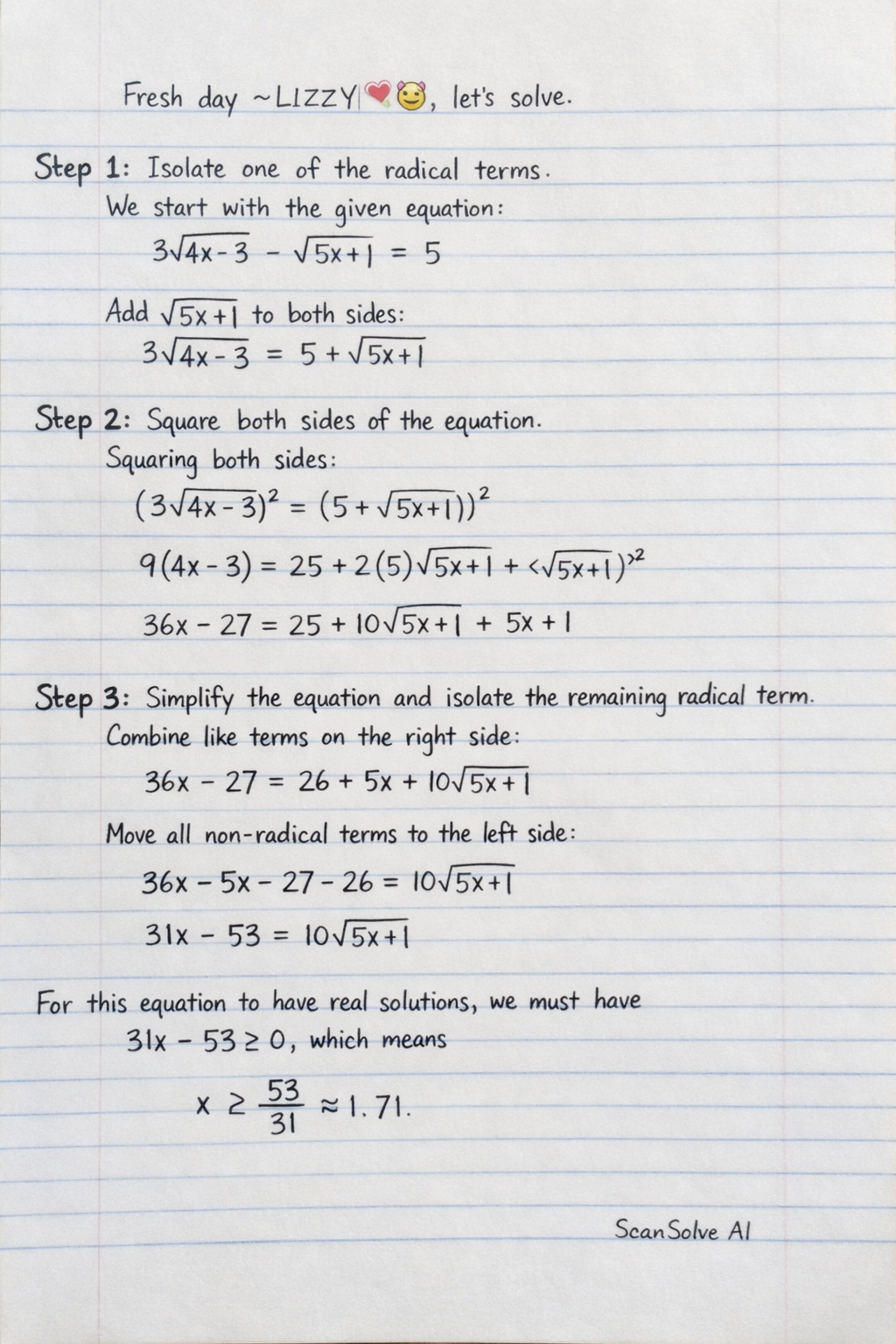
Handwritten Step-by-Step Solution
Get this as a handwritten image on WhatsApp — like a tutor wrote it for you.
Try on WhatsApp