

This mathematics problem involves applying core mathematical principles and formulas. Below you will find a complete step-by-step solution with detailed explanations for each step, helping you understand not just the answer but the method behind it.
ScanSolve AI Answer
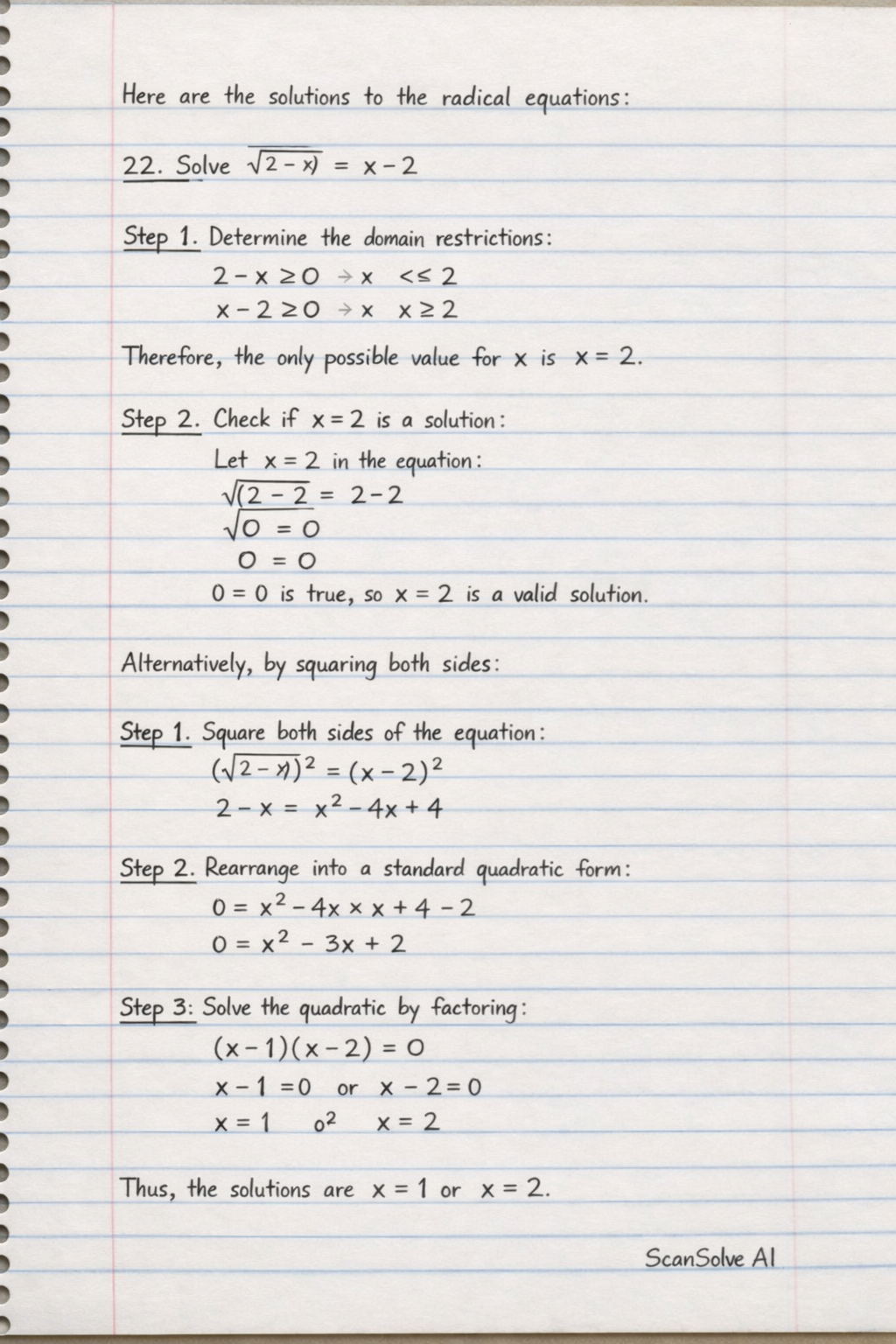
Here are the solutions to the radical equations: 22. Solve sqrt(2 - x) = x - 2 Step 1: Determine the domain restrictions. For the square root sqrt(2-x) to be defined, 2-x 0 x 2. For the right side x-2 to be non-negative (as it equals a square root), x-2 0 x 2. Combining these, the only possible value for x is x=2. Step 2: Check if x=2 is a solution. Substitute x=2 into the equation: sqrt(2 - 2) = 2 - 2 sqrt(0) = 0 0 = 0 This is true, so x=2 is a valid solution. Alternatively, by squaring both sides: Step 1: Square both sides of the equation. (sqrt(2 - x))^2 = (x - 2)^2 2 - x = x^2 - 4x + 4 Step 2: Rearrange the equation into a standard quadratic form. 0 = x^2 - 4x + x + 4 - 2 0 = x^2 - 3x + 2 Step 3: Solve the quadratic equation by factoring. (x - 1)(x - 2) = 0 This gives two potential solutions: x = 1 or x = 2. Step 4: Check for extraneous solutions using the original equation. For x=1: sqrt(2 - 1) = 1 - 2 sqrt(1) = -1 1 = -1 This is false, so x=1 is an extraneous solution. For x=2: sqrt(2 - 2) = 2 - 2 sqrt(0) = 0 0 = 0 This is true, so x=2 is a valid solution. The final answer is x = 2. --- 23. Solve sqrt(43 - x) - x + 1 = 0 Step 1: Isolate the radical term. sqrt(43 - x) = x - 1 Step 2: Determine the domain restrictions. For the square root sqrt(43-x) to be defined, 43-x 0 x 43. For the right side x-1 to be non-negative, x-1 0 x 1. So, any valid solution must satisfy 1 x 43. Step 3: Square both sides of the equation. (sqrt(43 - x))^2 = (x - 1)^2 43 - x = x^2 - 2x + 1 Step 4: Rearrange the equation into a standard quadratic form. 0 = x^2 - 2x + x + 1 - 43 0 = x^2 - x - 42 Step 5: Solve the quadratic equation by factoring. We look for two numbers that multiply to -42 and add to -1. These are -7 and 6. (x - 7)(x + 6) = 0 This gives two potential solutions: x = 7 or x = -6. Step 6: Check for extraneous solutions using the domain restrictions or the original equation. For x=7: This satisfies 1 7 43. Substitute into the original equation: sqrt(43 - 7) - 7 + 1 = 0 sqrt(36) - 6 = 0 6 - 6 = 0 0 = 0 This is true, so x=7 is a valid solution. For x=-6: This does not satisfy x 1 (since -6 < 1). So x=-6 is an extraneous solution. Alternatively, substitute into the original equation: sqrt(43 - (-6)) - (-6) + 1 = 0 sqrt(49) + 6 + 1 = 0 7 + 6 + 1 = 0 14 = 0 This is false, so x=-6 is an extraneous solution. The final answer is x = 7. --- 24. Solve 2sqrt(x + 6) + 2 = x Step 1: Isolate the radical term. 2sqrt(x + 6) = x - 2 Step 2: Determine the domain restrictions. For the square root sqrt(x+6) to be defined, x+6 0 x -6. For the right side x-2 to be non-negative (as it equals twice a square root), x-2 0 x 2. So, any valid solution must satisfy x 2. Step 3: Square both sides of the equation. (2sqrt(x + 6))^2 = (x - 2)^2 4(x + 6) = x^2 - 4x + 4 4x + 24 = x^2 - 4x + 4 Step 4: Rearrange the equation into a standard quadratic form. 0 = x^2 - 4x - 4x + 4 - 24 0 = x^2 - 8x - 20 Step 5: Solve the quadratic equation by factoring. We look for two numbers that multiply to -20 and add to -8. These are -10 and 2. (x - 10)(x + 2) = 0 This gives two potential solutions: x = 10 or x = -2. Step 6: Check for extraneous solutions using the domain restrictions or the original equation. For x=10: This satisfies x 2 (since 10 2). Substitute into the original equation: 2sqrt(10 + 6) + 2 = 10 2sqrt(16) + 2 = 10 2(4) + 2 = 10 8 + 2 = 10 10 = 10 This is true, so x=10 is a valid solution. For x=-2: This does not satisfy x 2 (since -2 < 2). So x=-2 is an extraneous solution. Alternatively, substitute into the original equation: 2sqrt(-2 + 6) + 2 = -2 2sqrt(4) + 2 = -2 2(2) + 2 = -2 4 + 2 = -2 6 = -2 This is false, so x=-2 is an extraneous solution. The final answer is x = 10.