

This mathematics problem involves applying core mathematical principles and formulas. Below you will find a complete step-by-step solution with detailed explanations for each step, helping you understand not just the answer but the method behind it.
ScanSolve AI Answer
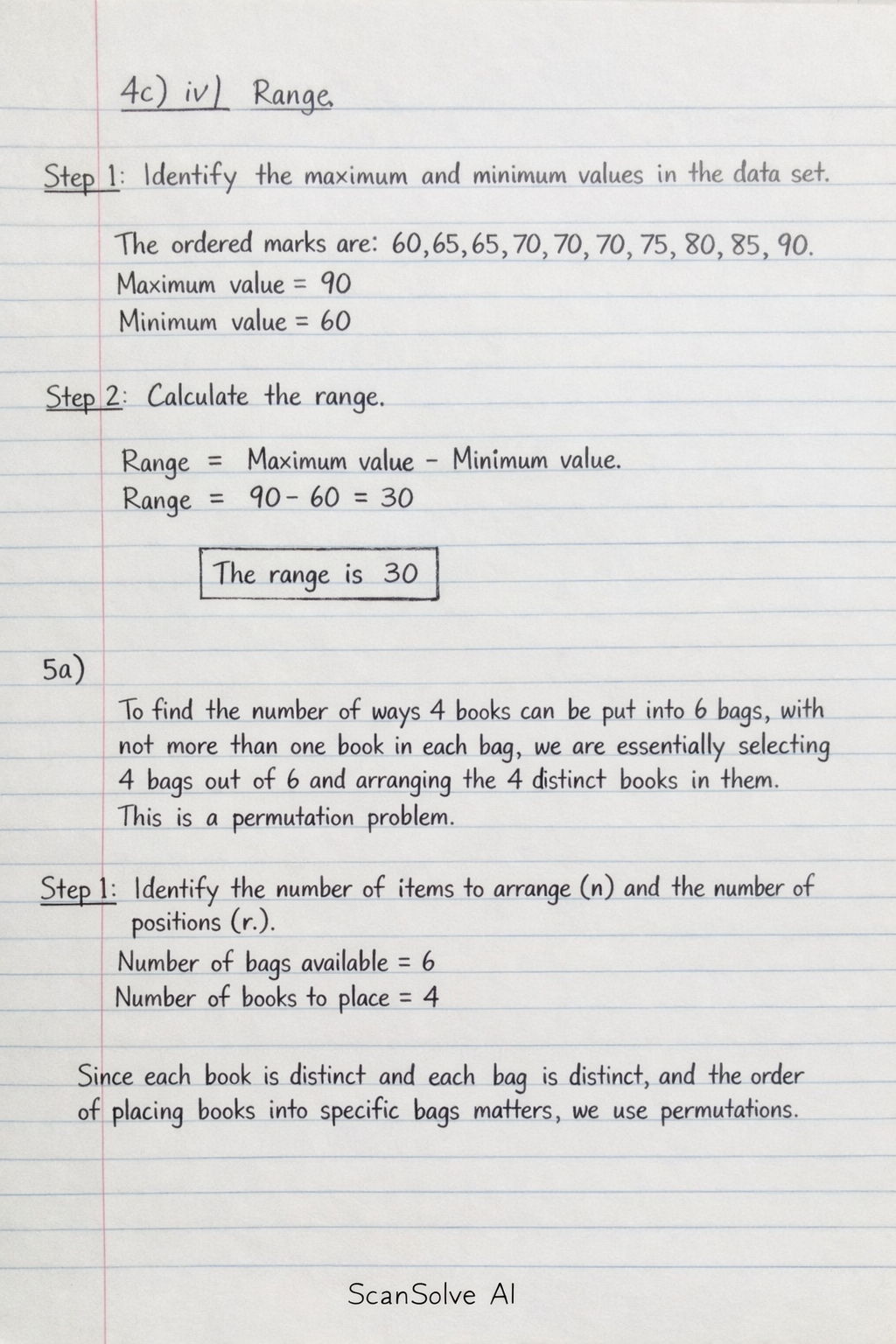
4c) iv) Range Step 1: Identify the maximum and minimum values in the data set. The ordered marks are: 60, 65, 65, 70, 70, 70, 75, 80, 85, 90. Maximum value = 90 Minimum value = 60 Step 2: Calculate the range. Range = Maximum value - Minimum value Range = 90 - 60 = 30 The range is 30. 5a) To find the number of ways 4 books can be put into 6 bags, with not more than one book in each bag, we are essentially selecting 4 bags out of 6 and arranging the 4 distinct books in them. This is a permutation problem. Step 1: Identify the number of items to arrange (n) and the number of positions (r). Number of bags available = 6 Number of books to place = 4 Since each book is distinct and each bag is distinct, and the order of placing books into specific bags matters, we use permutations. Step 2: Apply the permutation formula P(n, r) = (n!)/((n-r)!). Here, n=6 (bags) and r=4 (books). P(6, 4) = (6!)/((6-4)!) = (6!)/(2!) P(6, 4) = (6 × 5 × 4 × 3 × 2 × 1)/(2 × 1) P(6, 4) = 6 × 5 × 4 × 3 P(6, 4) = 30 × 12 P(6, 4) = 360 There are 360 different ways. 5b) A matrix is a rectangular array of numbers, symbols, or expressions arranged in rows and columns. It is used to represent linear transformations, systems of linear equations, and data. 5c) i)* Square Matrix: A square matrix is a matrix that has an equal number of rows and columns. Its dimension is typically denoted as n × n. ii)* Diagonal Matrix: A diagonal matrix is a square matrix where all the elements outside of the main diagonal are zero. The elements on the main diagonal can be any value. iii)* Symmetric Matrix: A symmetric matrix is a square matrix that is equal to its own transpose (A = A^T). This means that the element in row i and column j is equal to the element in row j and column i (a_ij = a_ji). iv)* Singular Matrix: A singular matrix is a square matrix whose determinant is equal to zero. A singular matrix does not have an inverse. 5d) Given matrices A = 1 & -2 & 3 \\ 4 & 5 & -6 and B = 3 & 0 & 2 \\ -7 & 1 & 8 . i) Find A+B Step 1: Add the corresponding elements of matrix A and matrix B. A+B = 1+3 & -2+0 & 3+2 \\ 4+(-7) & 5+1 & -6+8 Step 2: Perform the additions. A+B = 4 & -2 & 5 \\ -3 & 6 & 2 ii) Find A-B Step 1: Subtract the corresponding elements of matrix B from matrix A. A-B = 1-3 & -2-0 & 3-2 \\ 4-(-7) & 5-1 & -6-8 Step 2: Perform the subtractions. A-B = -2 & -2 & 1 \\ 11 & 4 & -14 6) Find the inverse of Matrix A Given matrix A = 1 & 2 & 3 \\ 4 & 1 & 5 \\ 6 & 0 & 2 . The inverse of a matrix A is given by A^-1 = (1)/((A)) adj(A). Step 1: Calculate the determinant of A. (A) = 1 1 & 5 \\ 0 & 2 - 2 4 & 5 \\ 6 & 2 + 3 4 & 1 \\ 6 & 0 (A) = 1((1)(2) - (5)(0)) - 2((4)(2) - (5)(6)) + 3((4)(0) - (1)(6)) (A) = 1(2 - 0) - 2(8 - 30) + 3(0 - 6) (A) = 1(2) - 2(-22) + 3(-6) (A) = 2 + 44 - 18 (A) = 28 Step 2: Calculate the cofactor matrix C. C_11 = 1 & 5 \\ 0 & 2 = 2 - 0 = 2 C_12 = - 4 & 5 \\ 6 & 2 = -(8 - 30) = -(-22) = 22 C_13 = 4 & 1 \\ 6 & 0 = 0 - 6 = -6 C_21 = - 2 & 3 \\ 0 & 2 = -(4 - 0) = -4 C_22 = 1 & 3 \\ 6 & 2 = 2 - 18 = -16 C_23 = - 1 & 2 \\ 6 & 0 = -(0 - 12) = -(-12) = 12 C_31 = 2 & 3 \\ 1 & 5 = 10 - 3 = 7 C_32 = - 1 & 3 \\ 4 & 5 = -(5 - 12) = -(-7) = 7 C_33 = 1 & 2 \\ 4 & 1 = 1 - 8 = -7 The cofactor matrix is: C = 2 & 22 & -6 \\ -4 & -16 & 12 \\ 7 & 7 & -7 Step 3: Calculate the adjoint matrix, which is the transpose of the cofactor matrix. adj(A) = C^T = 2 & -4 & 7 \\ 22 & -16 & 7 \\ -6 & 12 & -7 Step 4: Calculate the inverse matrix. A^-1 = (1)/((A)) adj(A) A^-1 = (1)/(28) 2