
We read your photo as:
Find the rate percent per annum simple interest for K420 to be the interest on K1200 invested for 5 years.
ScanSolve AI Answer
Step-by-step solution
12 stepsHere are the solutions for questions 3, 4, 5, and 6.
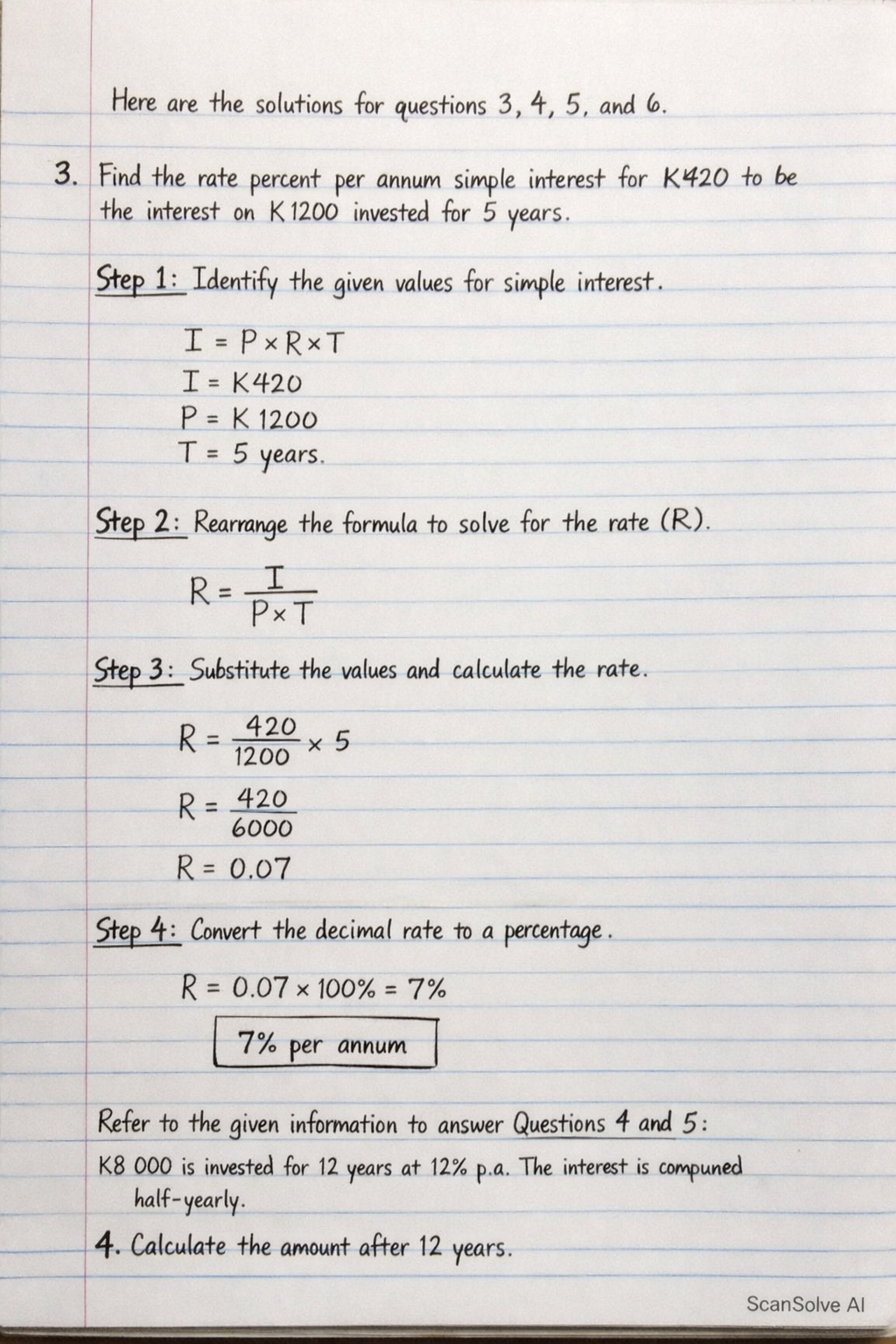
3. Find the rate percent per annum simple interest for K420 to be the interest on K1200 invested for 5 years.
Identify the given values for simple interest.
The formula for simple interest is , where is the interest, is the principal, is the annual interest rate, and is the time in years.
Given:
Interest () = K420
Principal () = K1200
Time () = 5 yearsRearrange the formula to solve for the rate ().
Substitute the values and calculate the rate.
Convert the decimal rate to a percentage.
Refer to the given information to answer Questions 4 and 5
K8 000 is invested for 12 years at 12% pa. The interest is compounded half-yearly.4. Calculate the amount after 12 years.
Identify the given values for compound interest.
The formula for compound amount is , where is the amount, is the principal, is the annual interest rate, is the number of times interest is compounded per year, and is the time in years.
Given:
Principal () = K8 000
Annual interest rate () = 12% = 0.12
Time () = 12 years
Compounding frequency () = 2 (half-yearly)Calculate the values for and .
Substitute the values into the compound amount formula and calculate.
5. Calculate the interest earned after 12 years.
Use the amount calculated in Question 4 and the original principal.
Amount () = K32391.24
Principal () = K8 000Subtract the principal from the amount to find the interest earned.
6. Evaluate: K5 000
Convert the percentage to a decimal and add it to 1.
Raise the result to the power of 5.
Multiply the result by K5 000.
Still stuck on this one?
Ask a follow-up, and the answer starts from this question.
More Mathematics Questions
Handwritten Step-by-Step Solution
Get this as a handwritten image on WhatsApp — like a tutor wrote it for you.
Try on WhatsApp