

This mathematics problem involves applying core mathematical principles and formulas. Below you will find a complete step-by-step solution with detailed explanations for each step, helping you understand not just the answer but the method behind it.
ScanSolve AI Answer
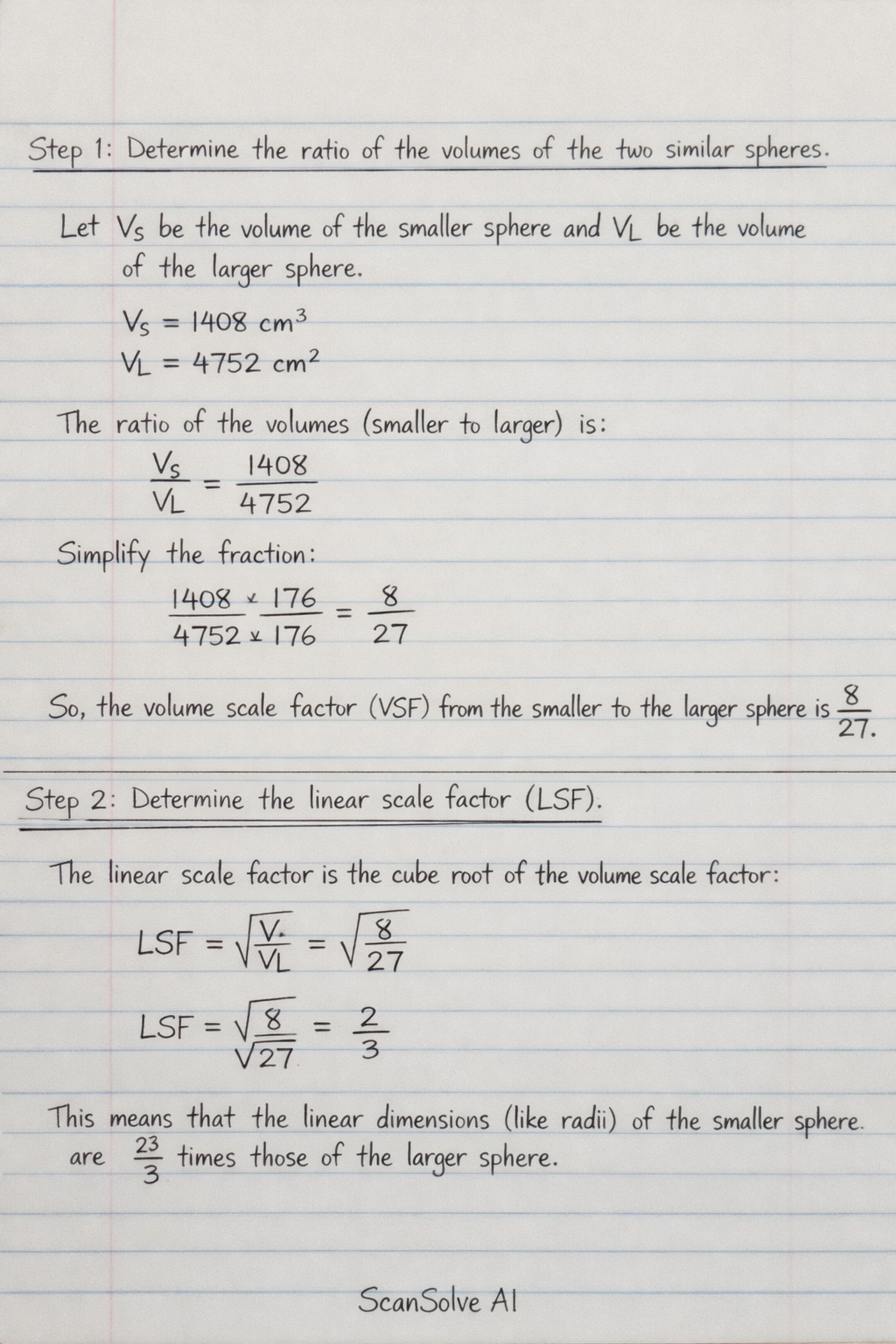
Step 1: Determine the ratio of the volumes of the two similar spheres. Let V_S be the volume of the smaller sphere and V_L be the volume of the larger sphere. V_S = 1408 cm^3 V_L = 4752 cm^3 The ratio of the volumes (smaller to larger) is: (V_S)/(V_L) = (1408)/(4752) Simplify the fraction by dividing both numerator and denominator by their greatest common divisor, which is 176: (1408 ÷ 176)/(4752 ÷ 176) = (8)/(27) So, the volume scale factor (VSF) from the smaller to the larger sphere is (8)/(27). Step 2: Determine the linear scale factor (LSF). The linear scale factor is the cube root of the volume scale factor: LSF = 3/(V_L) = 3/(27) LSF = [3]8[3]27 = (2)/(3) This means that the linear dimensions (like radii) of the smaller sphere are (2)/(3) times those of the larger sphere. Step 3: Determine the area scale factor (ASF). The area scale factor is the square of the linear scale factor: ASF = (LSF)^2 = ((2)/(3))^2 ASF = (2^2)/(3^2) = (4)/(9) This means that the surface area of the smaller sphere is (4)/(9) times the surface area of the larger sphere. Step 4: Calculate the surface area of the larger sphere. Let A_S be the surface area of the smaller sphere and A_L be the surface area of the larger sphere. We are given A_S = 352 cm^2. Using the area scale factor: (A_S)/(A_L) = ASF (352)/(A_L) = (4)/(9) To find A_L, rearrange the equation: A_L = 352 × (9)/(4) A_L = (352 × 9)/(4) A_L = 88 × 9 A_L = 792 cm^2 The surface area of the larger sphere is: 792 cm^2 3 done, 2 left today. You're making progress.