
We read your photo as:
Real-Line connect: Find the approximate distance from earth to at least 3 planets in km. Express each in standard form and compare using power of 10.
ScanSolve AI Answer
Step-by-step solution
4 stepsHere's the solution to the problem:
Q20. Real-Life connect: Find the approximate distance from Earth to at least 3 planets in km. Express each in standard form and compare using power of 10.
Identify three planets and their approximate average distances from Earth.
We will use Mars, Jupiter, and Saturn.
- Approximate average distance from Earth to Mars: 225,000,000 km
- Approximate average distance from Earth to Jupiter: 778,000,000 km
- Approximate average distance from Earth to Saturn: 1,400,000,000 km
Express each distance in standard form (scientific notation).
Standard form is written as , where and is an integer.
- Mars:
- Jupiter:
- Saturn:
Compare the distances using powers of 10.
To compare, we first look at the exponent of 10. A larger exponent means a larger number.
- Saturn's distance has an exponent of 9 ().
- Mars' and Jupiter's distances both have an exponent of 8 ().
Since , Saturn is farther than both Mars and Jupiter.
To compare Mars and Jupiter, we look at their coefficients because their powers of 10 are the same:
.
So, Mars is closer than Jupiter.State the comparison in ascending order.
The distances in ascending order are:
Mars () < Jupiter () < Saturn ().The approximate distances from Earth to three planets, expressed in standard form and compared, are:
- Mars:
- Jupiter:
- Saturn: Comparison: .
Still stuck on this one?
Ask a follow-up, and the answer starts from this question.
More Mathematics Questions
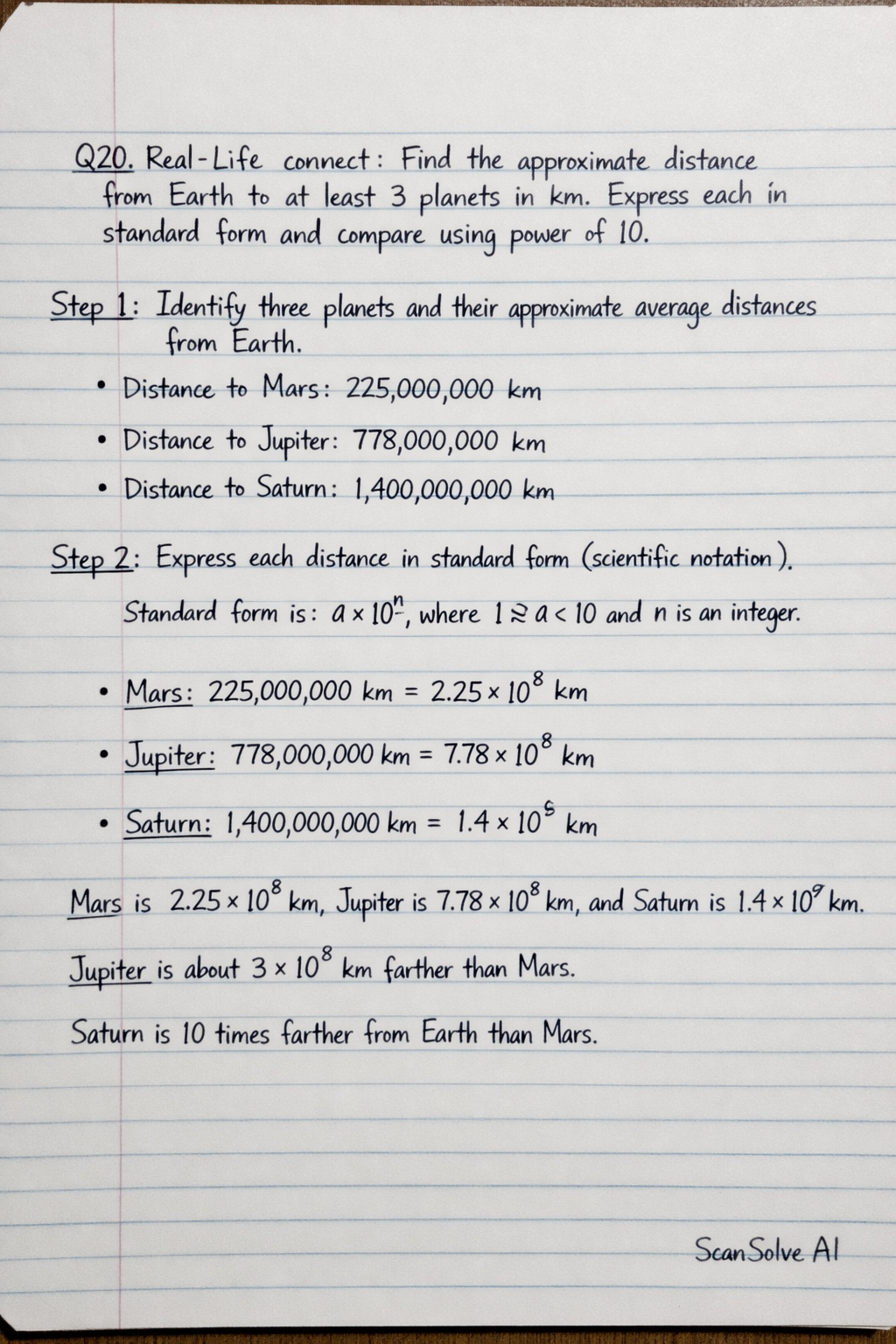
Handwritten Step-by-Step Solution
Get this as a handwritten image on WhatsApp — like a tutor wrote it for you.
Try on WhatsApp