This mathematics problem involves applying core mathematical principles and formulas. Below you will find a complete step-by-step solution with detailed explanations for each step, helping you understand not just the answer but the method behind it.
ScanSolve AI Answer
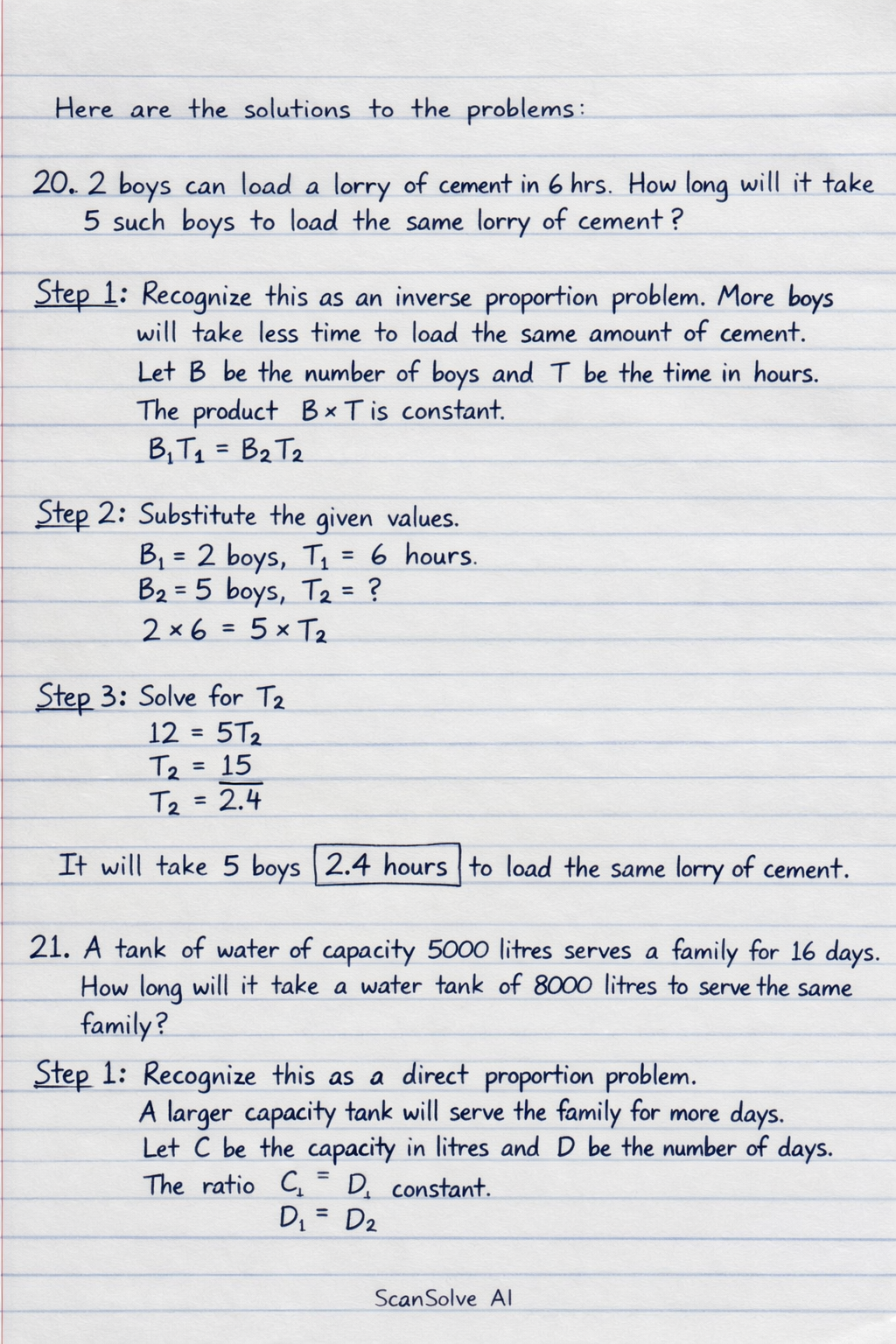
Here are the solutions to the problems:
20. 2 boys can load a lorry of cement in 6hrs. How long will it take 5 such boys to load the same lorry of cement?
Step 1: Recognize this as an inverse proportion problem. More boys will take less time to load the same amount of cement.
Let $B$ be the number of boys and $T$ be the time in hours.
The product $B \times T$ is constant.
$$B_1 T_1 = B_2 T_2$$
Step 2: Substitute the given values.
$B_1 = 2$ boys, $T_1 = 6$ hours
$B_2 = 5$ boys, $T_2 = ?$
$$2 \times 6 = 5 \times T_2$$
Step 3: Solve for $T_2$.
$$12 = 5 T_2$$
$$T_2 = \frac{12}{5}$$
$$T_2 = 2.4$$
It will take 5 boys $\boxed{\text{2.4 hours}}$ to load the same lorry of cement.
21. A tank of water of capacity 5000 litres serves a family for 16 days. How long will it take a water tank of 8000 litres to serve the same family?
Step 1: Recognize this as a direct proportion problem. A larger capacity tank will serve the family for more days.
Let $C$ be the capacity in litres and $D$ be the number of days.
The ratio $\frac{C}{D}$ is constant.
$$\frac{C_1}{D_1} = \frac{C_2}{D_2}$$
Step 2: Substitute the given values.
$C_1 = 5000$ litres, $D_1 = 16$ days
$C_2 = 8000$ litres, $D_2 = ?$
$$\frac{5000}{16} = \frac{8000}{D_2}$$
Step 3: Solve for $D_2$.
$$5000 D_2 = 8000 \times 16$$
$$5000 D_2 = 128000$$
$$D_2 = \frac{128000}{5000}$$
$$D_2 = \frac{128}{5}$$
$$D_2 = 25.6$$
A water tank of 8000 litres will serve the same family for $\boxed{\text{25.6 days}}$.
22. 9 men working at the same rate and working 8 hrs in a day take 12 days to complete a given task. How long will it take six such men working 10 hrs in a day to complete the same task?
Step 1: Recognize this as a compound proportion problem. The total work done is constant.
Let $M$ be the number of men, $H$ be the hours worked per day, and $D$ be the number of days.
The total work units can be represented as $M \times H \times D$.
$$M_1 H_1 D_1 = M_2 H_2 D_2$$
Step 2: Substitute the given values.
$M_1 = 9$ men, $H_1 = 8$ hours/day, $D_1 = 12$ days
$M_2 = 6$ men, $H_2 = 10$ hours/day, $D_2 = ?$
$$9 \times 8 \times 12 = 6 \times 10 \times D_2$$
Step 3: Calculate the total work units for the first scenario.
$$9 \times 8 \times 12 = 72 \times 12 = 864$$
Step 4: Set up the equation for the second scenario and solve for $D_2$.
$$864 = 60 D_2$$
$$D_2 = \frac{864}{60}$$
$$D_2 = \frac{144}{10}$$
$$D_2 = 14.4$$
It will take six men working 10 hours a day $\boxed{\text{14.4 days}}$ to complete the same task.
23. What is the order of the matrix below?
$$\begin{pmatrix} 7 & -1 \\ -2 & 3 \\ 9 & 4 \end{pmatrix}$$
Step 1: Count the number of rows.
There are 3 rows.
Step 2: Count the number of columns.
There are 2 columns.
Step 3: State the order as (number of rows) $\times$ (number of columns).
The order of the matrix is $\boxed{3 \times 2}$.
24. Are the matrices below compatible?
$$\begin{pmatrix} 2 & 3 \\ 4 & 9 \end{pmatrix} - \begin{pmatrix} 3 & 9 & -2 \\ 4 & 6 & 4 \\ 1 & 3 & 8 \end{pmatrix}$$
Step 1: Determine the order of the first matrix.
It has 2 rows and 2 columns, so its order is $2 \times 2$.
Step 2: Determine the order of the second matrix.
It has 3 rows and 3 columns, so its order is $3 \times 3$.
Step 3: Check for compatibility for subtraction.
For matrix addition or subtraction, the matrices must have the exact same order. Since the orders ($2 \times 2$ and $3 \times 3$) are different, the matrices are not compatible for subtraction.
The matrices are $\boxed{\text{not compatible}}$.
25. Work out
$$\begin{pmatrix} 6 & 6 \\ 3 & -7 \\ 4 & 10 \end{pmatrix} + \begin{pmatrix} 0 & 9 \\ 1 & 6 \\ -2 & -8 \end{pmatrix}$$
Step 1: Perform matrix addition by adding corresponding elements.
$$\begin{pmatrix} 6+0 & 6+9 \\ 3+1 & -7+6 \\ 4+(-2) & 10+(-8) \end{pmatrix}$$
Step 2: Simplify each element.
$$\begin{pmatrix} 6 & 15 \\ 4 & -1 \\ 2 & 2 \end{pmatrix}$$
The result of the addition is $\boxed{\begin{pmatrix} 6 & 15 \\ 4 & -1 \\ 2 & 2 \end{pmatrix}}$.
26. Given $A=B-C$ and
$$A = \begin{pmatrix} 2 & 0 & 3 \\ 4 & -1 & 7 \\ 6 & 3 & 9 \end{pmatrix}$$
$$B = \begin{pmatrix} 3 & 6 & 9 \\ -1 & 0 & 4 \\ 4 & 2 & 6 \end{pmatrix}$$
Step 1: Rearrange the equation to solve for $C$.
Given $A = B - C$, we can write $C = B - A$.
Step 2: Substitute the given matrices $A$ and $B$ into the equation for $C$.
$$C = \begin{pmatrix} 3 & 6 & 9 \\ -1 & 0 & 4 \\ 4 & 2 & 6 \end{pmatrix} - \begin{pmatrix} 2 & 0 & 3 \\ 4 & -1 & 7 \\ 6 & 3 & 9 \end{pmatrix}$$
Step 3: Perform matrix subtraction by subtracting corresponding elements.
$$C = \begin{pmatrix} 3-2 & 6-0 & 9-3 \\ -1-4 & 0-(-1) & 4-7 \\ 4-6 & 2-3 & 6-9 \end{pmatrix}$$
Step 4: Simplify each element.
$$C = \begin{pmatrix} 1 & 6 & 6 \\ -5 & 1 & -3 \\ -2 & -1 & -3 \end{pmatrix}$$
The matrix $C$ is $\boxed{\begin{pmatrix} 1 & 6 & 6 \\ -5 & 1 & -3 \\ -2 & -1 & -3 \end{pmatrix}}$.
That's 2 down. 3 left today — send the next one.
Recognize this as an inverse proportion problem. More boys will take less time to load the same amount of cement.
|Mathematics
Recognize this as an inverse proportion problem. More boys will take less time to load the same amount of cement.
ScanSolve AI Answer
Here are the solutions to the problems:
20. 2 boys can load a lorry of cement in 6hrs. How long will it take 5 such boys to load the same lorry of cement?
Step 1: Recognize this as an inverse proportion problem. More boys will take less time to load the same amount of cement.
Let B be the number of boys and T be the time in hours.
The product B×T is constant.
B1T1=B2T2
Step 2: Substitute the given values.
B1=2 boys, T1=6 hours
B2=5 boys, T2=?2×6=5×T2
Step 3: Solve for T2.
12=5T2T2=512T2=2.4
It will take 5 boys 2.4hours to load the same lorry of cement.
21. A tank of water of capacity 5000 litres serves a family for 16 days. How long will it take a water tank of 8000 litres to serve the same family?
Step 1: Recognize this as a direct proportion problem. A larger capacity tank will serve the family for more days.
Let C be the capacity in litres and D be the number of days.
The ratio DC is constant.
D1C1=D2C2
Step 2: Substitute the given values.
C1=5000 litres, D1=16 days
C2=8000 litres, D2=?165000=D28000
Step 3: Solve for D2.
5000D2=8000×165000D2=128000D2=5000128000D2=5128D2=25.6
A water tank of 8000 litres will serve the same family for 25.6days.
22. 9 men working at the same rate and working 8 hrs in a day take 12 days to complete a given task. How long will it take six such men working 10 hrs in a day to complete the same task?
Step 1: Recognize this as a compound proportion problem. The total work done is constant.
Let M be the number of men, H be the hours worked per day, and D be the number of days.
The total work units can be represented as M×H×D.
M1H1D1=M2H2D2
Step 2: Substitute the given values.
M1=9 men, H1=8 hours/day, D1=12 days
M2=6 men, H2=10 hours/day, D2=?9×8×12=6×10×D2
Step 3: Calculate the total work units for the first scenario.
9×8×12=72×12=864
Step 4: Set up the equation for the second scenario and solve for D2.
864=60D2D2=60864D2=10144D2=14.4
It will take six men working 10 hours a day 14.4days to complete the same task.
23. What is the order of the matrix below?7−29−134
Step 1: Count the number of rows.
There are 3 rows.
Step 2: Count the number of columns.
There are 2 columns.
Step 3: State the order as (number of rows) × (number of columns).
The order of the matrix is 3×2.
24. Are the matrices below compatible?(2439)−341963−248
Step 1: Determine the order of the first matrix.
It has 2 rows and 2 columns, so its order is 2×2.
Step 2: Determine the order of the second matrix.
It has 3 rows and 3 columns, so its order is 3×3.
Step 3: Check for compatibility for subtraction.
For matrix addition or subtraction, the matrices must have the exact same order. Since the orders (2×2 and 3×3) are different, the matrices are not compatible for subtraction.
The matrices are notcompatible.
25. Work out6346−710+01−296−8
Step 1: Perform matrix addition by adding corresponding elements.
6+03+14+(−2)6+9−7+610+(−8)
Step 2: Simplify each element.
64215−12
The result of the addition is 64215−12.
26. Given A=B−C andA=2460−13379B=3−14602946
Step 1: Rearrange the equation to solve for C.
Given A=B−C, we can write C=B−A.
Step 2: Substitute the given matrices A and B into the equation for C.
C=3−14602946−2460−13379
Step 3: Perform matrix subtraction by subtracting corresponding elements.
C=3−2−1−44−66−00−(−1)2−39−34−76−9
Step 4: Simplify each element.
C=1−5−261−16−3−3
The matrix C is 1−5−261−16−3−3.
That's 2 down. 3 left today — send the next one.
Need help with your own homework?
Get instant step-by-step solutions to any question. Free to start.