
We read your photo as:
In the given figure, O is the centre of the circle. Where, central angle AOC is equal 140 degrees. a. Write the relation between the inscribed angle ADC and the arc ABC. b. Find the value of angle ADC from the given figure. c. Experimentally verify that the opposite angles ABC and ADC of cyclic quadrilateral ABCD are supplementary.
ScanSolve AI Answer
Step-by-step solution
9 stepsHere are the solutions to the problems you've provided:
12. a) परिकोष कोण ADC र चाप ABC बिचको सम्बन्ध लेख्नुहोस्। (Write the relation between the inscribed angle ADC and the arc ABC.)
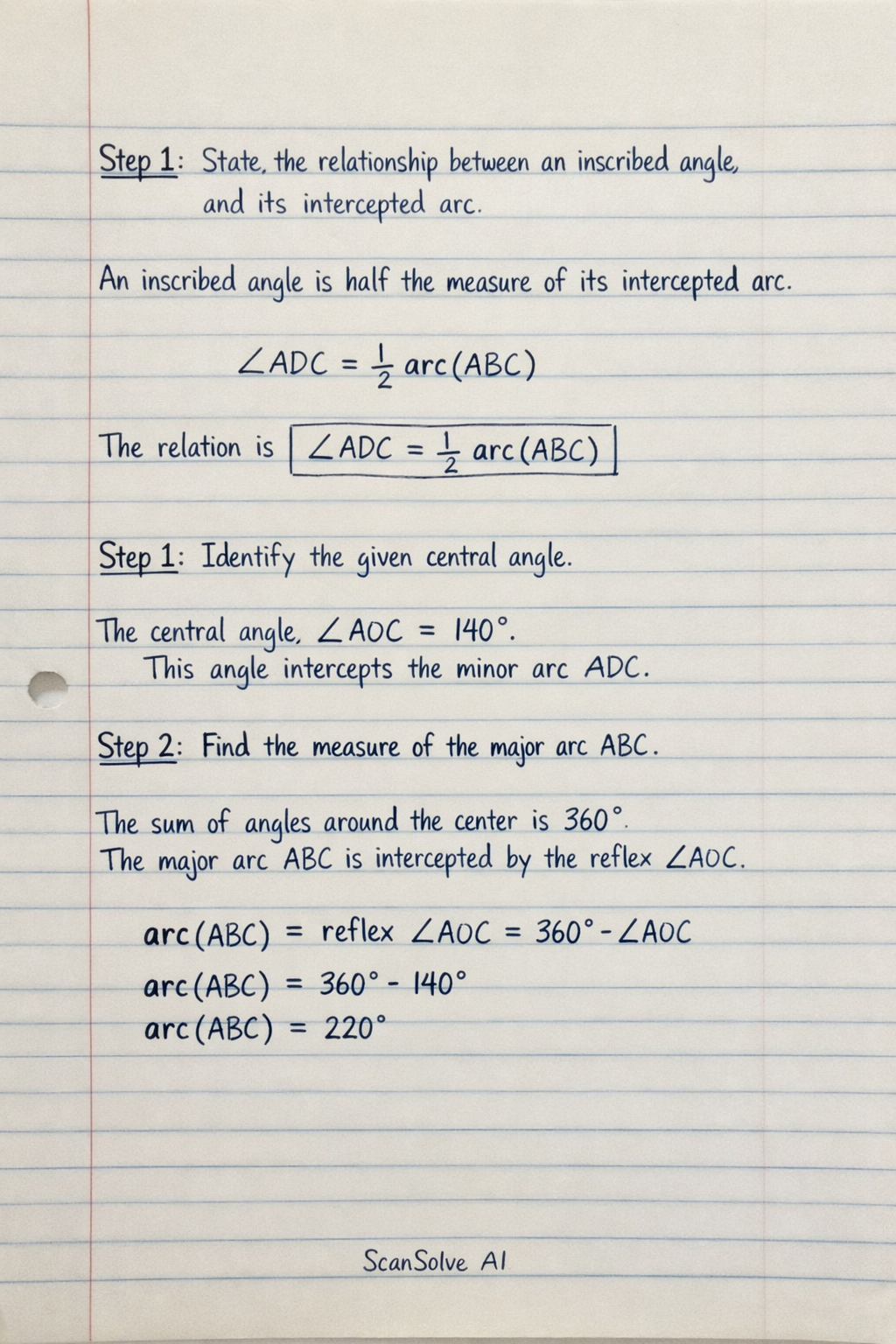
State the relationship between an inscribed angle and its intercepted arc.
An inscribed angle is half the measure of its intercepted arc.
The relation is .
12. b) दिइएको चित्रबाट को मान पत्ता लगाउनुहोस्। (Find the value of from the given figure.)
Identify the given central angle.
The central angle . This angle intercepts the minor arc ADC.
Find the measure of the major arc ABC.
The sum of angles around the center is . The major arc ABC is intercepted by the reflex angle .
Use the relation from part a) to find .
The inscribed angle intercepts arc ABC.
The value of is .
12. c) चक्रीय चतुर्भुज ABCD का सम्मुख कोणहरू ABC र ADC परिपूरक हुन्छन् भनी प्रयोगात्मक विधिबाट प्रमाणित गर्नुहोस्। (कम्तीमा 3 से.मि. अर्धव्यास भएका दुईओटा वृत्तहरू आवश्यक छन्।) (Experimentally verify that the opposite angles ABC and ADC of cyclic quadrilateral ABCD are supplementary. (Two circles with at least 3 cm radii are necessary.))
To experimentally verify that the opposite angles of a cyclic quadrilateral are supplementary, follow these steps:
Draw two circles with a radius of at least 3 cm.
Label the center of each circle as O.
For each circle, mark four points A, B, C, and D on the circumference in order to form a cyclic quadrilateral ABCD.
Connect these points to form the quadrilateral.
Using a protractor, carefully measure the interior angles and for each quadrilateral.
Add the measured values of and .
You should find that for both quadrilaterals, . Due to measurement errors, the sum might not be exactly , but it should be very close.
Conclude that the opposite angles of a cyclic quadrilateral are supplementary.
Still stuck on this one?
Ask a follow-up, and the answer starts from this question.
More Mathematics Questions
Handwritten Step-by-Step Solution
Get this as a handwritten image on WhatsApp — like a tutor wrote it for you.
Try on WhatsApp